Artists similar to Agnes Martin, quiet abstraction to collect
Artists linked to Agnes Martin (1912–2004) in published sources include Richard Tuttle, Eva Hesse, Ellen Gallagher and Tammi Campbell. Martin's own procedure is faint hand-drawn lines, pale colour washes and repetition that rewards slow looking, so for original work to collect now, judge that procedure in person rather than the name.
What Agnes Martin’s procedure actually is
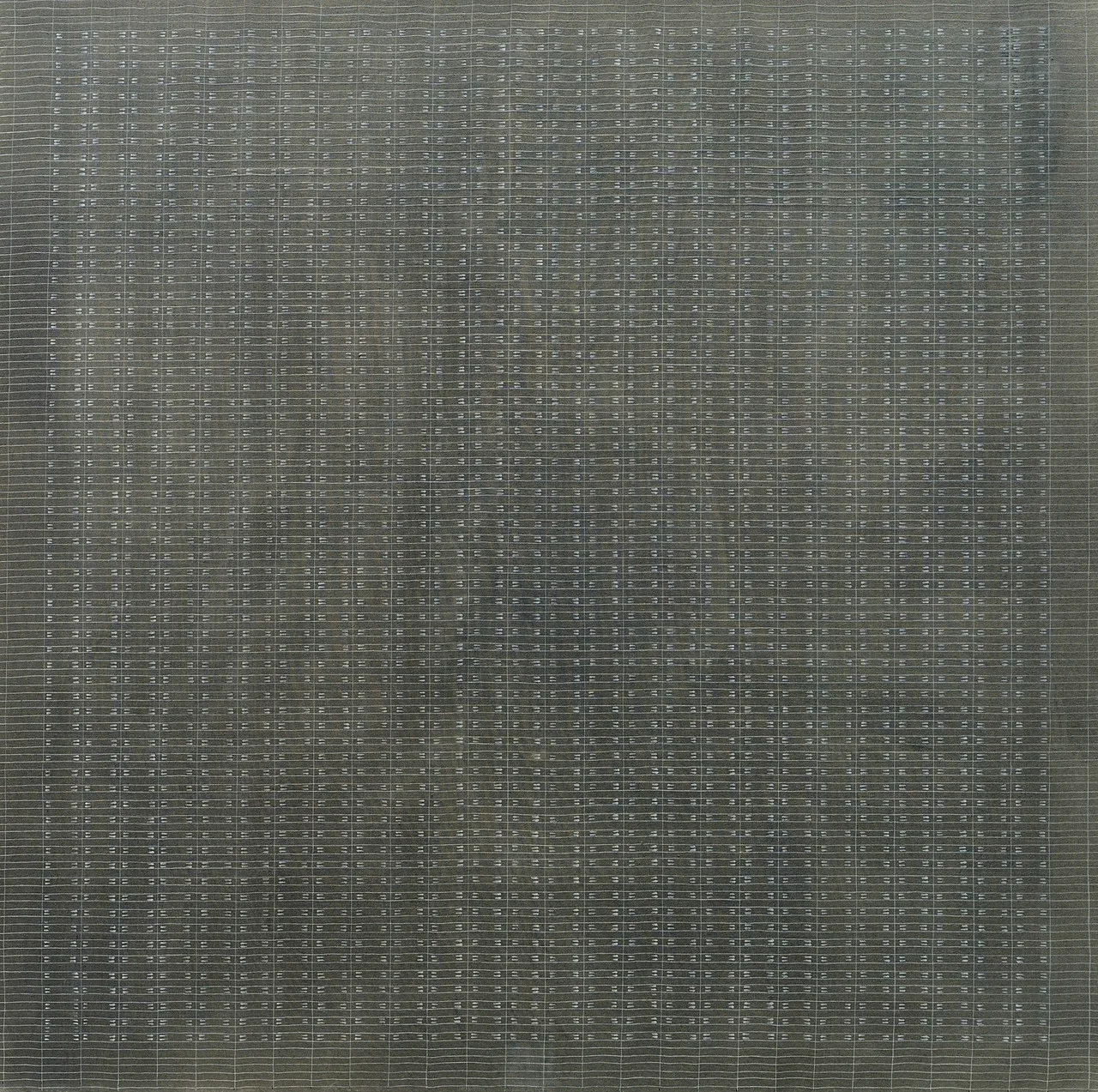
Martin’s mature paintings are known for subtle pencil lines and pale washes of colour, laid out as grids and stripes, and Tate describes her as working within tightly prescribed limits she set for herself. Tate traces her development from biomorphic abstraction to the grid and striped canvases that became her hallmark; in 1967 she left the city for solitude and settled in New Mexico, where she kept painting for more than three decades.
The turning point most often shown is White Flower (1960), oil on canvas, 182.6 x 182.9 cm according to the Guggenheim’s own record, in the Solomon R. Guggenheim Museum. Art Canada Institute notes that the six-foot-square canvas became her standard size for the next thirty-two years, and that the painting premiered at the Betty Parsons Gallery in 1961. Martin said of the title that it is not really about a flower but about a mental experience. That sentence is the best filter for this whole page: the comparison is about how the work is made and how it is looked at, not about what it depicts.
Minimalist or Abstract Expressionist? Why the label matters for comparisons
Martin did not accept the minimalist label. Art Canada Institute reports her saying that the artists grouped under it were all minimalists and had asked her to show with them, but that this was before the word was invented. She placed herself with the Abstract Expressionists, whose work she said dealt directly with subtle emotions of happiness. The critic Lucy Lippard, quoted in the same source, described her paintings as unique in their poetic approach to a strictly ordered and controlled execution.
For a collector this has a practical consequence. “Similar to Agnes Martin” can mean two different searches: strict order with an emotional charge (her own position) or reduction as a formal programme (the Minimalist position). They overlap in grids, repetition and economy of means, and they differ in intent. Decide which one you actually respond to before you start comparing artists.
Artists linked to Agnes Martin by influence or exhibition
The names below come from a single published source, Art Canada Institute’s monograph on Martin, and the link is only the one that source states: influence or shared exhibitions, not a shared method. None of them is a copy of Martin.
- Richard Tuttle, a Post-Minimalist also based in New Mexico, exhibited together with Martin, including at SITE Santa Fe in 1998.
- Eva Hesse (1936–1970) is named among the artists shaped by Martin; her New York career ran on a timeline close to Martin’s.
- Ellen Gallagher (born 1965) is named as a younger artist influenced by Martin.
- Tammi Campbell (born 1974, Saskatoon) makes daily grid drawings based on Martin’s On a Clear Day (1973) and has completed more than 1,000 of them. This is the most literal continuation of Martin’s procedure in the list.
If your interest is Martin’s own wider circle of Abstract Expressionist colleagues, the page on what to collect now if you like Abstract Expressionism follows that thread.
How to collect in this territory now: look for the procedure, not the name
Quiet work is the hardest kind to judge from a photograph, because the qualities that matter, a faint line, a barely different white, a shadow cast by a low relief, are the first things a screen flattens. Three checks are more useful than a name:
- See it in person, or ask for detail photographs. The studio can arrange a viewing in Brasília by appointment, and sends close-up photographs and video of a specific work on request.
- Ask what the work is made of and how. A hand-built surface and a printed image of a pale field look alike at thumbnail size and nothing alike at arm’s length.
- Buy with documentation. Every acquisition from the studio is direct from the artist and includes a signed Certificate of Authenticity with the technical record and Archive ID. The guide to buying art directly from the artist lists what to ask for.
Nothing here is a statement about future value. The point of the checks is to choose work you will want to keep looking at.
From the studio
From the studio: two works that approach quiet by different means
I will not set my work next to Martin’s, and I do not rank it against hers. What I can offer is a comparison of procedure, using two paintings from the Matter & Silence series.
Echo of Silence (2025, sculpted texture on canvas, 50 x 70 cm, R$ 2,400) holds its quiet through a single colour and a surface of concentric reliefs. There is no drawn line; the repeated element is the relief itself. That is where I see a relation to the kind of attention Martin asks for, and it is also where the two practices part ways: hers is a pencilled grid on a washed field, mine is a sculpted surface.
Silent Interval (2026, mixed media with acrylic on canvas, 120 x 160 cm, R$ 7,900) is closer to the “pale field” half of this page: a warm bone-white ground, one dark gesture falling through it, and a block of blue at the lower edge. The subject is the interval between the marks. Both works are better judged in person or through detail photographs than from the images on this page.
Frequently asked
Who are artists similar to Agnes Martin?
Artists linked to Agnes Martin in published sources are connected by influence or shared exhibitions rather than by resemblance. Art Canada Institute names Richard Tuttle, who exhibited with her at SITE Santa Fe in 1998, along with Eva Hesse, Ellen Gallagher and Tammi Campbell. None of them imitates Martin, and the link is one of influence or dialogue, not resemblance. Check the procedure of each in person or in museum records before treating any of them as a substitute.
What is Agnes Martin known for in terms of how the paintings are made?
Tate describes her mature work as subtle pencil lines and pale colour washes, organised as grids and stripes within limits she set for herself. A representative example is White Flower (1960), oil on canvas, 182.6 x 182.9 cm, at the Guggenheim. The six-foot-square canvas became her standard format for the next thirty-two years. The effect depends on close looking: from a distance the surface reads as a field of colour, up close as a field of decisions.
What can I collect now if I like Agnes Martin's work?
Look for original work where restraint is built into the making: a faint line, a pale or near-monochrome ground, a repeated gesture or relief. Prefer work you can see in person or in detail photographs, and ask how it was made. From this studio, Echo of Silence (50 x 70 cm, R$ 2,400) and Silent Interval (120 x 160 cm, R$ 7,900) are two Matter & Silence paintings that approach quiet by different routes.
Can I buy original abstract work with a related procedure directly from an artist?
Yes. Buying direct from the artist is legitimate and, at this studio, comes with an original unique painting, a Certificate of Authenticity signed by hand with the technical record and Archive ID, an invoice or official receipt, an acquisition agreement and care guidance. The studio ships within Brazil and internationally; shipping is quoted per destination and paid by the buyer, as are any import duties or taxes in the destination country.
How does Alyne Perfeito's practice relate to Agnes Martin's procedure?
Only at the level of procedure, and not in importance. Both ask the viewer for slow attention to a restrained surface. The materials differ: Martin worked with pencil lines and pale washes on a grid, while Echo of Silence is built from sculpted concentric relief on canvas and Silent Interval from a single dark gesture on a bone-white textured ground. The studio does not rank itself against established artists.
Want to see quiet abstraction up close?
Ask the studio for detail photographs or a short video of Echo of Silence or Silent Interval, or to arrange a viewing in Brasília by appointment.
Sources
- Tate — 2026-10-08
- Art Canada Institute — 2026-10-08
- Solomon R. Guggenheim Museum — 2026-10-08
- Art Canada Institute — 2026-10-08
- Perfeito Studio — internal collection record — 2026-10-08
- Perfeito Studio — internal studio facts — 2026-10-08
Published on · Updated on