Artists similar to Alberto Burri, when material is the painting
Artists close to Alberto Burri share a procedure rather than a style: the material is not a surface to paint on but the substance of the picture. By that test, three useful names to start with are Kurt Schwitters, Antoni Tàpies and Jannis Kounellis, each making ordinary matter, from found scraps to sand and sacking, the work itself.
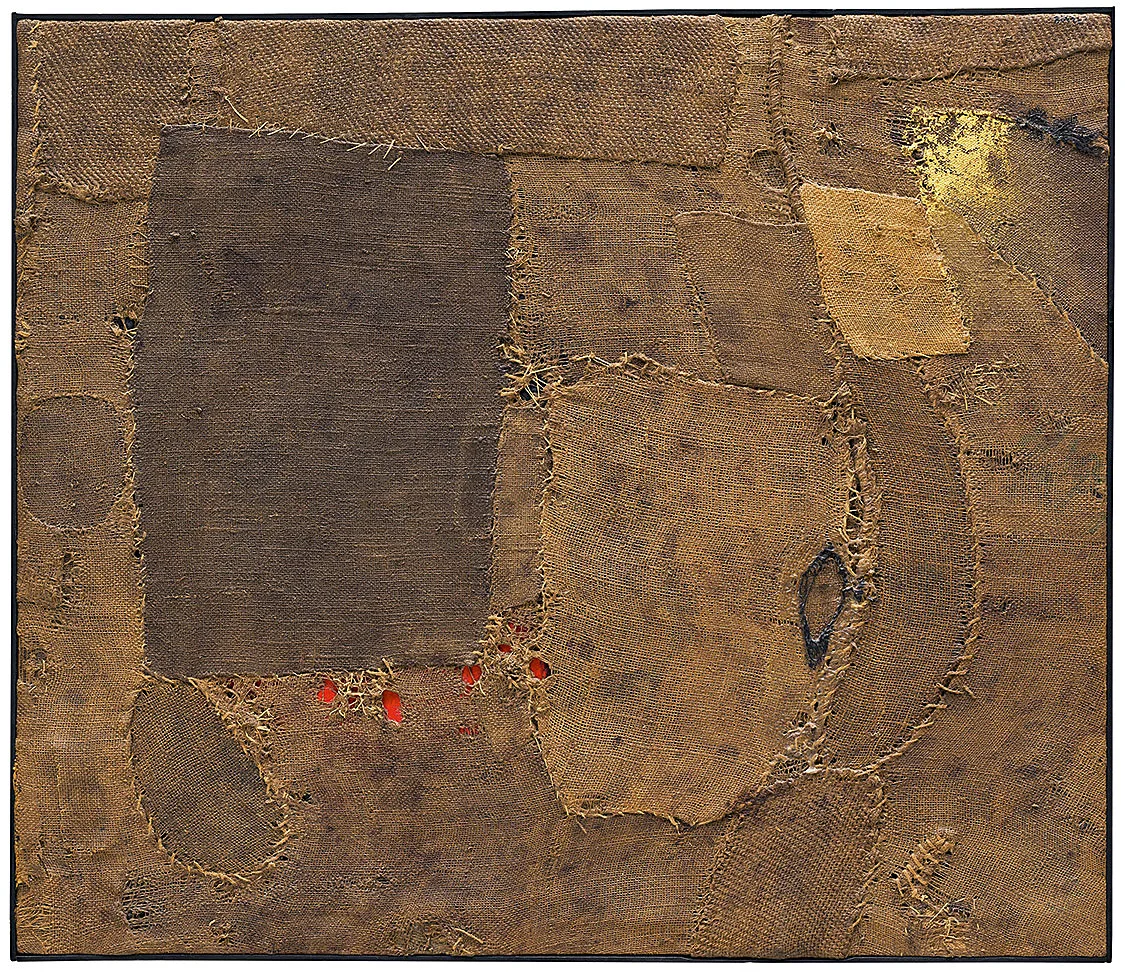
What Burri did with the material
Alberto Burri (born 1915 in Città di Castello, died 1995 in Nice) was a doctor in the Italian army when he was captured by the British in 1943 and held in a prisoner-of-war camp in Texas. The Guggenheim records that he began to paint there, covering his stretchers with burlap when other materials were unavailable, and that after returning to Italy in 1946 he gave up medicine for art.
From 1949 he made the Sacchi (sacks): collage constructions of burlap bags mounted on stretchers, patched and stitched. The Guggenheim's Composizione (1953), shown above, is listed as burlap, thread, synthetic polymer paint, gold leaf and PVA on black fabric, 86 × 100.4 cm. Burri refused a symbolic reading of the sacking. In 1976 he said, “The poorness of a medium is not a symbol: it is a device for painting.”
The Centre Pompidou's catalogue entry for the burned-plastic series dates the later steps. The first Combustioni, from 1953–54, were remnants of burned paper glued onto paper. Between 1958 and 1961 fire replaced the brush to make the welds of the Ferri series, and from 1961 the Plastiche and Combustioni plastiche appear. Plastica (1964), burnt PVC on a metal stretcher, 150.5 × 251 cm, belongs, in that entry's words, to a series in which painting is entirely absent and fire, working by removal of matter, shows the material for itself.
Three questions that sort artists by procedure
Looking at Burri through his surfaces gives a more useful test than looking at his period. Ask of any painter you are comparing: is the material the support or a layer inside the paint? Does the maker add matter or remove it? Is the material found, or prepared for the purpose?
Burri's sacking is the support and the image at once, it is found and then stitched, and in the plastic works matter is taken away by fire. A comparison usually holds on one or two of these points, and naming which one keeps it honest: it describes how a surface was made, and says nothing about whose work matters more.
Artists who share part of the procedure
Kurt Schwitters (1887–1948) is a direct precedent on the found-material question. Tate quotes his definition of Merz as “the combination, for artistic purposes of all conceivable materials”, and adds that he treated materials such as string, cotton wool or a pram wheel as equal to paint; his British-period collages also used fragments such as London bus tickets. The Guggenheim, in its entry on Composizione, adds that the Sacchi rely on lessons learned from the Cubist- and Dada-inspired constructions of Schwitters.
Antoni Tàpies (1923–2012) shares the thick, earthbound surface rather than the stitched one. His Great Painting (1958) in the Guggenheim is oil with marble dust and sand on canvas, 200.7 × 262.9 cm, and the museum notes his use of sand, straw, string and bits of fabric. Tate defines matter painting as the technique of using thick impasto paint into which other materials such as sand, mud, cement and shells have been added, and lists Jean Dubuffet (1901–1985), Tàpies and Julian Schnabel (born 1951) among the artists in its collection who fall under it.
Jannis Kounellis (1936–2017) is an Arte Povera name who also worked with burlap sacking. The Guggenheim Bilbao describes an untitled 1988 work made of steel panels holding burlap sacks filled with coal, each panel measuring 250 × 180.5 × 30 cm. Tate defines Arte Povera as a movement of the late 1960s and 1970s that used everyday materials such as soil, rags and twigs, and the Centre Pompidou states that Burri's work, based on raw materials, also influenced it. The comparison with Burri here is about shared matter, and these are separate practices.
What you can collect now, and how to read it
Every Burri, Tàpies and Kounellis work named on this page sits in a public collection: the Guggenheim in New York, the Centre Pompidou in Paris (where Plastica arrived as a gift of the artist in 1978) and the Guggenheim Bilbao. For most readers the practical question therefore changes. It stops being “which Burri can I own” and becomes “which living artist builds a surface in a related way, and can I speak to them directly”.
The three questions above travel with you. Ask whether the material is a layer or the support, whether it was added or removed, and whether it was found or prepared, then look at the surface in person or in detail photographs. Two companion guides cover the mechanics: how to buy art directly from the artist, and what to collect now if you like Abstract Expressionism. The Guggenheim places the Sacchi within Art Informel, the European counterpart of Abstract Expressionism.
From the studio
From the studio
I want to be exact about the difference, because the resemblance is easy to overstate. Burri's sacking is the picture. In my work the material lives inside a painted surface. Quartz Seam (98 × 152 cm, 2026) is recorded as mixed media with acrylic and imitation gold leaf on canvas: the pigment is laid thick enough to carry its own relief and then bounded rather than blended, and the gold runs along the seams between the fields. Elemental Veins (90 × 140 cm, 2025), mixed media with acrylic and metallic fragments on canvas, sets silvered fragments into layers of pigment and texture so that they catch the light.
The Guggenheim lists imitation gold leaf among the materials of Burri's Composizione, which is a small coincidence of materials and nothing more: his gold sits in stitched cloth, mine in built paint. Neither of my two works involves burning or stitching, and the point of showing them here is procedural. Both are works in which a material is allowed to be seen as a material, not only as a colour. As someone trained as an architect, I would ask you to look at the edges first, where one mass of paint or cloth meets another.
Frequently asked
Who are artists similar to Alberto Burri?
By procedure, three useful names to start with are Kurt Schwitters, who combined found materials for artistic purposes under the name Merz; Antoni Tàpies, whose Great Painting (1958) is oil with marble dust and sand on canvas; and Jannis Kounellis, who used burlap sacks and coal within Arte Povera. Each shares one part of Burri's method, such as found matter, a thick earthbound surface or sacking, rather than all of it. The comparison concerns how surfaces are made, not importance.
What is Alberto Burri known for in how the paintings are made?
The Guggenheim describes his Sacchi, begun in 1949, as collage constructions of burlap bags mounted on stretchers, with patched and stitched surfaces. Later the Centre Pompidou records the Combustioni, in which fire, and from 1961 burnt plastic, replaced the brush. His 1964 Plastica is burnt PVC on a metal stretcher, 150.5 by 251 cm. In both bodies of work the material is the picture rather than a base for paint.
What does Burri mean when he calls a poor material a device for painting?
In 1976 Burri said, as quoted by the Guggenheim, that he chose poor materials to prove they could still be useful, and that the poorness of a medium is not a symbol but a device for painting. The museum notes that the title Composition emphasizes his professed concern with construction, not metaphor. Early commentators had read the stitched sacking as a symbol of wounded flesh, a reading Burri did not accept.
What can I collect now if I like Burri's work?
The works named on this page are in museum collections, so the useful move is to carry the procedure over, not the name. Look for working artists who build a surface from a material that remains visible as a material, such as thick relief, metallic fragments, gold leaf or cloth, and ask whether it is a layer or the support, added or removed, found or prepared. Detail photographs of the surface are the best first step when you cannot see a work in person.
Is it possible to buy an original work with a related surface directly from an artist?
Yes. At Perfeito Studio every acquisition is made directly from the artist and includes a signed Certificate of Authenticity with the Archive ID, a fiscal invoice or receipt, an acquisition agreement and a conservation guide. Quartz Seam and Elemental Veins are two works whose surfaces carry imitation gold leaf and metallic fragments. The studio ships within Brazil and internationally; shipping is quoted per destination and paid by the buyer, as are any import duties or taxes.
How does Alyne Perfeito's practice relate to Burri's procedure, without comparing importance?
The relation is limited to one procedural question, set out in the From the studio section: whether a material is allowed to read as a material. Burri's sacking is the support and the image. In Quartz Seam and Elemental Veins, listed as mixed media with acrylic and imitation gold leaf or metallic fragments on canvas, the material sits inside a painted surface, and neither work involves burning or stitching. The studio makes no claim of influence or equivalence, and the comparison is by procedure only.
Ask about a surface in detail
Questions about Quartz Seam or Elemental Veins, or a request for detail photographs of the gold leaf and metallic fragments? Alyne replies personally, in English or Portuguese.
Sources
- Solomon R. Guggenheim Museum — 2026-10-07
- Centre Pompidou, Musée national d'art moderne — 2026-10-07
- Solomon R. Guggenheim Museum — 2026-10-07
- Tate — 2026-10-07
- Tate — 2026-10-07
- Guggenheim Museum Bilbao — 2026-10-07
- Tate — 2026-10-07
- Peggy Guggenheim Collection, Venice — 2026-10-07
- Perfeito Studio — 2026-10-07
- Perfeito Studio — 2026-10-07
Published on · Updated on