Artists similar to Yves Klein, pigment and monochrome colour
Few artists share Yves Klein's exact procedure: ultramarine pigment in a synthetic resin, rolled on so that one colour is the whole painting. Compared by method, Rodchenko (1921), Ellsworth Kelly and Piero Manzoni each show what Klein did and did not do. Original colour-field work is also sold directly by artists, with documentation from the maker.
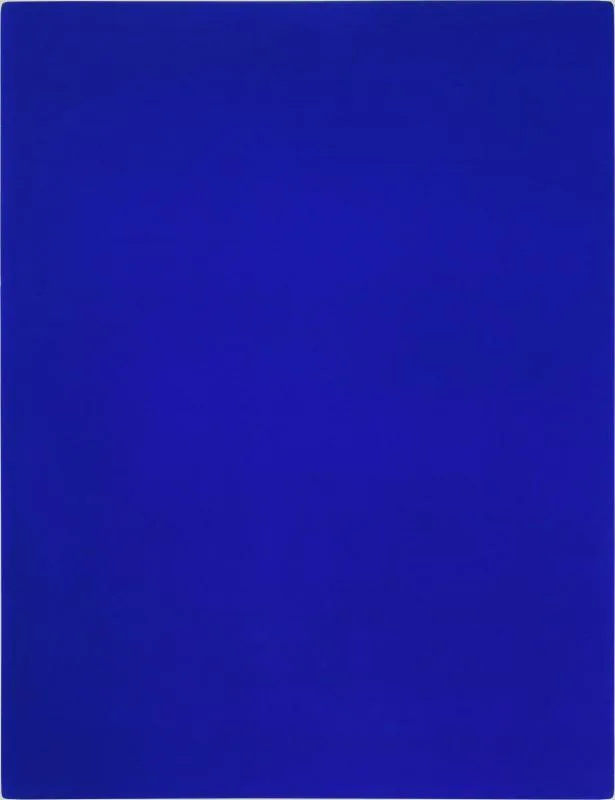
What Klein actually does with one colour
Yves Klein (1928–1962) made the single-colour canvas his method. In January 1957 he showed eleven identical blue canvases (78 × 56 cm) at the Apollinaire gallery in Milan, in an exhibition titled Proposte monocrome, epoca blu, according to the Centre Pompidou. The Centre Pompidou's teaching dossier on the monochrome adds that from 1956 he limited his monochromes to a single colour, blue.
The means were as specific as the idea. The Centre Pompidou describes IKB 3, Monochrome bleu (1960) as pure pigment and synthetic resin on canvas mounted on wood, 199 × 153 cm. The resin bonded the pigment without altering its brilliance and, applied with a roller to avoid unevenness, produced a velvety surface. The museum notes that the work's slightly raised form with rounded corners gives it a levitating effect, and that it is one of roughly two hundred IKB works, about fifteen of them at this largest format.
The pigment-and-binder question was a real problem for Klein. The Centre Pompidou writes that he turned to Édouard Adam, a colour merchant in Montparnasse, to find a binder that would not dull the colour. On 19 May 1960 he registered the IKB process with the French industrial property office in a Soleau envelope (no. 63471). The museum is explicit that this protected the technique, not the colour itself. This is the procedure the rest of this page uses as its measure: one saturated pigment, held in a binder that does not dull it, applied by roller to avoid unevenness.
Where the comparison with other monochrome painters stops
A list of "artists similar to Yves Klein" invites every blue or colour-field painter, but most of them solve a different problem. The Centre Pompidou's dossier on the monochrome places Klein beside several artists, and reading it by procedure gives a narrower picture.
- Alexander Rodchenko shows the idea that comes before Klein's. According to the dossier, in 1921 he returned to the three primary colours in order to free colour and painting from any purpose or content. The shared ground is a colour with nothing to depict. The difference is that Rodchenko's gesture rests on three colours, where Klein, from 1956, kept to one.
- Piero Manzoni is the instructive opposite. His first Achromes date from 1957: canvases creased or torn and soaked in mixtures of glue and plaster. The dossier says that, although influenced by Klein, Manzoni set himself apart from Klein's work point by point, replacing monochrome colour with the absence of colour. Read together, they show how much of Klein's meaning depends on the colour itself.
- Ellsworth Kelly is a contrast of attention. The dossier quotes the critic Ann Hindry: where Klein enrols the viewer in a vast epic of colour, Kelly leads the viewer through close work on the picture as an object.
The honest answer is that Klein has few direct procedural twins. What a viewer who loves his work usually wants is the experience: a saturated field that fills your vision and a surface worked by roller to avoid unevenness. That can be found, in other hands, among living artists who build a painting from fields of colour.
What to look for if you want that experience in an original
Three checks apply to any colour-field painting, whoever made it.
- The surface. Klein's was applied by roller to avoid unevenness and has a velvety finish, according to the Centre Pompidou. A painting built in layers will read differently. Ask for detail photographs taken in side light, and read how to look at an abstract painting for a five-minute method.
- The colour you are buying. Colour on a screen will differ from the canvas. Are the colours accurate when you buy a painting online? covers how to check a piece's colour before you decide.
- Direct documentation. Buying from the artist means the certificate, the technical record and the Archive ID come from the person who made the work. The route is covered in how to buy art directly from the artist.
If your taste runs wider than one colour, if you like Abstract Expressionism, what to collect now follows the same method.
From the studio: two colour fields that are not monochromes
This is a note on practice, not a comparison of stature. The Terra & Ether series by Alyne Perfeito is not monochrome: each work is built from several colours in layers, so it is not made the way Klein's paintings are. The two works below are listed only as square, colour-led pieces that a reader of this page may want to see up close.
The studio's records describe Amethyst Ground (100 × 100 cm, 2026, mixed media with acrylic on canvas, Archive ID AP-TAE-2026-005) as two temperatures in one square field: warm terracotta and ochre rising from below, cool violet and indigo settling from above, with a luminous band of bone and cream between them. Patina Field (100 × 100 cm, 2026, acrylic on canvas, Archive ID AP-TAE-2026-006) is described as vertical panels of slate blue and iron brown beside a passage of ochre, built by applying, scraping back and applying pigment again. Each is unique and signed. Prices are listed on the work pages, and the rest of the catalogue is at the gallery.
From the studio
A note from the studio on one colour and a square
Amethyst Ground is a 100 × 100 cm square, and it is not a monochrome: the terracotta and ochre below and the violet and indigo above are two colours in negotiation, with a pale band between them. Klein's paintings are about one colour alone; this one is about how two temperatures share a threshold. A monochrome is a useful lesson in looking for that reason: once the eye has spent time with one saturated field, it notices where a colour changes, and that is the first thing I look for in a painting, even though I do not paint a monochrome.
Frequently asked
Who are artists similar to Yves Klein?
Few artists share his exact procedure, which is one saturated pigment held in a resin binder and applied evenly so that the colour is the whole painting. The Centre Pompidou's dossier on the monochrome sets him beside Alexander Rodchenko, Piero Manzoni and Ellsworth Kelly, and each is better understood as a contrast than as a match. Compared by method, Klein has few direct twins. Living artists who build a painting from fields of colour are closer in experience than in technique.
What is Yves Klein known for in terms of how the paintings are made?
He is known for monochrome canvases in a blue he registered as International Klein Blue. According to the Centre Pompidou, the paint is pure ultramarine pigment bound with a synthetic resin, applied with a roller to avoid unevenness, which leaves a velvety surface. On 19 May 1960 he registered the process, not the colour itself, in a Soleau envelope with the French industrial property office.
What can I collect now if I like Yves Klein's work?
If what you value is a saturated field of colour on a quiet surface, look for original colour-field work by living artists. Compare the surface first: Klein's was rolled on evenly with a velvety finish, while many paintings are built in layers. Ask for detail photographs, ask how the colour was made, and ask what documentation comes with the work.
Is it possible to buy original abstract work with a related procedure directly from an artist?
Yes. Artists can sell directly, and the work then comes with documentation issued by the maker. At Perfeito Studio each painting is unique and signed, and a purchase includes a certificate of authenticity with the technical record and Archive ID. Detail photographs and a short video of a specific work, showing the surface, are available on request through WhatsApp, which helps when you are not in Brasília.
How does Alyne Perfeito's practice relate to Yves Klein's procedure, without comparing importance?
No comparison of standing is made or implied. The Terra & Ether works are mixed media or acrylic on canvas, built from several colours, so the means differ from Klein's single-pigment monochromes. Amethyst Ground and Patina Field are listed here only as two square works a reader of this page may want to see up close.
Want to see a colour field up close before you decide?
Ask for detail photographs and a short video of Amethyst Ground or Patina Field, and for the documentation that comes with each.
Also read
- Amethyst Ground, Terra & Ether (100 × 100 cm)
- Patina Field, Terra & Ether (100 × 100 cm)
- How to buy art directly from the artist
- If you like Abstract Expressionism, what to collect now
- See all available works
- How to look at an abstract painting
- Are the colours accurate when you buy a painting online?
Sources
- Centre Pompidou — 2026-10-09
- Centre Pompidou (Pompidou+ magazine) — 2026-10-09
- Centre Pompidou — 2026-10-09
- Perfeito Studio (src/data/obras.json) — 2026-10-09
- Perfeito Studio (src/data/obras.json) — 2026-10-09
Published on