Brazilian abstract artists to know: a short guide to the historical names
Brazilian abstraction is easiest to enter through three currents and ten names: São Paulo's concrete art of the 1950s (Waldemar Cordeiro, Luiz Sacilotto, Judith Lauand), Rio's neo-concrete break of 1959 and its circle (Lygia Clark, Lygia Pape, Hélio Oiticica, Amilcar de Castro), and informal painting (Tomie Ohtake, Manabu Mabe), plus Mira Schendel, who belongs to no group.
How this list was chosen
A list like this needs a rule, or it becomes a ranking by another name. The rule here can be checked: nine of the ten artists below are named by the Tate glossary or by the Enciclopédia Itaú Cultural either as a member or signatory of a concrete or neo-concrete group, or as a Brazilian figure of informal, lyrical abstraction. The tenth, Mira Schendel, is not placed in either group by those sources; she is an editorial addition of this guide, and her entry says so. The order follows the movements in time. It says nothing about importance.
The list is short on purpose and contains no living artists. Several names that appear in those same sources are left out, among them Geraldo de Barros, Lothar Charoux, Ivan Serpa, Franz Weissmann and Sergio de Camargo, and each is worth following up. For how this history reaches work being made now, see Brazilian abstract painting today.
São Paulo concrete art, from 1952
The exhibition Ruptura opened on 9 December 1952 at the Museu de Arte Moderna de São Paulo and is taken as the official start of concrete art in Brazil. Seven artists organised it, and Tate summarises their aim as a new art for a new country, built on truth and rationality through geometric abstraction.
Waldemar Cordeiro (1925-1973). Born in Rome to an Italian mother and a Brazilian father, he settled in Brazil for good at the end of the 1940s and became the theorist and leader of the group. His thinking drew on Konrad Fiedler's idea of pure visibility. A work to look for: Ideia Visível (1956).
Luiz Sacilotto (1924-2003). Cordeiro called him the main beam of concrete art. His paintings work with an equivalence between figure and ground, and an equal measure of filled and empty space. From 1954 his works are titled Concreção followed by the year and the sequence of execution, which is the series to search for.
Judith Lauand (1922-2022). She joined the group in 1955 and is recorded as the only woman to be officially part of it. Her compositions are built from precise lines, planes and vectors against contrasting colour. A work to look for: Do Círculo ao Oval (1958).
Rio and the neo-concrete break, 1959
In March 1959 a group in Rio de Janeiro published the Neo-Concrete Manifesto. Its signatories were Amilcar de Castro, Ferreira Gullar, Franz Weissmann, Lygia Clark, Lygia Pape, Reynaldo Jardim and Theon Spanudis. They objected to concrete art taken to what they called a dangerous rationalist exacerbation, and argued instead for freedom of experiment, expressive intent and a viewer who, by touching and handling the work, becomes part of it. Tate places the movement in the years when Brasília was being built.
Lygia Clark (1920-1988). A co-founder of the neo-concrete group, she moved from painting to three-dimensional objects. Her Bichos (1960) are geometric metal constructions joined by hinges, and they need the viewer's hands to reach new configurations.
Lygia Pape (1927-2004). The Tecelares (1955-1959) are unique woodcuts in which rigorous concrete lines meet the grain and pores of the wood. Itaú Cultural notes that she was the only printmaker in Grupo Frente. In 1958 she made Balé Neoconcreto I with the poet Reynaldo Jardim.
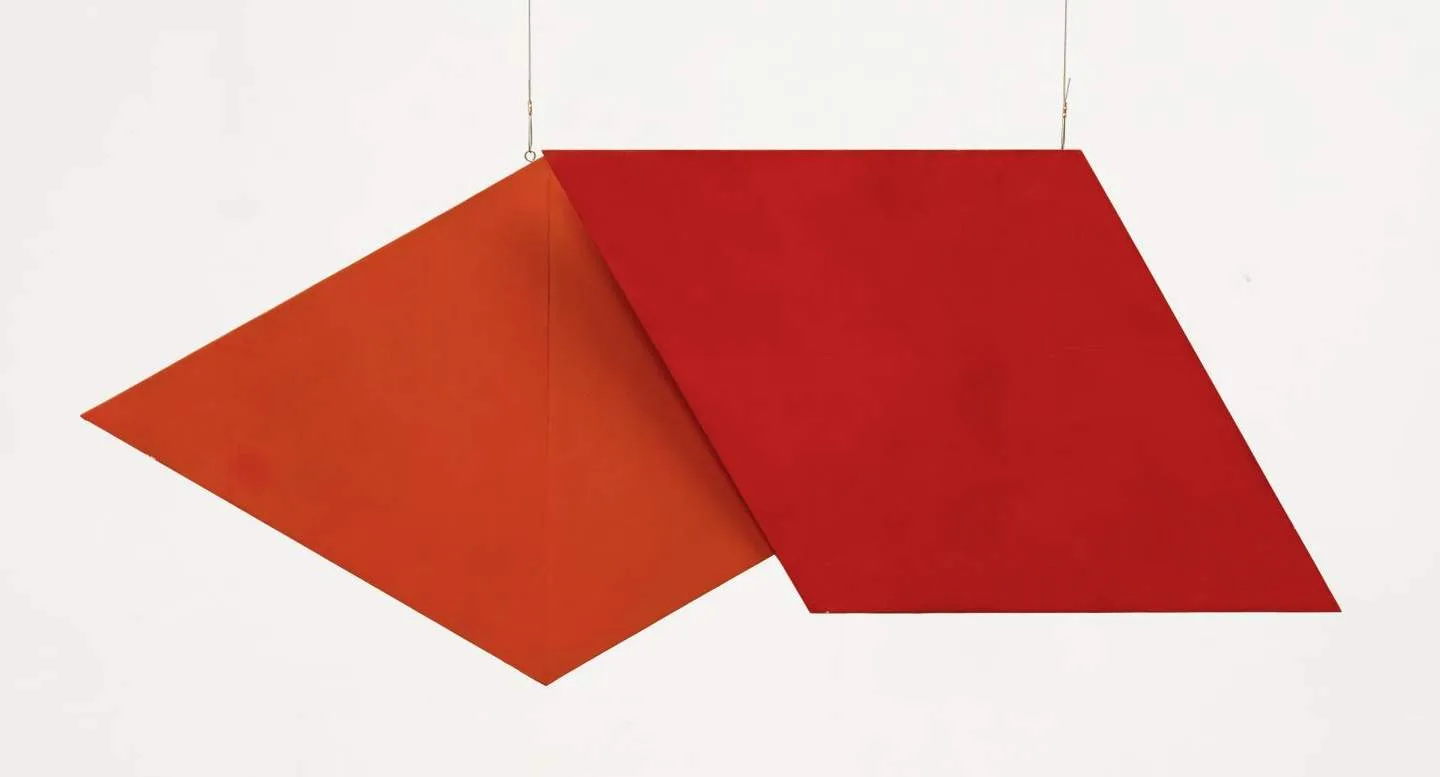
Hélio Oiticica (1937-1980). He did not sign the 1959 manifesto; Tate records that he joined the group in 1960. He began painting with Ivan Serpa in 1954. The Metaesquemas gouaches date from 1957, and in 1959 the Bilaterais and Relevos Espaciais became his first three-dimensional works. The red planes at the top of this page are one of them. His Parangolés, capes, banners and tents that fuse colour, dance and music, came later.
Amilcar de Castro (1920-2002). His sculpture does not add or subtract material. It starts from a plane, such as a circle or a rectangle, which is cut and folded into a three-dimensional object. Itaú Cultural contrasts this with Max Bill, the Swiss artist it credits as most responsible for bringing concrete ideas to Latin America: Bill starts from an idea and sublimates the material, while Castro keeps a tie to the ground and to nature.
Informal and lyrical abstraction: Tomie Ohtake and Manabu Mabe
The term informalismo was coined by the critic Michel Tapié in his 1952 book Un Art Autre. Itaú Cultural notes that the terminology is loose: informalism often appears as a synonym of tachism and is sometimes linked to lyrical abstraction. In Brazil it connects to lyrical abstraction, practised by artists Itaú Cultural describes as very different from one another, among them Mabe, Ohtake, Yolanda Mohalyi, Flavio-Shiró, Cicero Dias and Antonio Bandeira.
Tomie Ohtake (1913-2015). Born in Kyoto, she came to Brazil in 1936 and began painting in 1952. Between 1959 and 1962 she made “blind” paintings with her eyes covered. Itaú Cultural also notes a pulsation of colour in her early-1960s canvases that it compares with Mark Rothko's.
Manabu Mabe (1924-1997). Born in Kumamoto, he emigrated to Brazil in 1934 to work on coffee plantations and taught himself to paint. In 1959 he won the Leirner Prize and the Best National Painter award at the 5th São Paulo Bienal. His canvases are large chromatic stains made in quick, wide gestures, with references to Japanese calligraphy.
Mira Schendel, and where to go next
Schendel is the one name here that the sources do not tie to a group, so she is read as Itaú Cultural organises her work, by series.
Mira Schendel (1919-1988). Born in Zurich, she moved to Brazil in 1949 and to São Paulo in 1953. Itaú Cultural organises her work by series, with very different formats, supports and techniques, rather than by group. Her Monotipias (1964-1966) are drawn on the back of rice paper laid over an inked glass plate, with a fingernail or a pointed tool. Drawing from the reverse reduces control over the result, and that loss of control is part of the idea.
A practical way in is by temperament. If you want rigour, start with Sacilotto and Lauand. If you want work that asks something of the viewer, start with Clark and Oiticica. If you want painting that moves, start with Mabe and Ohtake. For the older argument underneath all of it, gestural versus geometric abstraction is the place to continue.
From the studio
From the studio
I trained as an architect and work in Brasília, the city that Tate's glossary ties to the neo-concrete moment. Reading this list as a painter, what I notice is procedure. Amilcar de Castro starts from a plane and cuts and folds it. In Do Círculo ao Oval, Lauand turns lines out from a point. Mabe works in large, fast strokes.
Patina Field (Terra & Ether series, 2026, acrylic on canvas, 100 × 100 cm) is made by applying pigment, scraping it back and applying it again, until the surface shows wear rather than gesture. I mention it only as a note on method, as the work of someone who reads these procedures as a painter, not as a comparison with the artists above.
Frequently asked
Who are the main Brazilian abstract artists?
No single list is definitive. The names most often attached to the historical movements by the Tate glossary and the Enciclopédia Itaú Cultural are Waldemar Cordeiro, Luiz Sacilotto and Judith Lauand for São Paulo concrete art; Lygia Clark, Lygia Pape, Hélio Oiticica and Amilcar de Castro for neo-concrete art; and Tomie Ohtake and Manabu Mabe for informal, lyrical abstraction. Mira Schendel is usually read by series rather than by group.
What is the difference between Brazilian concrete and neo-concrete art?
Concrete art began in São Paulo with the 1952 Ruptura exhibition and favoured rational, geometric abstraction with no symbolic content. The neo-concrete artists of Rio de Janeiro broke away with their manifesto of March 1959. They kept geometry but argued for freedom of experiment, expressive intent and a viewer who touches and handles the work. Itaú Cultural sums up the split as São Paulo's emphasis on pure visuality against Rio's link between art and life.
Are any of these artists still living?
No. All ten died between 1973 and 2022: Waldemar Cordeiro in 1973, Hélio Oiticica in 1980, Lygia Clark and Mira Schendel in 1988, Manabu Mabe in 1997, Amilcar de Castro in 2002, Luiz Sacilotto in 2003, Lygia Pape in 2004, Tomie Ohtake in 2015 and Judith Lauand in 2022. For work being made now, see the Journal guide to Brazilian abstract painting today.
Where should a beginner start with Brazilian abstract art?
Start with one work rather than a movement. For geometry, look at Sacilotto's Concreção series or Lauand's Do Círculo ao Oval. For work that needs the viewer, look at Lygia Clark's Bichos or Hélio Oiticica's Relevos Espaciais. For painting built on gesture and colour, look at Manabu Mabe or Tomie Ohtake. The Tate and Itaú Cultural pages listed below give dates and context for each.
Are these artists collected by museums outside Brazil?
Yes. Tate, for example, holds Hélio Oiticica's Spatial Relief (red) REL 036 from 1959, the work pictured on this page. Itaú Cultural records Amilcar de Castro's 1968 Guggenheim Memorial Foundation grant and Manabu Mabe's prize at the 1960 Venice Biennale. This guide does not cover prices or auction results.
See Patina Field, from the Terra & Ether series
One original, signed and documented. Write to the studio for detail photographs, dimensions on your wall and acquisition details.
Sources
- Enciclopédia Itaú Cultural — 2026-10-07
- Tate (Art Terms) — 2026-10-07
- Enciclopédia Itaú Cultural — 2026-10-07
- Enciclopédia Itaú Cultural — 2026-10-07
- Enciclopédia Itaú Cultural — 2026-10-07
- Enciclopédia Itaú Cultural — 2026-10-07
- Tate (Art Terms) — 2026-10-07
- Tate — 2026-10-07
- Enciclopédia Itaú Cultural — 2026-10-07
- Enciclopédia Itaú Cultural — 2026-10-07
- Enciclopédia Itaú Cultural — 2026-10-07
- Enciclopédia Itaú Cultural — 2026-10-07
- Enciclopédia Itaú Cultural — 2026-10-07
- Enciclopédia Itaú Cultural — 2026-10-07
- Enciclopédia Itaú Cultural — 2026-10-07
- Enciclopédia Itaú Cultural — 2026-10-07
Published on