Brazilian artists similar to Beatriz Milhazes, color and pattern
There is no fixed list of artists similar to Beatriz Milhazes; the useful comparison is procedure. Her own method, monotransfer, paints motifs on plastic and transfers them to canvas in stages. To collect in this territory now, look for layered, staged color in original work and judge the surface in person.
What Beatriz Milhazes's procedure actually is
Beatriz Milhazes was born in 1960 in Rio de Janeiro, where she still lives and works (Tate). The Tate's press text says she developed her method in 1989, after becoming frustrated with visible brushstrokes: she paints her motifs onto plastic sheeting and then transposes them onto canvas. The same text notes that this retains the fidelity of the colors and intensifies fluorescent and metallic pigments, and that it adapts the concept of collage to her painting practice.
MASP, which showed her work in the exhibition Avenida Paulista, describes the same process in plain terms: she paints on a sheet of transparent plastic and then transfers the painted, dry element to the canvas. The museum displayed one of those plastic sheets in a vitrine. The Tate also observes that her slick surfaces conceal small details of cracks and layers.
So the procedure, stated narrowly, is this: color is made in separate passes, assembled on the canvas in stages, and the finished surface hides how many stages there were. That is what a collector can actually look for in other artists, and it says nothing about who is better or more important.
Brazilian artists who share part of the procedure
Two kinds of names belong here, and they are different things. The first is the set of references MASP gives for Milhazes herself: the exhibition text lists multiple sources, among them Tarsila do Amaral (1886-1973), Sonia Delaunay, Bridget Riley and Ione Saldanha, as examples only. That is a statement about her sources, not a verdict on who resembles her, so treat it as a reading list. The page on artists similar to Tarsila do Amaral follows the first of those names.
The second is a Brazilian painter who worked in layers of color by a different route. The Instituto Tomie Ohtake describes how, from 1962, Tomie Ohtake (1913-2015) moved to clearly bounded fields of color, flat masses built from many layers of paint and prepared through small collages of torn colored paper. The overlap with Milhazes is limited to this: color assembled in stages, with flat masses. The materials, the scale and the look of the result are different, which is why the Tomie Ohtake page compares her by procedure only.
Living artists are deliberately not listed here. A list of living names would need a sourced fact for each and would imply a ranking this page does not want to make.
What to collect now if staged, layered color is what you respond to
Name the procedure before the artist. Four checks help separate work that is built in stages from work that only looks colorful at thumbnail size:
- Can you see more than one pass? Look for color that sits over, under or beside another color, not a single flat coat.
- Does the surface record how it was made? Runs, edges, scraped areas or raised marks are evidence of process. Ask for detail photographs.
- Is the scale right for your wall? Layered color changes character with size, so ask for exact dimensions and look at a room photograph.
- Is it documented? Every acquisition from this studio is direct from the artist and includes a signed Certificate of Authenticity with the technical record and Archive ID. The guide to buying art directly from the artist lists what to ask any seller.
For buyers abroad, the studio ships internationally; shipping is quoted per destination and paid by the buyer, as are any import duties or taxes in the destination country. This text is informational and is not tax or customs advice. Nothing on this page is a statement about future value. The original works are in the studio gallery.
From the studio
From the studio: color built in layers, not transferred
I will not set my work beside Milhazes's, and I do not rank it against hers. What I can offer is a plain account of how two of my own paintings are made, so that a reader who likes staged color can compare the procedure.
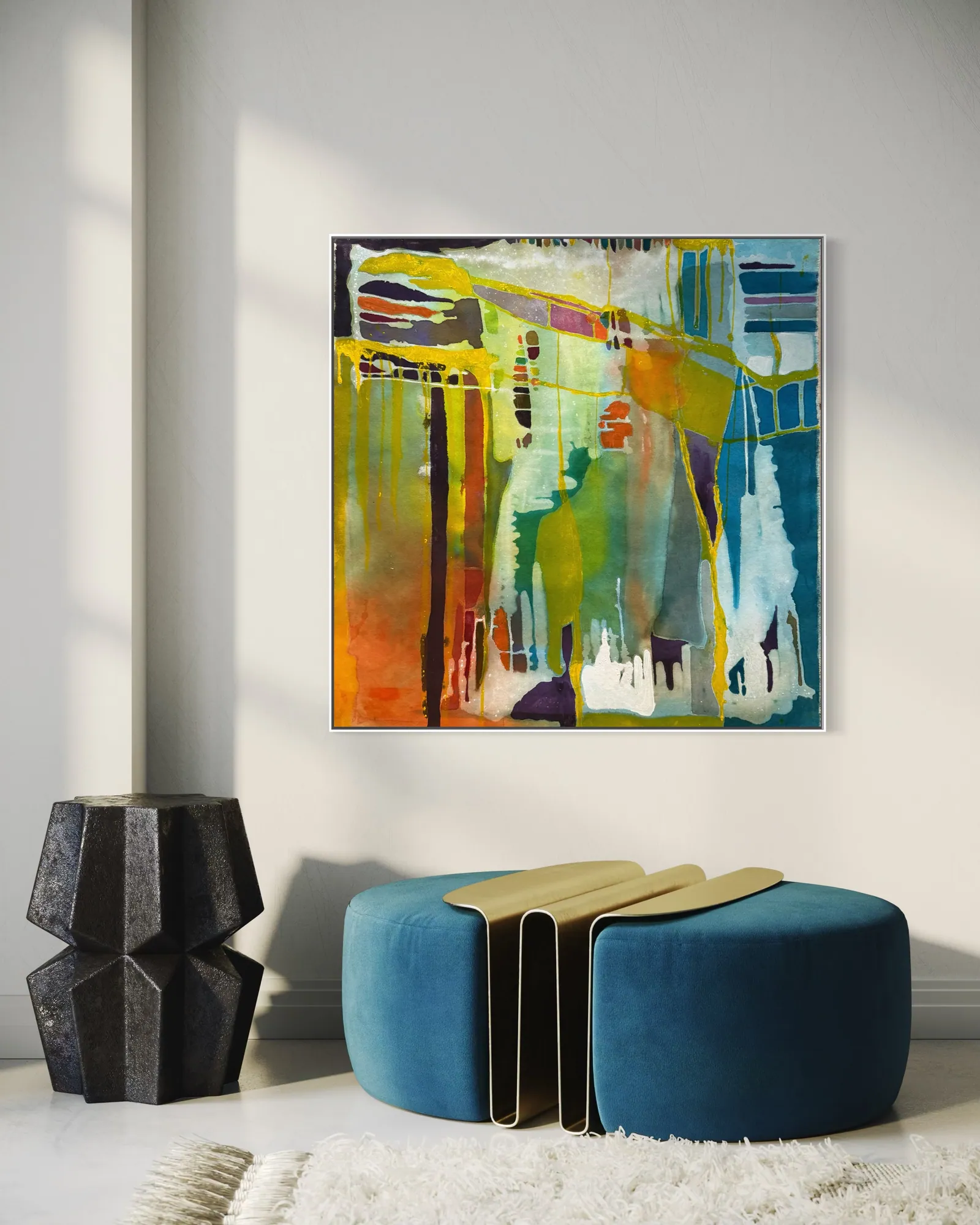
Prism Garden (acrylic on canvas, 100 x 100 cm, 2026, R$ 5,500) is made in washes, pigment diluted until it moves by itself and is left to run and settle, in layers thin enough to see through. Lime green and citrine pool near the center, petroleum blue gathers at the right edge, and vertical threads of yellow descend through the whole composition. Milhazes transfers motifs painted on plastic onto canvas, and the Tate describes her surfaces as smooth; these two paintings are made in diluted, translucent layers, and the surface keeps the run of the liquid. A reader who likes staged color can compare how each surface records its making.
Vibrant Awakening (acrylic on canvas, 100 x 150 cm, 2025, R$ 5,900) uses broad, fluid gestures and translucent layers on a larger vertical format. As an architect by training, I judge a painting against a wall, so I would rather you saw both in a room or in detail photographs than judged them from this page.
Frequently asked
Who are artists similar to Beatriz Milhazes?
There is no authoritative list, and the useful comparison is procedure. MASP names Tarsila do Amaral, Sonia Delaunay, Bridget Riley and Ione Saldanha among the references behind Milhazes's work, and that is a statement about her sources. Among Brazilian painters, Tomie Ohtake also built color in many layers, though by a different route. Compare artists by how the work is made, not by who is grouped with whom.
What is Beatriz Milhazes known for in terms of how the paintings are made?
According to the Tate, she developed monotransfer in 1989: she paints motifs onto plastic sheeting and transposes them onto canvas. The Tate says this retains the fidelity of the colors, intensifies fluorescent and metallic pigments, and adapts the concept of collage to painting. MASP describes the same method and displayed one of the transparent plastic sheets in a vitrine during its Avenida Paulista exhibition.
What can I collect now if I like Beatriz Milhazes's work?
Look for original work where color is built in separate stages and the surface still shows evidence of process. Ask for exact dimensions, detail photographs and documentation, and judge scale against your wall. From this studio, Prism Garden (100 x 100 cm, R$ 5,500) and Vibrant Awakening (100 x 150 cm, R$ 5,900) are two Luminous Rebirth paintings made in translucent layers of acrylic.
Is it possible to buy original abstract work with a related procedure directly from an artist?
Yes. Buying direct from the artist is legitimate and, at this studio, comes with an original unique painting, a Certificate of Authenticity signed by hand with the technical record and Archive ID, an invoice or official receipt, an acquisition agreement and care guidance. The studio ships within Brazil and internationally; shipping is quoted per destination and paid by the buyer, as are any import duties or taxes in the destination country.
How does Alyne Perfeito's practice relate to Beatriz Milhazes's procedure, without comparing importance?
Only at the level of procedure, and not in importance. Milhazes transfers motifs painted on plastic onto canvas; the two Alyne Perfeito paintings discussed here, Prism Garden and Vibrant Awakening, are made in diluted, translucent layers of acrylic, and the surface keeps the run of the paint. A reader who likes staged color can compare how each surface records its making. The studio does not rank itself against established artists.
Want to see layered color up close?
Ask the studio for detail photographs or a short video of Prism Garden or Vibrant Awakening, or to arrange a viewing in Brasília by appointment.
Sources
- Tate (press release, Maresias) — 2026-10-11
- MASP, Museu de Arte de São Paulo — 2026-10-11
- MASP, Museu de Arte de São Paulo — 2026-10-11
- Instituto Tomie Ohtake — 2026-10-11
- Perfeito Studio — 2026-10-11
- Perfeito Studio — 2026-10-11
Published on · Updated on