Famous Brazilian painters: who to know and where their work is held
Famous Brazilian painters include Tarsila do Amaral, Anita Malfatti, Alfredo Volpi, Di Cavalcanti, Candido Portinari, Tomie Ohtake, Djanira and Maria Auxiliadora. This is a sourced list of eight painters who have died, each with a museum record confirming a work, and it is not a ranking.
How this list was chosen
Nobody keeps an official list of Brazil's greatest painters, and this page does not pretend to. It uses three tests that anyone can check. Each painter is no longer living, has an entry in the Itaú Cultural encyclopedia, and has at least one work with a public museum record that was read for this page (MASP or Tate on their own sites, or, for Djanira, the Pinacoteca de São Paulo's record on Google Arts & Culture). Living painters are left out on purpose, not as a judgment: a closed career is easier to source.
The eight are given in order of birth. For each one the page says what the sources say and names a work held in a public collection. It does not say who matters most.
The modernists: Tarsila, Malfatti, Di Cavalcanti and Portinari
Each of these four painters is tied to Brazilian modernism, and the sources describe a shared habit: lessons taken from European art, applied to Brazilian subjects.
Tarsila do Amaral (1886–1973)
Itaú Cultural records that Tarsila went to Paris in 1920 and studied there, and that in 1928 she gave her best-known painting, Abaporu, to the writer Oswald de Andrade, which led him to found the anthropophagic movement. Abaporu (oil on canvas, 85 x 73 cm) is held by MALBA, in Buenos Aires. MASP, in São Paulo, has an earlier work in its collection on long-term loan from the Banco Central do Brasil: Autorretrato com vestido laranja (Self-Portrait with Orange Dress, 1921, oil on canvas, 50 x 41 cm, inventory C.01273). A fuller biography is on Who was Tarsila do Amaral?
Anita Malfatti (1889–1964)
Itaú Cultural describes Malfatti as decisive in bringing modernist aesthetics to Brazil. Her solo exhibition of December 1917 drew a violent reaction from critics, among them Monteiro Lobato, and Oswald de Andrade defended her in print in 1918. She showed 20 works at the 1922 Semana de Arte Moderna and spent five years in Paris from 1923. MASP has Interior de Mônaco (1925, oil on canvas, 24 x 60 cm, inventory C.01193) on long-term loan from the B3 stock exchange; the museum's catalogue note sees the influence of the School of Paris and of Matisse.
Di Cavalcanti (1897–1976)
According to Itaú Cultural, Emiliano Di Cavalcanti conceived the idea of the 1922 Semana de Arte Moderna and made its catalogue and poster, and later painted popular figures in what the entry calls a constant search for a national art. In Brasília he painted Candangos (1960), an oil-on-canvas panel for the Chamber of Deputies. MASP holds Cinco moças de Guaratinguetá (1930, oil on canvas, 90.5 x 70 cm, inventory MASP.00316), a gift of Frederico Barata in 1947.
Candido Portinari (1903–1962)
Portinari was born in Brodósqui, São Paulo, and trained at the Escola Nacional de Belas Artes in Rio de Janeiro from 1920. Itaú Cultural states that his painting Café (1935) won a Carnegie Institute prize in Pittsburgh that year, making him the first Brazilian modernist awarded abroad, and that the Guerra e Paz panels for the United Nations headquarters in New York were inaugurated in 1956. MASP holds O pranto de Jeremias (1944, tempera on canvas, 190 x 180.5 cm, inventory MASP.00331), part of the Biblical Series Assis Chateaubriand commissioned for Rádio Tupi in São Paulo; the museum's note points to Picasso's Guernica as an influence on the series.
Flat colour and abstraction: Volpi and Tomie Ohtake
Two painters on the list moved toward large colour surfaces and, in time, abstraction, by very different routes.
Alfredo Volpi (1896–1988)
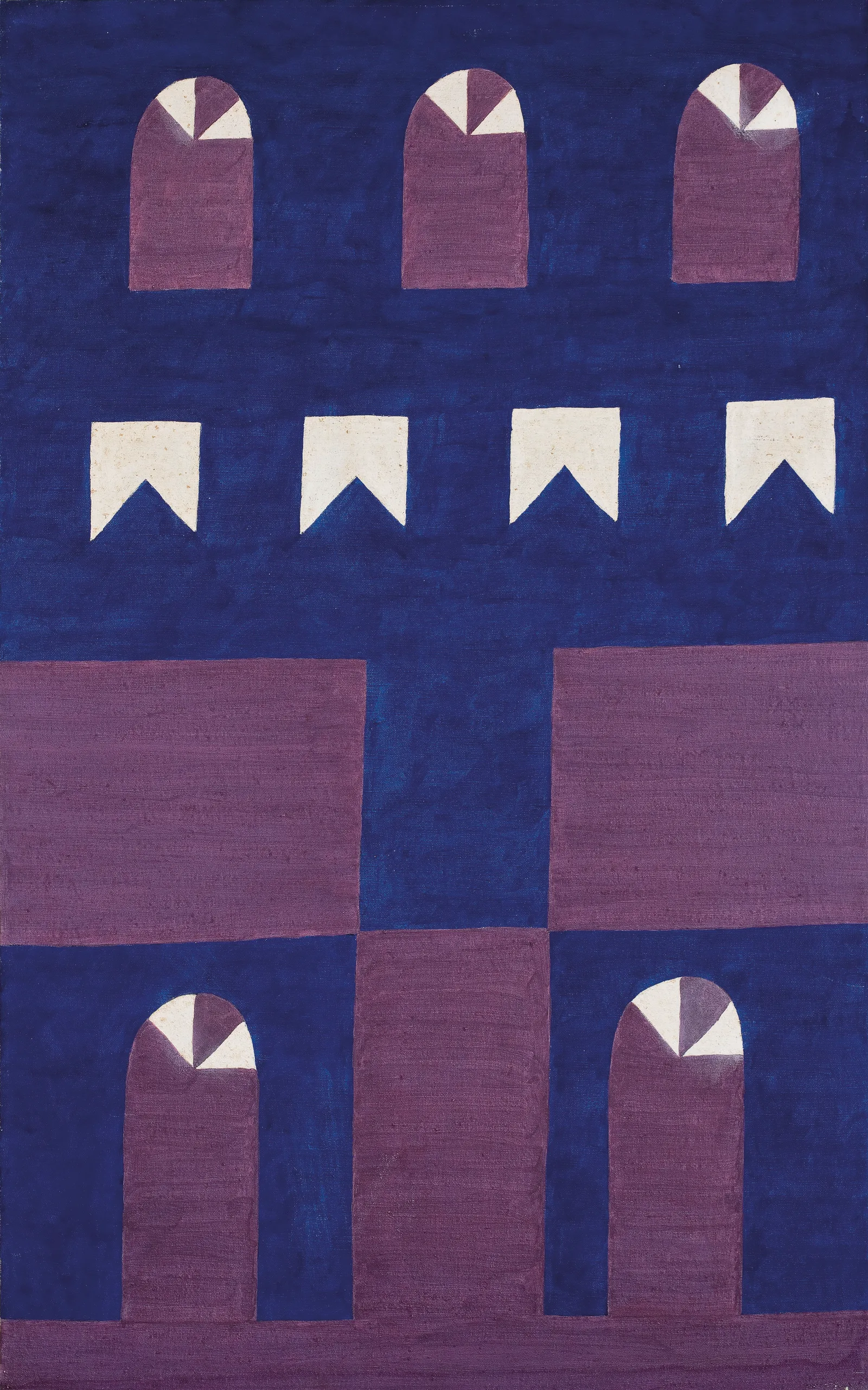
Volpi was born in Lucca, Italy, and was brought to Brazil in 1897. MASP calls him self-taught and notes that he worked as a wall painter and decorator before turning to art. The same museum records that in 1954 he painted his first canvases of little flags (bandeirinhas), a reference to popular festivals that speaks formally to the abstract language of the Brazilian Concrete artists. Itaú Cultural adds that he was invited to the National Exhibitions of Concrete Art of 1956 and 1957, and received the Guggenheim Prize in 1958; it reads his tempera as a counterweight to the industrial paint and mechanical finish favoured by the Concretists. The painting at the top of this page, Fachada com bandeiras (1959, tempera on canvas, 115.5 x 72 cm), is in the MASP collection, a gift of Ernest Wolf in 1990.
Tomie Ohtake (1913–2015)
Ohtake was born in Kyoto and came to Brazil in 1936 on a visit to a brother; events linked to the Pacific War kept her from returning to Japan, and she settled in São Paulo, according to Itaú Cultural. She began to paint in 1952. Between 1959 and 1962 she made what the encyclopedia calls pinturas às cegas, painted with her eyes covered, and one of them received the Isenção de Júri prize at the 1960 Salão Nacional de Arte Moderna. Tate in London holds Untitled (from the series Blind Paintings), dated 1962 (reference T14807). Itaú Cultural also notes an affinity between her pulsing colour fields and Mark Rothko; for that reference point see Who was Mark Rothko?
Daily life and faith: Djanira and Maria Auxiliadora
The last two painters put daily life, work and religious feeling at the centre of the picture.
Djanira (1914–1979)
Djanira was born in Avaré, São Paulo, and died in Rio de Janeiro. Itaú Cultural says she began to draw during a stay in a tuberculosis sanatorium that started in 1937, took part in a Brazilian modern painting show at the Royal Academy of Arts in London in 1943, and lived in the United States between 1944 and 1947. It adds that the Museu Nacional de Belas Artes in Rio holds 813 of her works. The Pinacoteca de São Paulo holds Três orixás (1966, oil on canvas, 130.4 x 195.5 cm), acquired by the São Paulo State Government in 1969.
Maria Auxiliadora (1935–1974)
Maria Auxiliadora da Silva was born in Minas Gerais and died in São Paulo. Itaú Cultural calls her self-taught and describes pure, saturated colour, reliefs built from acrylic paste and strands of hair, and scenes of urban and rural life, capoeira and samba. MASP has shown 82 of her works in an exhibition and published a catalogue in 2018. Its collection includes an untitled painting of 1968, mixed media on canvas, 50 x 65 cm (inventory MASP.11212), a festive composition of musicians and dancers.
Where the works named here are held
These are the public records and reports I read for this page. A collection record says where a work is kept, and in two cases below the keeper is a lender rather than the owner; it does not say what is on the wall this month, so check each museum's own site before planning a visit.
- MASP, São Paulo: Tarsila (long-term loan from the Banco Central), Malfatti (long-term loan from B3), Volpi, Di Cavalcanti, Portinari and Maria Auxiliadora, with the inventory numbers given above.
- Pinacoteca de São Paulo: Djanira, Três orixás (1966).
- MALBA, Buenos Aires: Tarsila, Abaporu (1928).
- MoMA, New York: Tarsila, A lua (The Moon, 1928), reported in the press as a purchase in February 2019.
- Tate, London: Tomie Ohtake, Untitled (from the series Blind Paintings), 1962.
For abstract painting made in Brazil more recently, see Brazilian abstract painting today: where to look.
From the studio
From the studio
When I look at paintings like the ones on this list, I notice procedure first: what the paint is, how thick it sits, where an edge falls. Volpi's tempera, which Itaú Cultural describes as a thin, sparse texture, leaves the colour flat. In Golden Passage, from the Black & Gold series (2025, mixed media, texture paste and imitation gold leaf on canvas, 60 x 80 cm), the surface goes the other way and is built up in relief.
That is the only comparison I can honestly make, and it is a comparison of method, not of standing. Trained as an architect, I tend to read a canvas as I would read a wall, by what it does to the room around it.
Frequently asked
Who are the most famous Brazilian painters?
There is no official ranking, so any answer is a selection. This page picks eight painters who have died, each with an Itaú Cultural entry and a museum record that was read for the page: Tarsila do Amaral, Anita Malfatti, Di Cavalcanti, Candido Portinari, Alfredo Volpi, Tomie Ohtake, Djanira and Maria Auxiliadora. They are ordered by birth year, and the page says where a work by each is held, so you can check the claims yourself.
Which Brazilian painters are in major museum collections?
Of the eight painters on this page, MASP in São Paulo has works by Tarsila and Malfatti (both on long-term loan), Volpi, Di Cavalcanti, Portinari and Maria Auxiliadora. The Pinacoteca de São Paulo holds Djanira's Três orixás. Outside Brazil, MALBA in Buenos Aires holds Tarsila's Abaporu, Tate in London holds a 1962 Blind Painting by Tomie Ohtake, and MoMA in New York bought Tarsila's A lua, reported in February 2019.
What is the difference between Brazilian modernist and Brazilian abstract painters?
On this list the modernists, Tarsila, Malfatti, Di Cavalcanti and Portinari, keep recognisable Brazilian subjects and apply lessons from European avant-gardes. Volpi and Tomie Ohtake belong to a later moment: Volpi's flags and facades move toward the abstract language of the Concrete artists, and Ohtake explored abstraction after a brief figurative phase, according to Itaú Cultural. The line between the two is gradual, not a clean break.
Where can I see Brazilian paintings outside Brazil?
Three institutions named on this page hold works by Brazilian painters outside the country: MALBA in Buenos Aires (Tarsila's Abaporu), MoMA in New York (Tarsila's A lua) and Tate in London (Ohtake's 1962 Blind Painting). A collection record shows where a work belongs, not what is on view, so confirm display status on each museum's own website.
Are there famous Brazilian women painters?
Yes. Five of the eight painters on this page are women: Tarsila do Amaral, Anita Malfatti, Tomie Ohtake, Djanira and Maria Auxiliadora. Itaú Cultural describes Malfatti as decisive in bringing modernist aesthetics to Brazil and records that Tarsila's Abaporu led to the anthropophagic movement. Ohtake began painting in 1952 and later painted blindfolded, and Maria Auxiliadora was self-taught. Each is documented in the encyclopedia and in a museum record cited here.
Why are there no living painters on this list?
It is a choice of method, not a verdict on living artists. For painters who have died, a career is complete and documented in encyclopedias and museum records, so each claim on this page can be traced to a source. Living painters change, show and sell continuously, which makes a short, sourced list harder to keep accurate. For how new abstract work is made in Brazil today, see the Journal page on Brazilian abstract painting.
Contemporary Brazilian painting, direct from the studio in Brasília
Each original comes with a signed certificate of authenticity and an Archive ID. Ask about a specific work and the studio will reply on WhatsApp.
Sources
- Enciclopédia Itaú Cultural — 2026-10-07
- MASP — 2026-10-07
- The Brooklyn Rail — 2026-10-07
- Jornal do Brasil — 2026-10-07
- Enciclopédia Itaú Cultural — 2026-10-07
- MASP — 2026-10-07
- Enciclopédia Itaú Cultural — 2026-10-07
- MASP — 2026-10-07
- Enciclopédia Itaú Cultural — 2026-10-07
- MASP — 2026-10-07
- MASP — 2026-10-07
- Enciclopédia Itaú Cultural — 2026-10-07
- Enciclopédia Itaú Cultural — 2026-10-07
- Tate — 2026-10-07
- Enciclopédia Itaú Cultural — 2026-10-07
- Google Arts & Culture (Pinacoteca de São Paulo) — 2026-10-07
- Enciclopédia Itaú Cultural — 2026-10-07
- MASP — 2026-10-07
- MASP — 2026-10-07
Published on · Updated on