If you like Gerhard Richter's abstract paintings, what to collect now
Richter's abstract paintings are built in layers and then disturbed with a squeegee, so earlier layers resurface. If you like that, look for painters whose surface is a record of building and removing rather than for his name. This page does not discuss the market for his work; direct purchase from a working artist is the route described here.
What Richter's abstract procedure actually is
Tate describes Gerhard Richter (born 1932) as having frequently made abstract works by applying layers of paint and then wiping a squeegee across the surface. As the upper layers are dragged, earlier moments in the making of the painting are allowed to resurface. Tate's account of the tool is plain: a length of flexible Perspex fitted with a wooden handle, whose edge etches, scrapes or smears paint across the work.
SFMOMA's audio guide to a 1988 Abstraktes Bild (oil on linen, 62 × 62.2 cm) puts the same idea in a curator's words: the abstract pictures are built one layer at a time, sometimes scraped to remove paint, sometimes allowed to merge. Add a layer, take one away.
That is the whole attraction, and it is a matter of procedure, not of subject. The surface is a record of addition and subtraction, and what you see at the end is partly what the painter chose and partly what the tool uncovered.
Painters who work by building, then removing
Liking Richter does not have to mean liking his palette. The procedure is what travels. One clear relative is the French painter Pierre Soulages (born 1919). The Louvre's press materials for its 2019–2020 exhibition describe his work as pursuing light through layering and scraping, and as using the reflection of light in the outrenoir paintings. In a note on one painting, a Centre Pompidou teaching dossier says the varying depth of the grooves cut by the tool produces endless variation. Soulages's palette is black; the shared logic is procedural: lay paint down, then work it back until the surface carries its own history. We look at him on a separate page: Artists similar to Pierre Soulages.
Two caveats keep the comparison honest. First, the tools differ: Richter's is a flexible Perspex squeegee wiped across the surface; Soulages made some of his own tools (alongside builders' brushes and squeegees). Second, a shared procedure says nothing about relative importance, and this page does not rank anyone. It sorts by how the surface was made.
What you can actually collect now
Richter's abstract paintings are held by museums such as SFMOMA, which is where you see them. This page cites no auction figures and makes no claim about the secondary market; that is a separate conversation with its own risks, and the Abstract Expressionism companion page covers the general logic of why original work by canonical names is out of reach for most buyers.
The practical alternative is original work by a living painter whose surface is made by a comparable procedure, bought directly from the artist. It comes with no auction history and no promise of anything later, and nothing here suggests otherwise. What you gain is a unique object, a direct line to the person who made it, and documentation you can ask for. How to buy art directly from the artist sets out the questions worth asking.
To judge whether a surface really comes from building and removing, look for these signals:
- Evidence of subtraction. Places where an upper layer has been disturbed and something underneath shows through, rather than a pattern applied on top.
- Layers visible at the edges. Breaks, tears and thin spots where more than one colour or texture is readable.
- A surface that changes with your position. In the studio's experience, a worked surface looks different from the side than from the front, and a photograph rarely carries that.
- Technical record. Medium and dimensions stated precisely, and a certificate that carries them.
From the studio
From the studio
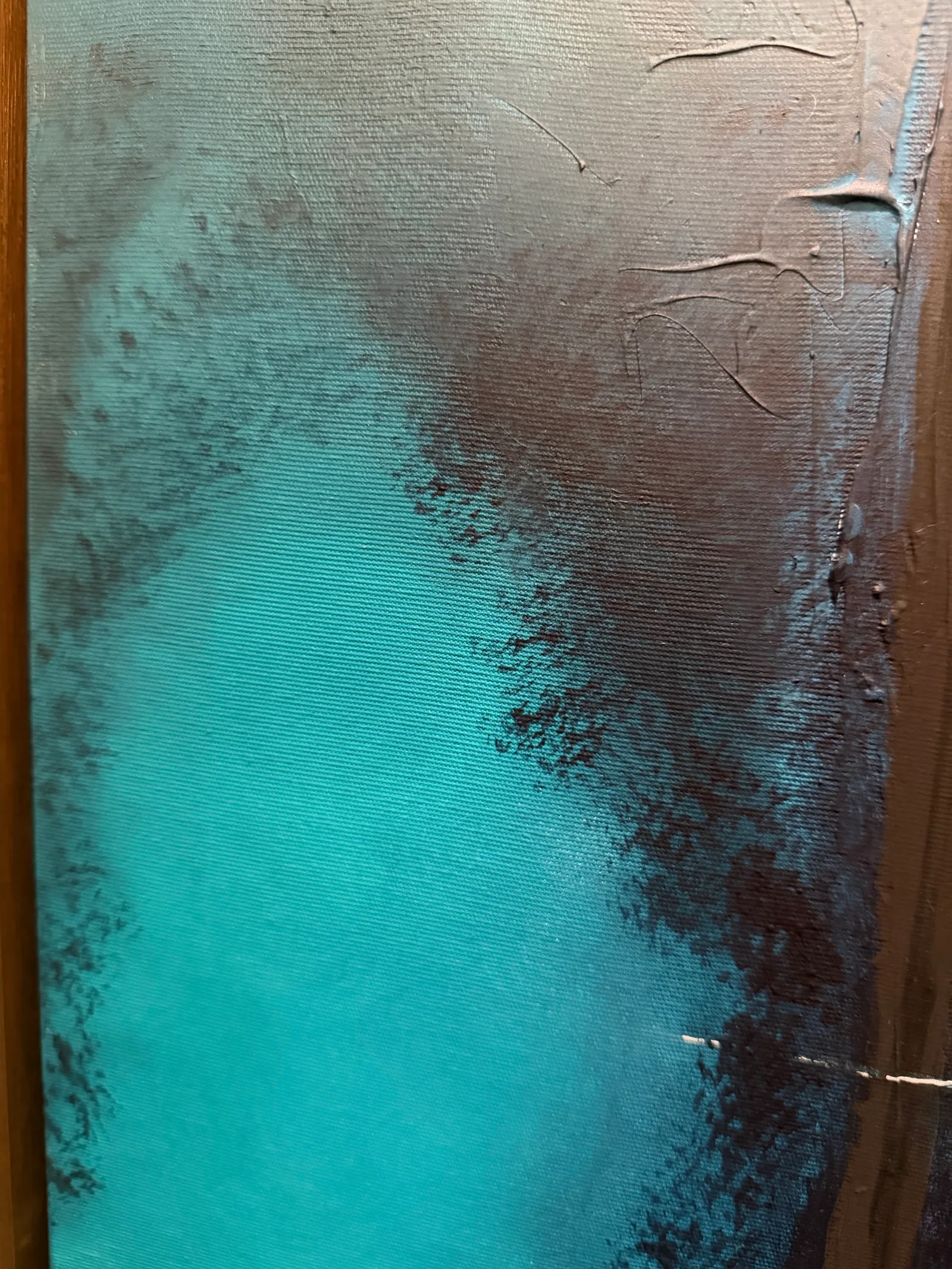
I will not claim Richter's method as mine, and this page does not equate the two. What I can say is how I read the comparison. As an architect I tend to read a surface like a section: what was laid down first, what was cut back, what is left showing. Veil of Light (70 × 110 cm, 2026, mixed media on canvas with sculpted texture and acrylic) is where that reading is easiest to see in my own work. In the detail photograph above, dark pigment breaks into a speckled edge over the turquoise, and the weave of the canvas shows through.
Prism Garden (100 × 100 cm, 2026, acrylic on canvas) goes the other way: thin, translucent washes that were left to run and settle, with vertical threads of yellow drawn by gravity. It is a build-up without scraping, and I include it so the contrast is visible.
I am early in my career: no gallery representation, no institutional collection, no auction record. Both pieces are unique, signed, and come with a certificate carrying the technical record. Please look at the surface in person, or ask me for more detail photographs, before deciding anything.
Frequently asked
Who are artists similar to Gerhard Richter?
It depends on which side of his work you mean. For abstract painting built by layering and then disturbing the surface, Pierre Soulages is a clear procedural relative, with a different tool, working in black. This page compares by how surfaces are made, not by importance, and it does not claim any ranking among painters.
What is Gerhard Richter known for in terms of how the paintings are made?
Tate describes him as often making abstract works by laying down layers of paint and then wiping a squeegee across the surface, so earlier moments in the painting resurface. Tate's conservator account describes the squeegee as a length of flexible Perspex fitted with a wooden handle, used to etch, scrape or smear paint across the work.
What can I collect now if I like Gerhard Richter's work?
Richter's abstract paintings are in museum collections, and this page makes no claim about the secondary market. If what you like is the procedure, the realistic option is original work by a living painter whose surface is built and then worked back, bought directly from the artist with documentation. That route carries no guarantee of future value.
Is it possible to buy original abstract work with a related procedure directly from an artist?
Yes. Perfeito Studio sells original, unique paintings directly from Alyne Perfeito, with a signed certificate of authenticity carrying the technical record and Archive ID, an acquisition agreement, a dossier and professional packaging. The studio ships within Brazil and internationally; shipping and any import duties are paid by the buyer. Viewing in Brasília is possible by appointment.
How does Alyne Perfeito's practice relate to Gerhard Richter's procedure, without comparing importance?
Both involve surfaces that carry traces of how they were built. That is the whole comparison. Her tools and method are her own: Veil of Light is mixed media on canvas with sculpted texture and acrylic, and Prism Garden is acrylic washes. She is early in her career and makes no claim of equivalence with an established painter.
Want to see the surface of Veil of Light up close?
Ask for more detail photographs or arrange a viewing in Brasília. A straight answer on technique, documentation and availability, with no pitch and no promise of appreciation.
Sources
- Tate Modern — 2026-10-11
- Tate — 2026-10-11
- Tate — 2026-10-11
- San Francisco Museum of Modern Art — 2026-10-11
- Musee du Louvre, press room — 2026-10-11
- Centre Pompidou, education resources — 2026-10-11
Published on