If you like Kandinsky, what to collect now
Wassily Kandinsky is known for freeing colour and line from representation, drawing an analogy with music. His paintings of this period are mostly in museum collections, as with the Chicago painting below, so collecting in his direction today means original work by living artists that shares part of that procedure, compared by method and never by standing.
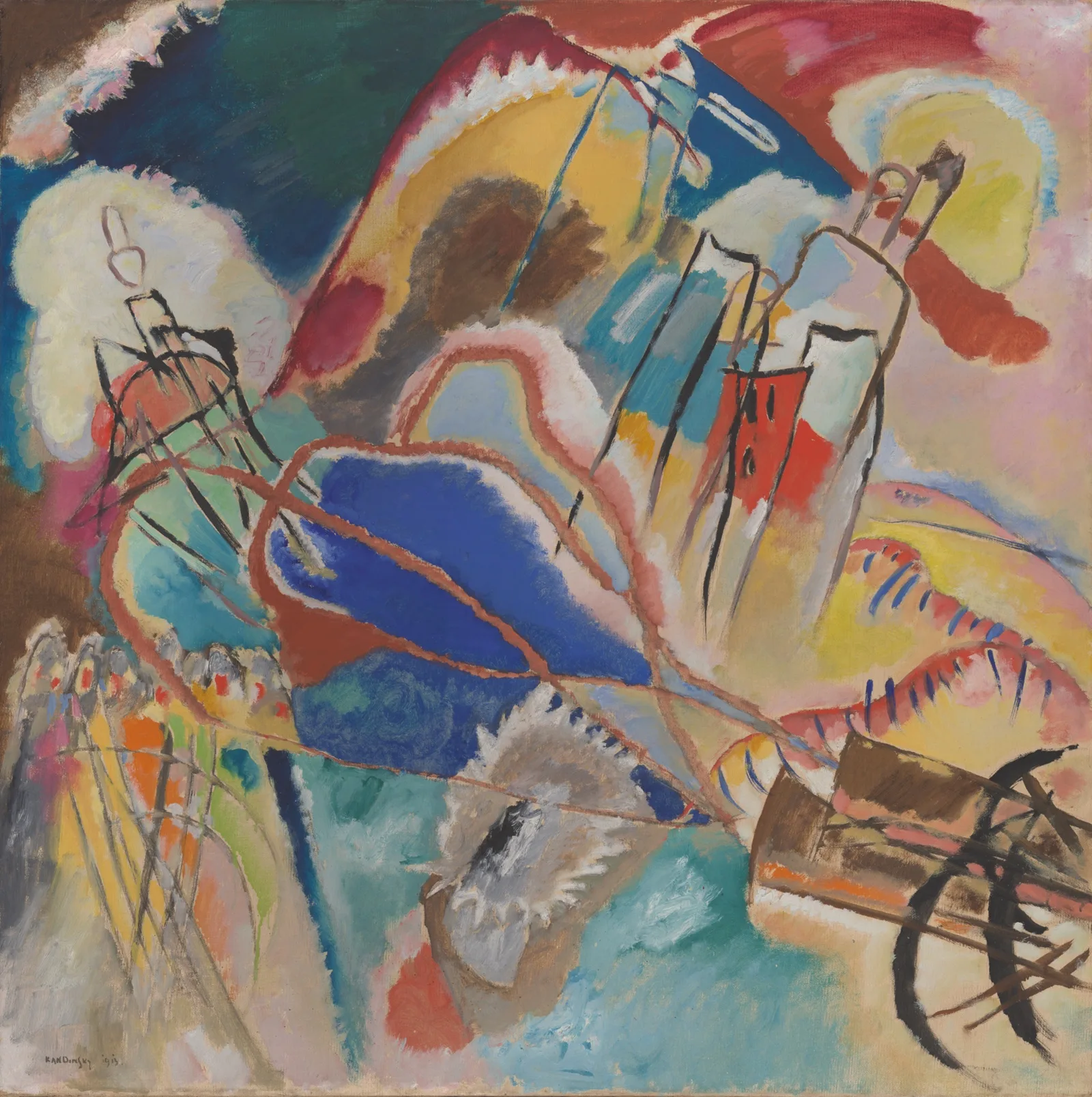
What Kandinsky does with colour and line
Vasily Kandinsky (1866–1944), born in Moscow and died at Neuilly-sur-Seine, was a painter of abstraction. In his 1912 book Concerning the Spiritual in Art he drew an analogy between music and painting as two means of abstraction, which the Art Institute of Chicago describes as a radical mode of artmaking, one that freed colour and line from their traditionally representational functions. The museum quotes him as seeking an art that could stir what he called "vibrations in the soul" rather than imitate the physical world.
Between 1910 and 1914 he painted a group of works he called improvisations, which he described as unconscious, spontaneous expressions. The point for a collector is the procedure: colour and mark are organised as rhythm and relation, closer to a score than to a description of a scene.
One painting, read closely: Improvisation No. 30 (Cannons)
The Art Institute of Chicago holds Improvisation No. 30 (Cannons), 1913, oil on canvas, 111 × 111.3 cm (accession 1931.511, Arthur Jerome Eddy Memorial Collection). The museum describes it as one of his first improvisations. It also records a letter in which Kandinsky told the Chicago collector Arthur Jerome Eddy that the cannons could probably be explained by the constant war talk of the year, but that the true contents are what the spectator experiences under the effect of the forms and colour combinations of the picture.
That sentence is the useful one. Even where a recognisable detail survives, he asks you to judge the picture by what colour and form do to you, which is a procedure you can look for in other original work.
Where his work lives, and what that means for a collector
Kandinsky's paintings of this period are mostly in museum collections, as with the Chicago painting above, and this page does not quote prices or auction results for Kandinsky: a figure without a dated source is not information, and Perfeito Studio does not set or quote secondary-market values for any artist. What the page can do is describe the procedure you are responding to, so that you can recognise it elsewhere. For the practical side of buying from a living artist, see how to buy art directly from the artist.
The Journal covers neighbouring ground in if you like Abstract Expressionism, what to collect now, where the question is gesture and scale rather than colour as rhythm.
How to read a related original, procedure first
Four questions help when a painting reminds you of Kandinsky. Is colour organised as relation, with passages answering one another, or does it describe an object? Does the eye travel across the surface, or settle in one place? Where did the paint move by itself, and where was it placed by hand? And what does a close detail show that the full image does not?
Ask for detail photographs before deciding. The studio sends additional detail photographs and video of a specific work on request through WhatsApp. Works can also be seen in Brasília by appointment.
From the studio
From the studio
I should be exact about where my work meets Kandinsky's procedure and where it does not. I do not follow his colour theory and I make no claim of kinship with him. What I can say is narrower. Prism Garden (2026, acrylic on canvas, 100 × 100 cm) is built in washes: pigment diluted until it moves on its own, allowed to run and settle, with vertical threads of yellow drawn down by gravity rather than by hand. Colour there is a relation between lime, citrine, petroleum blue and small marks of orange and magenta, not a description of a garden.
Solar Rain (2026, acrylic on canvas, 70 × 110 cm) works with two temperatures, a saturated yellow field crossed by red and copper marks that descend and pool toward the edge. As an architect by training I think about how colour behaves on a wall, and these two paintings answer that differently. I am early in my career, with no institutional history behind the work. If Kandinsky's way of using colour draws you, the honest test is to look at these surfaces in detail and decide for yourself.
Frequently asked
Who are artists similar to Wassily Kandinsky?
It depends on which part of his work you mean. For colour and line freed from description, the Journal has pages on related procedures, and the page on Abstract Expressionism covers gesture and scale. This site compares by procedure only and does not rank artists or place any living artist alongside him.
What is Wassily Kandinsky known for in terms of how the paintings are made?
The Art Institute of Chicago says that in his 1912 book Concerning the Spiritual in Art he made an analogy between music and painting as two means of abstraction, freeing colour and line from representational functions. Between 1910 and 1914 he painted improvisations, works he described as unconscious, spontaneous expressions.
What can I collect now if I like Wassily Kandinsky's work?
Kandinsky's paintings of this period are mostly in museum collections, so the practical path is original work by living artists whose procedure you respond to, such as colour organised as relation rather than description. Ask for close-up photographs of the surface. This page does not advise on buying Kandinsky's own work or on secondary-market values.
Is it possible to buy original abstract work with a related procedure directly from an artist?
Yes. At Perfeito Studio every acquisition is direct from the artist and includes the original unique painting, a signed Certificate of Authenticity with the Archive ID, a fiscal invoice or receipt, an acquisition agreement, an artist dossier, care guidance and professional packaging. Prices are set by the studio and stated in Brazilian Real. Nothing here is a promise of future value.
How does Alyne Perfeito's practice relate to Wassily Kandinsky's procedure, without comparing importance?
Only in part, and not by importance. Prism Garden and Solar Rain use colour as relation and as light, one in translucent washes and one in a saturated field with descending marks. The studio does not claim to follow Kandinsky's colour theory. Any connection is yours to judge from the surface.
Want detail photographs of Prism Garden or Solar Rain?
Ask about the surface, the Archive ID or a viewing in Brasília. No pitch and no promise of appreciation.
Sources
Published on