Who was Mira Schendel?
Mira Schendel (1919-1988) was a Swiss-born artist who was persecuted in wartime Italy, emigrated to Brazil in 1949, settled in São Paulo in 1953 and became, in Tate's words, one of Latin America's most important and prolific post-war artists. She is known for over 2,000 rice-paper monotypes, the knotted Droguinhas and the Graphic Objects, works where line, language and transparency become a quiet kind of space.
From Zurich to São Paulo
Mira Schendel was born Myrrha Dagmar Dub on 7 June 1919 in Zurich, into a family of Jewish origin, and was baptised Catholic. After her parents separated she grew up in Milan, where she studied art and, from 1937, philosophy at the Università Cattolica del Sacro Cuore. In 1938 a decree stripping Jews of Italian citizenship forced her to stop her studies. She fled to Yugoslavia during the war, and in July 1949 sailed from Naples for Brazil, first settling in Porto Alegre.
She moved to São Paulo in 1953, began signing her works simply "Mira", and died on 24 July 1988. In São Paulo she joined a circle of philosophers, poets, psychoanalysts, physicists and critics, among them the physicist and critic Mário Schenberg and the philosopher Vilém Flusser.
Transparency, line and silence: the work
Schendel's best-known works begin in 1964, when she started making monotypes on rice paper; by 1967 she had produced more than 2,000. The sheets carry lines, letters, numbers and fragments of words that behave less like text than like marks on the verge of becoming text. The philosopher Vilém Flusser called her writings "pre-texts": what texts are before they become texts.
In 1966, at the gallery Signals in London, she showed the Droguinhas ("Little Nothings"), soft sculptures of knotted rice paper, and the Trenzinho ("Little Train"). In 1968 she represented Brazil at the 34th Venice Biennale, alongside Lygia Clark, Farnese de Andrade and Anna Letycia Quadros, showing Objetos gráficos (Graphic Objects). Later series include the 1970s Toquinhos and Datiloscritos, temperas with gold leaf from 1979 to 1986, and the Sarrafos (Battens) of 1986-87: white panels in tempera and gesso on wood with black wooden battens attached.
Concrete, neo-concrete, or neither?
Schendel worked in the same Brazilian years and cities as the Concrete and Neo-Concrete artists, and Tate's chronology records the connections: in 1963 critics read her dark, earthy paintings with abstract divisions as a move toward "concretism", and in 1966 the Concrete poet Haroldo de Campos wrote a poem for her Rio de Janeiro catalogue. But the chronology does not list her among the members of either group. Tate's exhibition page names her with Lygia Clark and Hélio Oiticica as artists who reinvented the language of European Modernism in Brazil.
For the wider context, see our guides to Concrete art in Brazil and Neo-Concrete art.
Materials and where to see the work
Her materials are modest and exact: rice paper, transfer lettering and typewriter, tempera and gesso on wood panels, acrylic for the transparent Transformáveis sculptures, and gold leaf. The Droguinhas are soft sculptures of knotted rice paper.
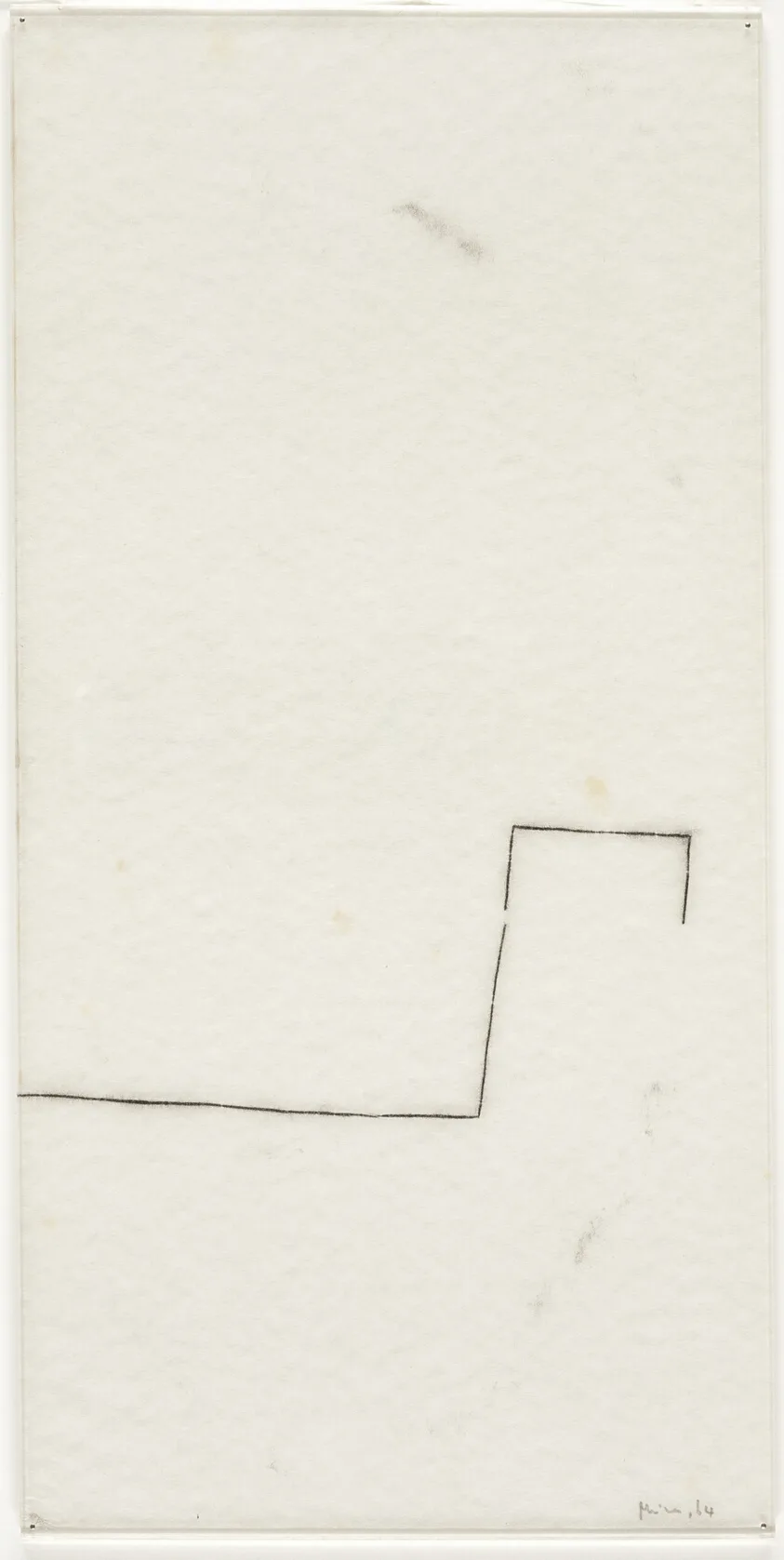
Tate Modern staged the first international full-scale survey of her work from 25 September 2013 to 19 January 2014, organised with the Pinacoteca do Estado de São Paulo. Tate's artist page lists Untitled (1963), Untitled (Genesis) (1965) and Untitled (Disks) (1972), and the Art Institute of Chicago's records include several 1964 monotypes, one of which is shown above. Display changes, so check the museum's own site before planning a visit.
From the studio
From the atelier
What I find useful in Schendel is a question of procedure, not a comparison: how much a surface can hold when almost nothing is placed on it. In Silent Interval (2026, mixed media with acrylic on canvas, 120 x 160 cm), from the Matter & Silence series, a single dark gesture runs down a warm bone-white field and a block of blue anchors the lower edge. The subject is the space between the two marks, and the worked, scored ground is what gives that space a surface.
My training is in architecture, so I tend to read a painting as a room with very little in it: where the eye rests, where it is allowed to pause. That is a way of working, and I do not place it beside hers in stature. It is simply why I return to the quiet end of her practice.
Frequently asked
Who was Mira Schendel?
Mira Schendel (1919-1988) was an artist born in Zurich who grew up in Milan, was persecuted in Italy during the war and fled to Yugoslavia, lived in Rome after the war and emigrated to Brazil in 1949 and settled in São Paulo in 1953. Tate describes her as one of Latin America's most important and prolific post-war artists. She is known for rice-paper monotypes, the knotted Droguinhas, the Graphic Objects shown at the 1968 Venice Biennale, and the Sarrafos of her final years.
What are Mira Schendel's Droguinhas?
The Droguinhas, meaning "Little Nothings", are soft sculptures of knotted rice paper that she made in 1965-66. Tate notes that they were first shown in London, in the exhibition Signals in 1966. They sit between drawing and sculpture, made from a material usually associated with the flat sheet.
Why was she not strictly concrete or neo-concrete?
Schendel worked alongside the Concrete and Neo-Concrete artists in Brazil, and critics linked her 1963 paintings to concretism. Tate's chronology, however, does not list her among the members of either group. Tate's exhibition page names her with Lygia Clark and Hélio Oiticica as artists who reinvented the language of European Modernism in Brazil.
What materials did she use?
Her key material was rice paper, used for the monotypes, the Droguinhas and the Graphic Objects. She also worked in tempera and gesso on wood panels, with transfer lettering and typewritten characters on paper. Later series used acrylic for transparent sculptures called Transformáveis, tempera with gold leaf from 1979 to 1986, and black wooden battens on white panels in the Sarrafos of 1986-87.
Where can I see her work?
Tate's artist page lists Untitled (1963), Untitled (Genesis) (1965) and Untitled (Disks) (1972), and the Art Institute of Chicago's records include several 1964 monotypes on Japanese paper. Tate Modern's 2013-14 retrospective was organised with the Pinacoteca do Estado de São Paulo. Because displays change, confirm what is on view with each museum before travelling.
See Silent Interval, from the Matter & Silence series
One original, one signature. Write to the atelier for detail photos, how it reads at scale, and acquisition details.
Sources
- Tate Modern, Mira Schendel timeline by Ana Cândida de Avelar (PDF) — 2026-10-14
- Tate Modern, Mira Schendel timeline (PDF) — 2026-10-14
- Tate Modern press release — 2026-10-14
- Tate Modern, exhibition page — 2026-10-14
- Tate, artist page — 2026-10-14
- Art Institute of Chicago, collection API — 2026-10-14
- Perfeito Studio, obras catalog — 2026-10-14
Published on