Journal · Exhibitions & museums
What is CASACOR? A guide to Brazil's designer showhouse circuit
CASACOR is a Brazilian showhouse of architecture, design and landscaping in which professionals each sign an environment, usually answering a shared annual theme. It is staged as a time-limited event in different cities, in venues with their own character, such as a city park or a former airport terminal, and combines rooms, gardens, art areas and shops.
What CASACOR is
Coverage by eMóbile describes CASACOR as a showcase of architecture, design and landscaping. The core idea is simple: each participating professional or office designs a full environment, and visitors walk through the result as if through a series of finished rooms. The Brazilian design outlet eMóbile describes these as environments signed by their authors, and notes that the participants receive a thematic challenge to respond to.
The environments are not limited to living rooms. In a São Paulo edition reported by eMóbile, the program included houses, apartments, studios, lofts and gardens, plus two areas for artistic installations and spaces for food and shopping. That mix explains why the event reads as part design show, part cultural outing, and part retail destination.
How the circuit works
CASACOR is not a single exhibition in a single place. The two sources read for this guide cover two city editions, São Paulo and Rio Grande do Sul (in Porto Alegre), and neither gives a full list of cities, so this page does not claim one. What the two have in common is useful: both are time-limited editions built around the same 2026 theme, and both treat the venue as part of the story.
Venue choice is a recurring feature. eMóbile reports that a recent São Paulo edition took place in an urban park whose trees are protected heritage, where building in green areas is not allowed. The Rio Grande do Sul edition, according to the magazine Onne, occupies a former airport passenger terminal built in the 1950s and closed for years before the show reopened it to the public. Onne reports that the Rio Grande do Sul edition ran for almost two months.
Curation and the annual theme
Onne reports that the Rio Grande do Sul edition has a technical curator, a curated master plan for the site, and a separate curator for its art gallery, which in that edition showed artists from Brazil, Italy and Japan. eMóbile reports that the São Paulo theme came from the brand's annual research into macro-trends, and that the cast mixed newcomers with offices that had taken part in earlier editions.
The two outlets report the same theme for their respective cities, which suggests that the theme is set at brand level and then interpreted locally by each edition and each participant. For a reader outside Brazil, this is the key to reading any CASACOR coverage: the rooms are rooms signed by individual professionals, but they sit inside a common frame.
Why it matters if you collect art or specify interiors
For an international collector, architect or decorator, CASACOR is best understood as a window onto how Brazilian designers currently compose rooms: palettes, materials, furniture, lighting and, in many cases, art on the walls. Both São Paulo and Rio Grande do Sul, as reported, give dedicated space to art, through installations in one case and a curated gallery in the other. The sources describe the format; they do not explain the motivations of each exhibitor, and this guide does not speculate about them.
If you are weighing art for a room of your own, a showhouse is a useful exercise in scale and context. A single wall is asked to do real work, and the way a piece sits against furniture, light and material is visible in a way a catalog image cannot show. Perfeito Studio's page for architects and designers covers how the studio works with professionals who are specifying art for a project.
Dates, venues and entry terms change from season to season, so this evergreen guide does not list them. Check the organizer's official channels for the current edition.
From the studio
From the studio
I am trained as an architect, so I read a showhouse the way I read a plan: room by room, asking what each wall has been given to carry. That habit shapes how the studio works. When someone writes about a piece, I ask for the wall first and the room second, and for the direction of the light in the afternoon.
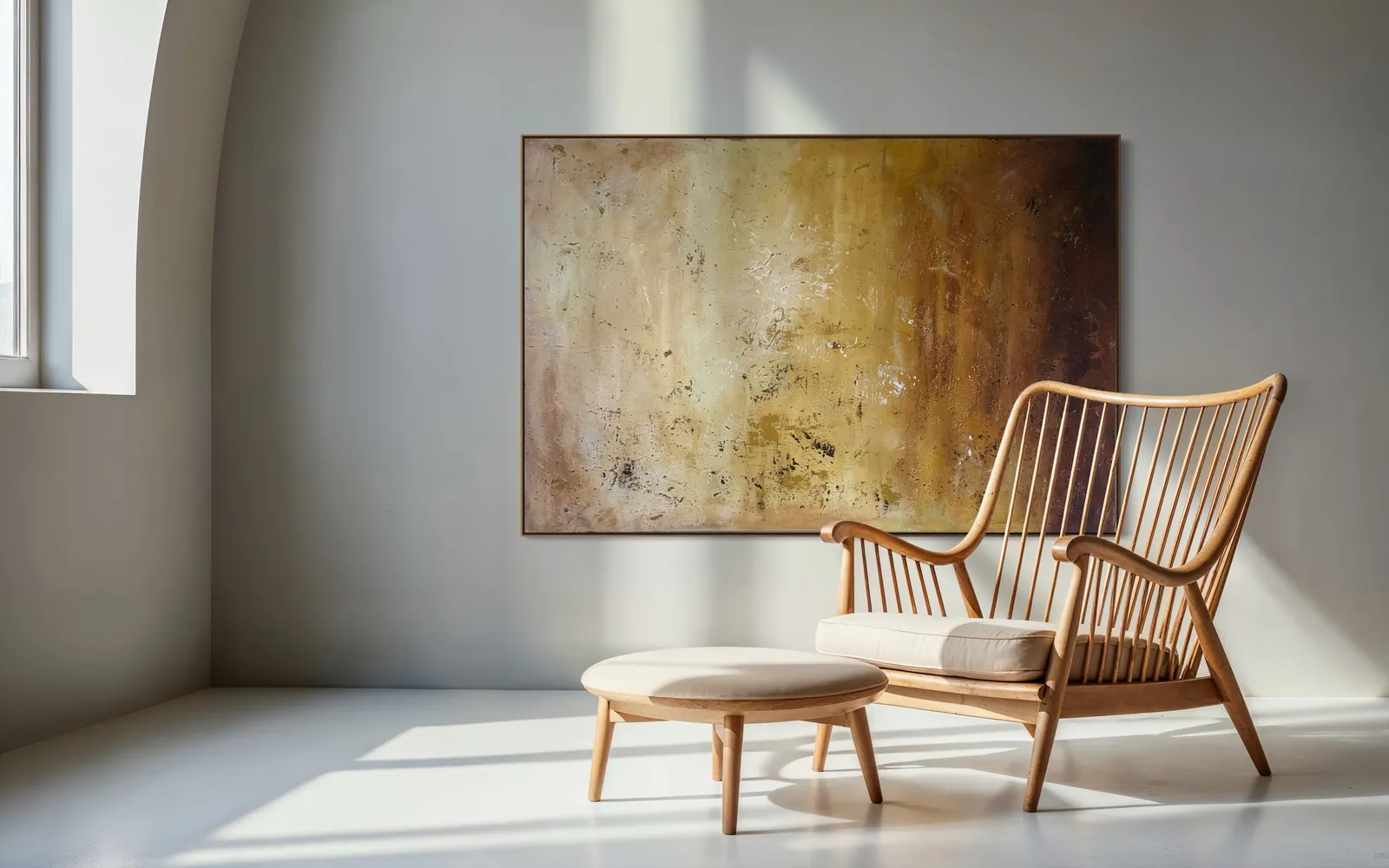
Amber Strata is a good example of a work built for that kind of reading. It is a horizontal field of ochre, bone and oxidized umber on canvas, 150 × 100 cm, from the Terra & Ether series, made in 2026. The horizontality asks for a long, calm wall, and the warm tones respond to wood and pale plaster. In a room like the one pictured, the painting does the work that a designed environment usually assigns to its focal wall.
Frequently asked
Is CASACOR a museum exhibition or a design fair?
Neither, strictly. Coverage describes it as a showcase of architecture, design and landscaping in which professionals sign complete environments that visitors walk through. It is closer to a temporary showhouse than to a trade fair stand or a museum gallery, although some editions also include areas for art installations and a dedicated art gallery, along with food and retail spaces.
Who designs the rooms at CASACOR?
Participating architects, designers and offices, each responsible for one environment. The press coverage read for this guide says participants answer a thematic challenge and that the cast mixes newcomers with offices from earlier editions. This guide deliberately does not name individual professionals, because the roster changes every season and the format matters more than any one name.
Does CASACOR only take place in São Paulo?
No. The sources read for this guide report editions in São Paulo and in Rio Grande do Sul, in Porto Alegre. They do not give a complete list of cities, so this page does not state how many editions exist. The reliable point is that it is a circuit of time-limited editions, with each city edition set in its own venue and following a theme shared across the brand.
Are CASACOR venues special buildings or places?
Reported examples include an urban park in São Paulo (whose trees are protected heritage) and a former airport passenger terminal in Porto Alegre. In São Paulo, eMóbile reports that the park's trees are protected heritage and that building in green areas is not allowed; in Porto Alegre, Onne says the master plan organizes circulation without erasing the character of the existing terminal. These are two examples, not a general rule.
Why would an art buyer care about a showhouse?
A showhouse shows art in context: on a real wall, against furniture, light and material, at the scale of a room. That is difficult to judge from a catalog image. It is a way to see how Brazilian designers currently pair interiors and art. It is not a market guide, and nothing here implies that any work shown there gains value.
Where can I find dates, venues and ticket information?
Not here. Seasons, venues and entry terms change every year, and this evergreen guide intentionally omits them so it does not go out of date. Consult the organizer's official channels for the current edition, and cross-check with recent coverage from Brazilian design and architecture outlets before planning a trip around it.
Planning a room around a painting?
Send a photo of the wall and the direction of the light. Alyne replies with details of the work. Original works are priced from roughly BRL 2,400 to BRL 8,800; any conversion to your currency is approximate.
Sources
- eMóbile — 2026-10-21
- Revista Onne & Only — 2026-10-21
- Perfeito Studio (src/data/obras.json) — 2026-10-21
Published on