Art exhibition loan agreement: what it covers, clause by clause
An art exhibition loan agreement is a contract between the lender and the borrower that sets the loan period and lists each work with its dimensions, value and credit line. It allocates insurance (in the standard NEMO template, on a nail-to-nail basis), packing, transport, condition reports, reproduction rights and termination. Each clause is explained below, with two real paintings as examples.

What an exhibition loan agreement covers, section by section
The Standard Loan Agreement for Temporary Exhibitions, a template published by NEMO (the Network of European Museum Organisations), splits the paperwork in two. The first three pages are a form to fill in; the next eleven are the loan conditions. The form asks for the lender and the borrower; the exhibition title, dates and tour venues; and the duration of the loan.
It then asks for the loan itself, one entry per work: artist and place of origin, title or description, date, material and technique, dimensions in centimetres (with or without frame), inventory number and credit line. Four further fields complete the form: insurance (the insurance value, and whether a state indemnity, the borrower or the lender covers it), costs (insurance premium, administration, framing or glazing, other), special requirements (packing, shipping, couriers, barriers) and the pick-up and return address, followed by contact persons and signatures.
The conditions that follow are numbered by topic, and most topics come in alternative wordings, labelled Version A, B and so on, so that the two parties choose the one that matches their arrangement. The headings are: general conditions, costs, liability, packing and transportation, couriers, care of objects and installation, security, reproductions and publicity, acknowledgements, sponsors, withdrawal and termination, immunity from seizure, and governing law and jurisdiction. The template states that it complies with the ICOM Code of Ethics.
A museum-specific example follows the same logic. The National Museum of Norway publishes general terms for its outgoing loans, grouped under insurance, transport, handling and mounting, care, return, and photography, rights and credit.


Insurance and liability: nail to nail, agreed value, who pays
Insurance is the clause where agreements differ most, and the NEMO template shows why it offers several versions. In Versions A and B the borrower's state or government indemnity covers the works; in C and D the borrower insures; in E and F the lender insures; in G the lender insures only the transit and no cover applies while the work is at the borrower's premises, so the borrower answers for repair and conservation costs of any damage.
Three terms recur in almost every version. Nail to nail is the template's basis of cover: all risks, including transit, for the whole loan, from the moment the work leaves the lender until it is back. The National Museum of Norway applies the same principle: its terms say cover runs from the time the works leave the museum. Agreed value is the figure the lender sets and the borrower accepts, listed on the agreement; in the template's Versions B and D it cannot be disputed if damage occurs. And the certificate, either of indemnity or of insurance, must be presented before transport procedures begin (to the lender where the borrower covers the work, to the borrower where the lender does), and the lender may withhold the work if the documents do not match the required cover.
On who pays, the template lists insurance, packing and transport among the costs the borrower bears, while Versions E, F and G have the lender take out the insurance and leave the premium to be entered in the costs field of the form. The National Museum of Norway makes the borrower responsible for insurance costs and asks for the insurance document at least three weeks before the transport date.
If something happens, the lender is notified immediately. In several versions the damage is recorded in a condition report with photographs, in Version B sent to the lender within three days. On total loss the agreed value is paid; for damage, the restoration cost and the loss in value are assessed by experts named by the lender and approved by the borrower. These are the template's own terms; a real agreement is settled between the parties, ideally with legal advice. This page is not legal advice.
Transport, handling, security and condition on arrival
The practical clauses read like a handling manual. Under packing and transportation, the template has the borrower bear the cost and liability of transport, with the choice of transport agent agreed between lender and borrower; the works are packed in protective materials and repacked the same way for the return. A stricter version asks for a carrier experienced with delicate objects, art handlers supervising removal and unpacking, protection against vibration and extremes of temperature and humidity, double drivers, and a vehicle never left unattended.
A separate clause covers couriers: a member of the lender's staff may accompany the work, with the borrower paying the courier's travel, per diems and hotel. Under care of objects, installation is done by qualified art handlers; the borrower may not change the condition of the work, move or re-hang it without the lender's permission except in an emergency, and may not unframe or clean it. The lender supplies a condition report that the borrower completes on arrival; if the lender cannot, the borrower prepares one when unpacking, and any change is reported without delay.
The security clause asks for guards, barriers, plinths or showcases, fire-safety compliance, and a ban on smoking, eating and drinking in the exhibition areas; the lender may inspect the work during the show and may ask for a facility report before signing. The National Museum of Norway adds environmental limits: no exposure to sunlight or strong light, and light, temperature and humidity kept within the limits specified for each work, with the lender told at once if they are exceeded.
What a condition report records, and who normally writes it, is covered in what a condition report is; transit cover for paintings is covered in what insurance covers a painting in international transit.
Credit line, reproductions, termination and seizure
The last group of clauses governs what happens around the work. On reproductions, the template says loaned objects may not be photographed, filmed or copied without the lender's prior written agreement. Version B allows lender-supplied images only in the exhibition catalogue and promotion material, requires credit to the title, artist, owner and photographer, and requires the borrower to obtain the copyrights. The press and the museum may photograph the work as part of the exhibition, and filming is supervised. The borrower sends the lender copies of publications and a stated number of catalogues.
On acknowledgements, the lender is credited in labels, notices, literature, publicity and catalogues, in the wording written into the agreement. The National Museum of Norway gives a model of the format: artist, title, copyright holder and photographer, then the lending museum. Hence the credit line field in the form, and why a checklist entry carries it; see the exhibition checklist, entry by entry.
Withdrawal and termination come in two forms. The lender may terminate with immediate effect if the borrower defaults, and either party may cancel the exhibition or end the agreement with 28 days' notice, with the lender bearing the costs of that termination in the template. The immunity-from-seizure clause has the lender confirm legal ownership and, in Version B, that no third-party claim is known; the final clause fixes the governing law and the arbitration body, to be filled in by the parties.
The record behind the form: two paintings as examples
A loan form is only as good as the record that fills its fields. Here is what the studio's site publishes for two paintings, so the fields of the form can be filled from a single source.
| Field of the form | Elemental Veins | Vibrant Awakening |
|---|---|---|
| Artist | Alyne Perfeito | Alyne Perfeito |
| Date | 2025 | 2025 |
| Series | Terra & Ether | Luminous Rebirth |
| Material and technique | Mixed media with acrylic and metallic fragments on canvas | Acrylic on canvas |
| Dimensions | 90 x 140 cm (35 x 55 in), width by height as the studio lists it; vertical | 100 x 150 cm (39 x 59 in), width by height as the studio lists it; vertical |
| Inventory number | Archive ID AP-TAE-2025-001 | Archive ID AP-LMR-2025-003 |
| Price set by the studio | R$ 6,400 | R$ 5,900 |
| Insurance value | Not a studio figure: agreed between the parties and the insurer | |
| Weight, framing, hanging hardware | Not published for the work: ask the studio | |
Every acquisition from the studio comes with a signed Certificate of Authenticity carrying the full technical record and the Archive ID, with a QR code linking to the work's official page. The studio does not set or quote secondary-market values, so the agreed value in an insurance clause is a figure for the owner, the venue and the insurer to settle. See Elemental Veins and Vibrant Awakening for the records themselves.
For exhibition proposals, the studio states that high-resolution images and the technical record of any work are sent on request. Alyne Perfeito is a Brazilian visual artist and trained architect based in Brasília; her current body of work was painted in 2025-2026. The studio publishes no loan agreement of its own. Where the works can be seen and how they travel is on the page for galleries and curators.
For whoever acquires a work
A painting acquired from the studio can later be lent by its owner, and the loan record is then built from what came with it. The acquisition includes the original, unique painting; a signed Certificate of Authenticity with the technical record and Archive ID; a fiscal invoice or official receipt; an Artwork Acquisition Agreement covering transfer of ownership, copyright and image use; an artist dossier; care guidance; and professional packaging. Each painting is also photographed in detail before it leaves the studio.
On scale, the dimensions above are the starting point for the wall and the crate alike: 90 cm wide and 140 cm high for Elemental Veins, 100 cm wide and 150 cm high for Vibrant Awakening. Ask the studio for the work's information before planning hanging or transport, since weight and hanging hardware are not published. The studio ships within Brazil and internationally; shipping is quoted per destination and paid by the buyer, with professional packaging included and transit insurance available (shipping).
From the studio
A note from the studio
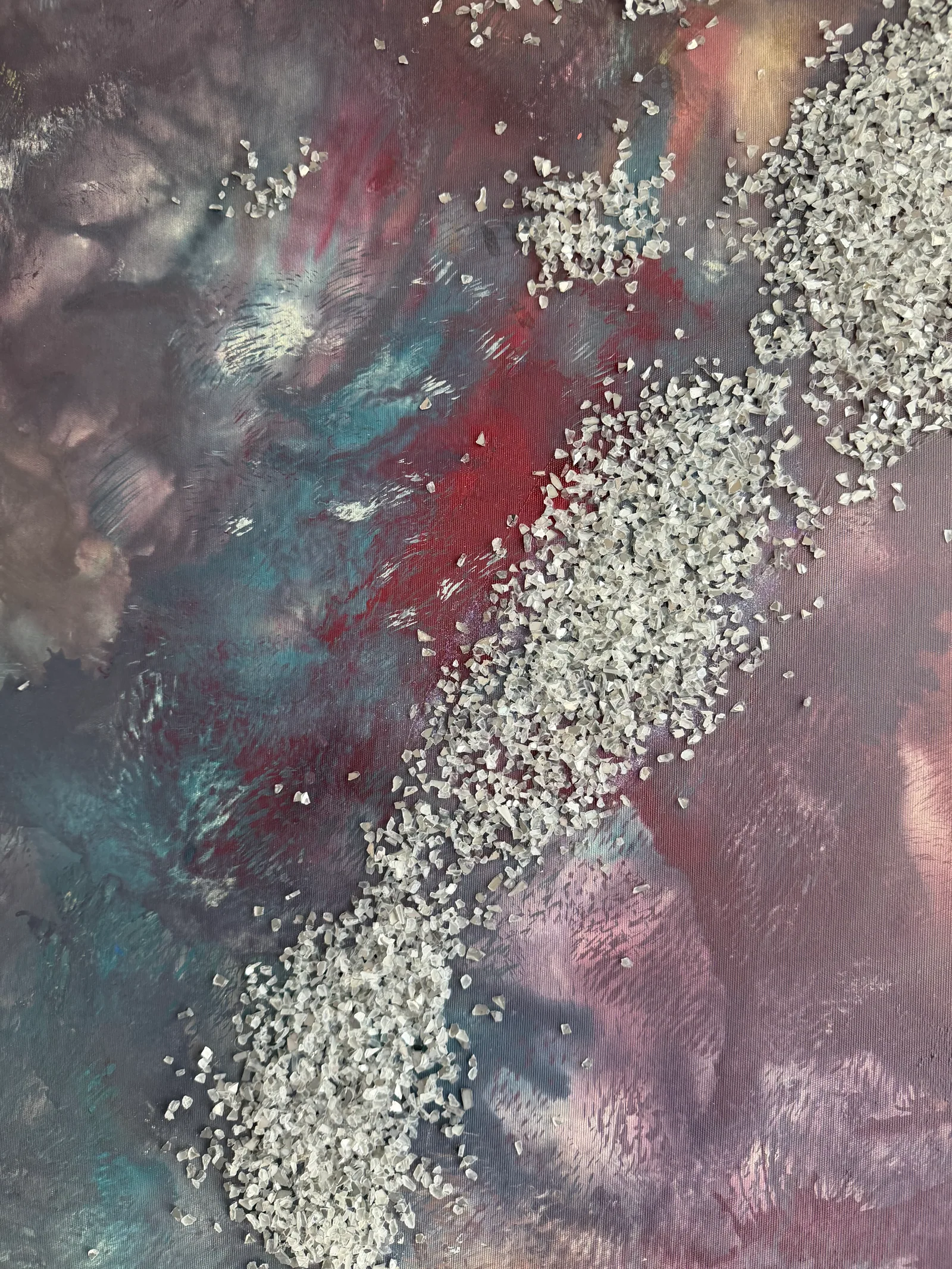
Alyne Perfeito trained as an architect, and the studio keeps one record per work: series, year, medium, dimensions, Archive ID, signature, a signed certificate with a QR code, and detail photographs. In Elemental Veins the detail image matters for a loan form: the pale metallic fragments sit proud of the layered acrylic ground and are hard to read in a full view, so a condition record of this surface is best made with close photographs. Ask for them together with the technical record.
Frequently asked
What does an art loan agreement for an exhibition include?
The parties, the exhibition title, dates and venues, the loan period, and one entry per work with artist, title, date, material, dimensions, inventory number and credit line. Then insurance, costs, special requirements and the return address, followed by conditions on liability, packing and transport, couriers, care and installation, security, reproductions, credit, termination, immunity from seizure and governing law. This follows the NEMO standard template; each institution adds its own terms.
Who pays for insurance and transport when a work is lent?
It is agreed in the contract. In the NEMO template the borrower bears the costs of the loan, including insurance, packing and transport, and the parties choose among versions in which a state indemnity, the borrower or the lender takes out the cover. The National Museum of Norway makes the borrower responsible for insurance and for ordering the transport. Read the costs field and the liability clause together.
What is nail-to-nail insurance?
It is cover against all risks from the moment the work leaves the lender until it is returned, covering transit, installation and display. The NEMO template and the National Museum of Norway both use the term; the National Museum states that cover runs from the time the works leave the museum. It typically carries standard exclusions such as wear and tear, inherent vice and war.
Can an artist lend a work directly, without a gallery?
The template's lender confirms legal ownership of the object, so what matters is who owns the work and whether the venue accepts that lender. Venues set their own policies. Perfeito Studio does not publish a loan agreement; for exhibition proposals it states that high-resolution images and the technical record of any work are sent on request.
What happens if a lent work is damaged?
The lender is notified immediately. Several versions of the NEMO template require the damage to be recorded in a condition report with photographs, in one version sent within three days. For total loss the agreed value is paid; for damage, restoration cost and loss in value are assessed by experts named by the lender and approved by the borrower. This is a template, not legal advice.
Ask for the record of a work
For exhibition proposals, the technical record, detail photographs and high-resolution images of a specific painting are sent on request, directly by the studio.
Sources
- Standard Loan Agreement for Temporary Exhibitions (NEMO standard loan agreement, as hosted by touring-artists.info) — 2026-10-30
- The National Museum of Norway — 2026-10-30
- Perfeito Studio — 2026-10-30
Published on