Art for a law firm: reception, client floors and partners' offices under one budget
Budget a law firm's art one wall at a time: a separate line for reception, the client floor and each partners' office, with freight and import duties listed apart. Settle in writing who chooses and whether the firm or a partner owns each work. In this guide's worked example, three originals total 14,300 reais.
One wall, one line: a worked budget for three zones
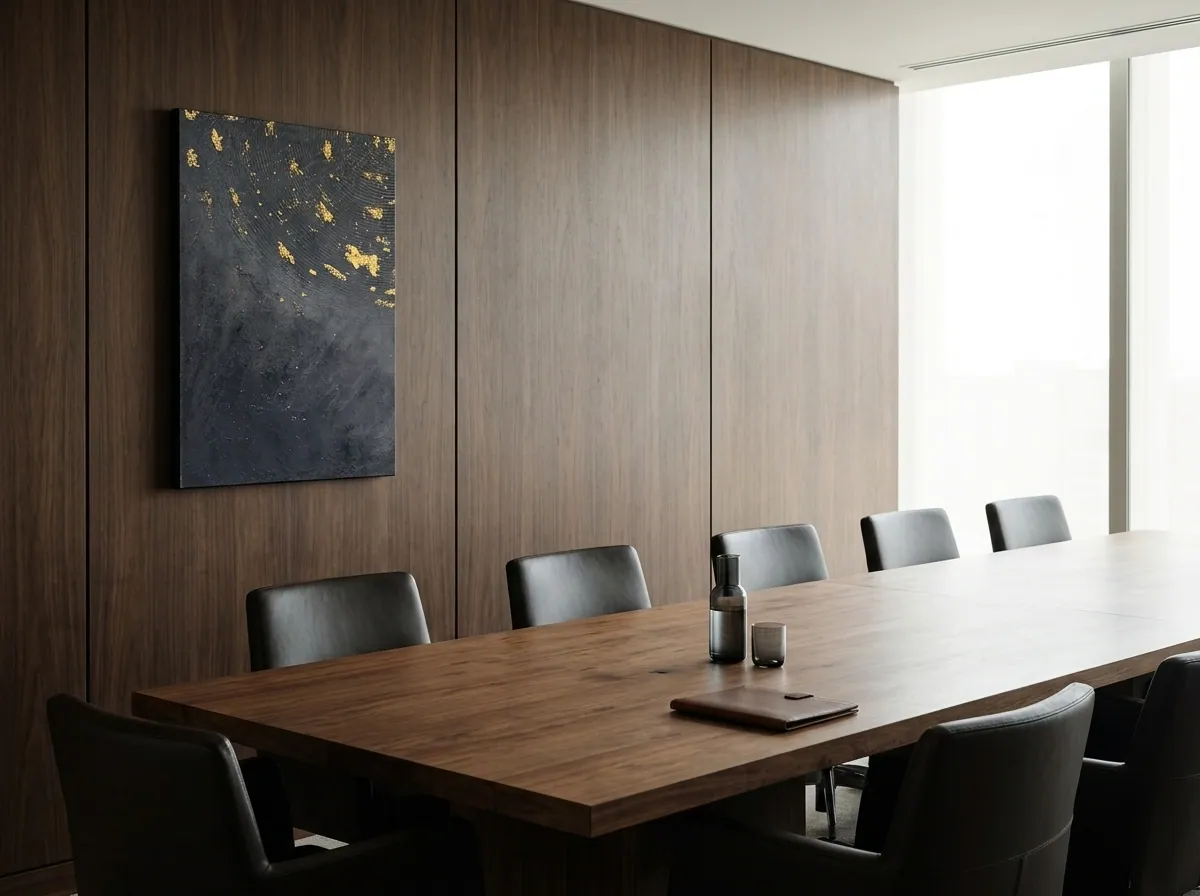
Celestial Plan (Black & Gold, 2025) is built on canvas with texture paste, which carries fine concentric ridges across a black ground, and fragments of imitation gold leaf (metallic leaf) that the studio seals with a spray sealant. It measures 50 x 70 cm (19.7 x 27.6 in) and is listed at R$ 2,700. In a law firm's budget it is one line, for one wall: a partner's office or a meeting room.
A firm that buys for the whole premises needs more than one line. The three works discussed on this page show how the lines add up, using the studio's listed prices in Brazilian reais:
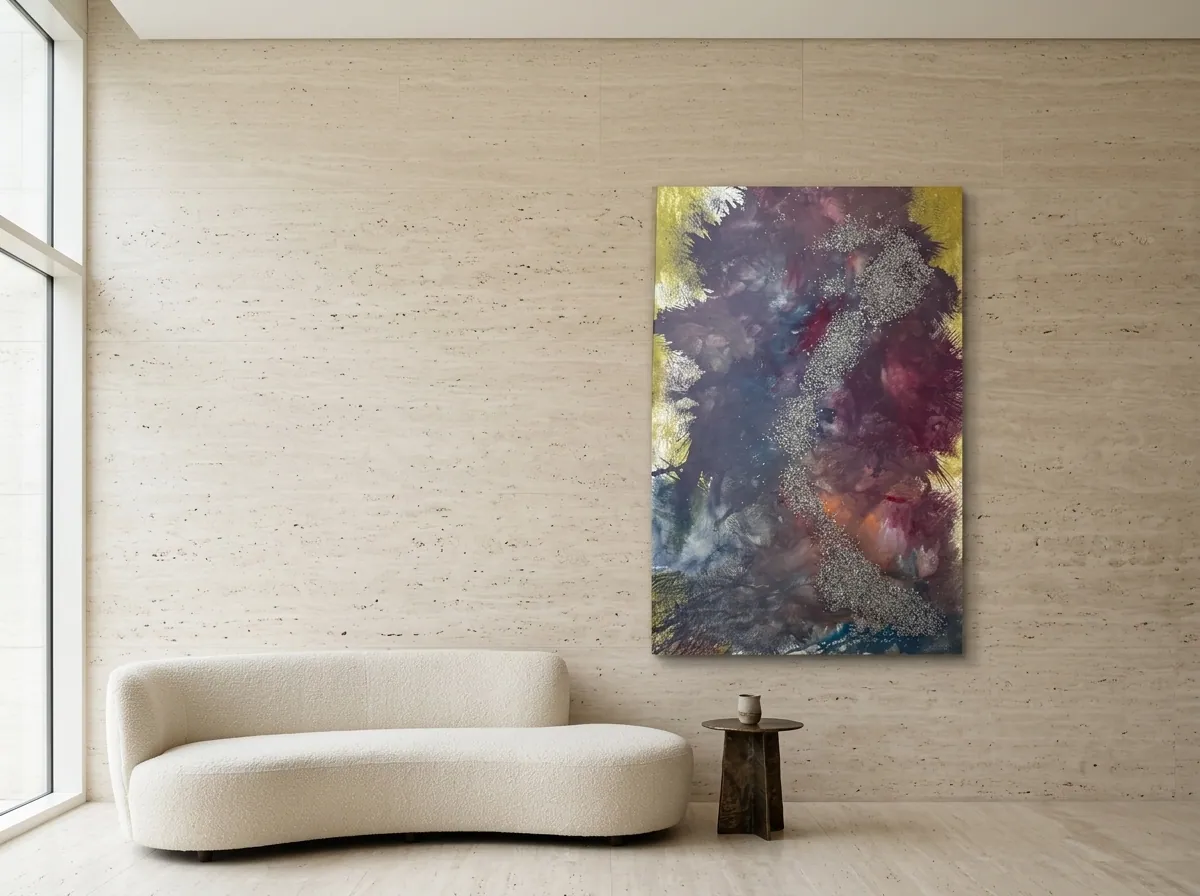
- Reception. Elemental Veins, Terra & Ether, 2025, AP-TAE-2025-001. Mixed media with acrylic and metallic fragments on canvas, 90 x 140 cm (35 x 55 in), vertical. R$ 6,400.
- Client floor. Amethyst Ground, Terra & Ether, 2026, AP-TAE-2026-005. Mixed media with acrylic on canvas, 100 x 100 cm (39.4 x 39.4 in), square. R$ 5,200.
- Partners' offices. Celestial Plan, Black & Gold, 2025, AP-BNG-2025-002. 50 x 70 cm. R$ 2,700.
Together that is 14,300 reais (2,700 + 6,400 + 5,200) for three unique paintings, before freight, any import duties and installation. No percentage split is offered here because none is sourced; the lines come from the catalogue, and a firm should replace these three with its own walls. The studio also sells smaller and larger works, listed on the gallery page.


Who decides: one name for the brief, the occupant for the office
The studio holds no data on how law firms reach decisions, and this page claims none. What follows is a practical suggestion, not a description of any firm's habit.
Because each painting is a single original with its own certificate, price and Archive ID, the three zones can be decided separately. One way to organise it: a single named person holds the brief and the total, so that reception, client floor and offices are priced against the same sheet; the partner who sits in a given office is consulted for that wall only. If a committee is used, the shared spaces, reception and client floor, are where it has the most to decide.
Each room also asks a different question. In reception, a visitor waits and looks, so the work is read from a seat or from the desk. On a client floor the work is read from a table, for the length of a meeting. In a partner's office it is read daily by one person and, in a room used for video calls, by whoever is on the other end of the camera; this journal's page on a boardroom and the video-conference camera covers that case. For palette, tone and the choice between originals and prints in a law office, see art for a law office; this page does not repeat it.
Whose work is it: the firm's or a partner's
The paperwork forces the question, so it is better asked before the order. Every acquisition from the studio includes a fiscal invoice or official receipt and an Artwork Acquisition Agreement that covers transfer of ownership, copyright and image use. The name on those documents is the name that matters. A firm that wants the works to be firm property should say so at the start and name the legal entity as buyer; a partner who wants a work for a private office should buy it in a personal name.
Which of the two suits a given firm is a matter for its accountant and counsel, not for the studio. The accounting side, including why a company can hold an original artwork as an asset rather than an expense, is covered in can a company own art as a corporate asset. The studio sets its prices in reais and does not set or quote secondary-market values, so it cannot supply a figure for a balance sheet beyond the invoice price.
Mergers, moves and partner exits: what the paperwork settles and what it does not
Whether a work stays with a firm after a merger, or leaves with a departing partner, is decided by the firm's own agreements and the law that applies to them. The studio makes no legal claim about it. What the studio's documents give a firm is a clean record per work, which makes a later decision easier to execute.
Each painting carries a signed Certificate of Authenticity with the technical record and the Archive ID. The certificate has a QR code that points to the work's official page on perfeitostudio.com, so provenance can be checked at any time by whoever holds the work. Together with the invoice and the Agreement, that is one folder per painting. A firm can list those folders on a schedule of its property, and assign a work to a person, or move it to another office, without reconstructing where it came from.
As a recommendation: write the rule in the partnership document before the first work is hung, and keep the folders where the firm keeps its other records, not in the office of the partner who chose the piece.
For whoever is acquiring: scale, light, distance, documents and shipping
Scale against the wall. Cut paper to the listed width and height of each work and tape it up. A 90 x 140 cm vertical needs a clear wall in a reception; a 100 x 100 cm square suits a wall between furniture; at 50 x 70 cm, Celestial Plan is the smallest of the three, and a long meeting-room wall may call for something wider.
Light. The catalogue text for Elemental Veins says its silvered fragments reflect light, and Celestial Plan carries metallic leaf. As a recommendation, look at the wall at the hours the room is used and from the seats where people sit, so that a window or a lamp does not land on the metallic areas.
Distance. Stand where a visitor first sees the wall, then sit where a client sits. Elemental Veins and Amethyst Ground both build their surface in layers of pigment, so check them from across the room and again close up.
Documents. Every acquisition is direct from the artist and includes the original, unique painting; a signed Certificate of Authenticity with the technical record and Archive ID; a fiscal invoice or official receipt; an Artwork Acquisition Agreement; an artist dossier; conservation and care guidance; and professional packaging. In Brazil, payment is by Pix with a 10% discount or by card in interest-free instalments; from outside Brazil, by international bank transfer in USD.
Shipping. The studio ships within Brazil and internationally; freight is quoted per destination and paid by the buyer, as are import duties. See shipping and international delivery. The studio does not publish the weight of the works: ask it for the information on a specific work before it goes into a schedule.

From the studio
From the studio: three zones are three viewing distances
I am an architect by training, so I read a firm's premises as a plan with three viewing distances. In reception the eye arrives from the door and the work is seen standing; that is the wall I would test Elemental Veins on, whose pigment, metallic dust and organic texture are laid in layers on a 90 x 140 cm canvas. On the client floor the work is seen seated and for longer, and Amethyst Ground, built in overlapping strata with small raised marks of deep red and black, is the work I would test there. In a partner's office the viewer is one person at close range, and Celestial Plan, at 50 x 70 cm, is the work I would test there: concentric ridges in texture paste and fragments of metallic leaf on black.
The scale of the wall, not the preference of the buyer, decides which of these suits which room. Send the studio the wall width and the ceiling height, and a photograph of where the light comes from.
Frequently asked
How should a law firm budget for art across several floors?
Price each wall as its own line instead of splitting a percentage by floor. Give reception, the client floor and each partners' office a line for the work, then add freight, any import duties and installation as separate lines. In this guide's example, three originals from Perfeito Studio cost 2,700, 6,400 and 5,200 reais, a combined 14,300 reais before those extras. No percentage rule is sourced here.
Who should choose the art at a law firm?
There is no sourced rule for law firms. A practical arrangement is one named person who holds the brief and the total, so every zone is priced on one sheet, with the partner who occupies an office consulted for that wall only. Shared spaces such as reception and client floors suit a small group. Each painting is a single original with its own documents, so zones can be decided separately.
Does the art belong to the firm or to a partner?
It belongs to whoever is named as buyer. Every acquisition includes a fiscal invoice or official receipt and an Artwork Acquisition Agreement covering transfer of ownership, so decide before ordering whether the legal entity or an individual buys. Which suits the firm is a question for its accountant and counsel. The studio does not give tax or legal advice.
What happens to the art when a partner leaves or the firm merges?
That depends on the firm's own agreements and applicable law, and the studio makes no legal claim. What the paperwork provides is one folder per painting: a signed Certificate of Authenticity with a QR code to the work's official page, the invoice and the Agreement. Writing the rule into the partnership document before hanging is a recommendation, not a requirement.
Can a law firm outside Brazil acquire these works?
Yes. The studio ships within Brazil and internationally. Freight is quoted per destination and paid by the buyer, as are any import duties or taxes in the destination country; professional packaging is included and transit insurance is available. International shipping is quoted on request, and buyers outside Brazil can pay by bank transfer in USD.
Planning art for the whole premises?
Send the studio the wall widths, the ceiling heights and where the light comes from, and ask about a specific work.
Sources
- Perfeito Studio — 2026-11-03
- Perfeito Studio — 2026-11-03
- Perfeito Studio — 2026-11-03
- Perfeito Studio — 2026-11-03
- Perfeito Studio — 2026-11-03
Published on