Art tear sheet: what goes on one for a gallery or an interior designer, with a filled example
An art tear sheet is a one-page presentation of a work: a large image, then title, artist, year, medium, dimensions and a reference number, with price and logistics added when the reader needs them. Designers use one page per item; galleries also use a thumbnail overview. The example below fills one for Quartz Seam (2026), 98 x 152 cm.

What a tear sheet is, and the two ways it is used
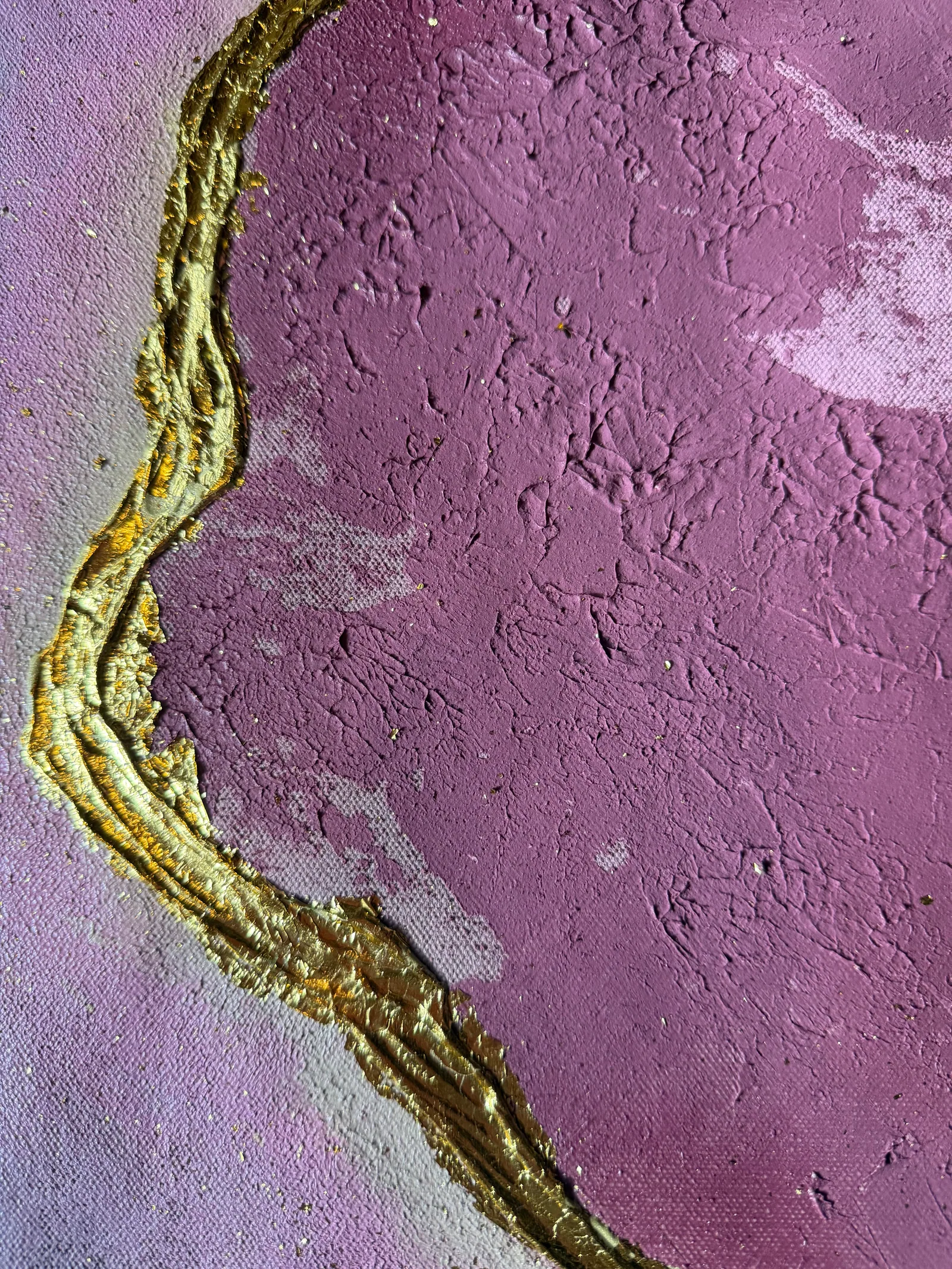
Quartz Seam opens as a field of dusty rose broken by thin seams of imitation gold leaf (metallic leaf), laid over pigment thick enough to carry its own relief. A page about it has two jobs: show the surface well enough to be believed, and give the reader the data to act on it.
The term is borrowed from publishing, where a tear sheet is a page cut from a publication as proof that something ran, and it has settled into two working senses. In interior design, Houzz describes a tear sheet as covering one item, with one large photograph and smaller text below it: brand and specifications, dimensions, materials and finish, lead time, and business branding, with price, vendor and SKU being the details some designers keep to internal versions. It separates this from a spec sheet, which lists several items. In the gallery trade, Artwork Archive describes a Tear Sheet report as an overview of available inventory with smaller thumbnails, aimed at galleries and dealers, that doubles as a quick price list.
So the difference the searcher is asking about is one of scale and purpose: the designer's page presents a single selection to a client, while the gallery's page surveys several works. Both pair an image with the same core data, which is what the rest of this page fills in.


A filled example: Quartz Seam
Every entry comes from the studio's record for the work. This page shows the fields; it is not a downloadable file.
| Field | Entry for Quartz Seam |
|---|---|
| Image | The work alone, plus one room view marked as a digital visualisation |
| Title, artist | Quartz Seam, Alyne Perfeito |
| Series, year | Terra & Ether, 2026 |
| Medium | Mixed media with acrylic and imitation gold leaf (metallic leaf) on canvas |
| Dimensions | Width 98 cm × height 152 cm (38.6 × 59.8 in) |
| Orientation | Vertical |
| Archive ID | AP-TAE-2026-007 |
| Price | R$ 6,700 (Brazilian real, set by the studio) |
| Documents | Signed Certificate of Authenticity with a QR code linking to the work's official page |
| Delivery | Domestic delivery up to 15 business days depending on destination; international shipping quoted on request |
| Weight, hanging system | Not stated in the work's record; ask the studio for the information on this work |
The last row is deliberate: a sheet should show an unknown as unknown. The work's own page, Quartz Seam, carries the same fields.
Price on the sheet or off it
Practitioner guidance splits on this. Houzz notes that price helps a client see how an item fits a budget, and that some designers leave the data out of client-facing sheets and keep it on internal ones. Artwork Archive treats the gallery tear sheet as a price list in its own right. Neither is a standard; it is a choice by whoever sends the page.
For the studio's works the price is a stated fact: Quartz Seam is R$ 6,700 and Amber Strata, the horizontal work at 150 x 100 cm wide by high, is R$ 6,700 as well, both in Brazilian real and set by the studio. The studio does not quote secondary-market values, so a sheet should not carry one. For commercial conditions with partners, the studio's page for architects says only that terms for repeat collaborations are available upon request.
The work alone or the work in a room
The designer's tear sheet is built around one large image, and a gallery's thumbnail overview around many, so the choice is practical: use the work alone for the record and a room view to show scale. A room image is useful only if it is honest about being one. The view below places Quartz Seam, 98 x 152 cm, above a long low sofa in a large sitting room; it is a digital visualisation, labelled as such, and it does not replace seeing the work.
The studio's page for architects states that custom previews of a work in the actual space are prepared when reference photography is provided, and that a per-project dossier and technical documentation can enter client decks. Detail photographs of a specific work are available on request, which suits a sheet that has to show the metallic leaf and relief up close.

For those acquiring: what the sheet points to
A tear sheet is a summary; the record behind it is what an acquisition delivers. Every acquisition is direct from the artist and includes the signed Certificate of Authenticity with the full technical record and the Archive ID, a fiscal invoice or official receipt, the Artwork Acquisition Agreement, an artist dossier, conservation and care guidance, and professional packaging.
On scale: a vertical of 98 x 152 cm, such as Quartz Seam, needs a wall that can hold one large field of colour, whereas Patina Field, a square of 100 x 100 cm at R$ 5,200, sits well in a narrower stretch. Shipping is quoted per destination and paid by the buyer; the terms are on the shipping page.
From the studio
The view from the studio
Alyne Perfeito is also a trained architect, and a presentation page for a client resembles a drawing sheet: one subject, a scale, the data a builder needs. Quartz Seam shows why the data line matters. It is a vertical, 98 cm wide and 152 cm high, with a medium that names imitation metallic leaf; on a thumbnail the seams read as gold, and only the medium line says what they are. A sheet that carries the Archive ID, AP-TAE-2026-007, ties the image to the same record the certificate carries.
Frequently asked
What is a tear sheet in the art world?
It is a one-page presentation of a work: an image with the key data. The term is borrowed from publishing, where a tear sheet is a page cut from a publication to prove that something ran. In galleries, Artwork Archive describes the Tear Sheet report as an overview of available inventory with thumbnails that doubles as a quick price list. In interior design it usually means one item per page.
What is the difference between a gallery tear sheet and a designer's product tear sheet?
Scale and purpose. Houzz describes the designer's tear sheet as covering one item with one large photograph, used to show a selection to a client, unlike a spec sheet that lists several items. The gallery version, per Artwork Archive, surveys available inventory with smaller thumbnails. Both pair an image with title, dimensions and other core data.
Should the price appear on a tear sheet?
It is a choice. Houzz says price helps a client judge fit with a budget, and some designers omit data from client-facing sheets and keep it on internal ones. Artwork Archive treats the gallery sheet as a price list. If the price appears, state the currency and who set it; the studio sets its prices in Brazilian real.
Which image should be used: the work alone or the work in a room?
Use both, for different jobs. The work alone is the record of colour and surface; a room view shows scale. A room view made digitally must be labelled as a digital visualisation. The studio also supplies detail photographs of a specific work on request, which suit a sheet that must show relief or metallic leaf.
Can a studio supply a tear sheet for a client presentation?
The studio states what it provides: per-work technical data and images on each work's page, detail photographs on request, and, for architects, previews in the actual space when reference photography is provided, plus a project dossier. It does not describe a ready-made tear sheet file, so ask about the format you need for a specific work.
Ask for the data of a specific work
Dimensions, Archive ID, detail photographs and room previews can be requested from the studio.
Sources
- Houzz Pro — 2026-10-29
- Artwork Archive Help — 2026-10-29
- Wikipedia — 2026-10-29
- Perfeito Studio (src/data/obras.json) — 2026-10-29
- Perfeito Studio (site.json, studio-facts.json) — 2026-10-29
Published on