Corporate art advisory: what the service covers, from the first brief to the collection policy
Corporate art advisory is the work of planning, sourcing, installing and managing artwork for a company's premises. It usually runs from a written brief and budget, through selection and purchase, to installation, records and a collection policy. This guide takes each stage in turn and shows what one documented painting, Golden Passage, adds to the record.
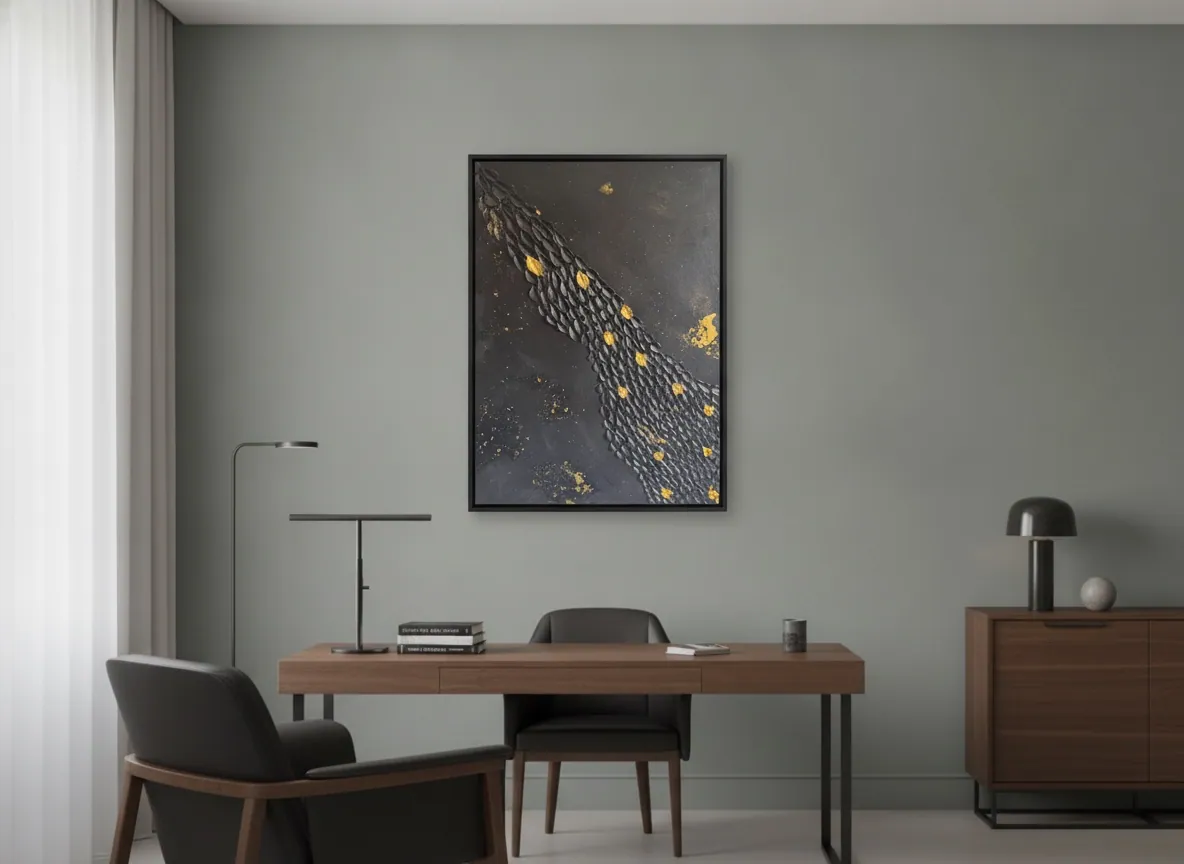
From first brief to installed work: the stages of a corporate art advisory
Golden Passage (2025) is built from black texture paste worked into overlapping ridges, with fragments of imitation gold leaf (metallic leaf) set into the surface of a 60 x 80 cm canvas. A company meets an object like that at the end of a longer process, and that process is what an advisory service covers.
Firms that publish their scope describe broadly the same sequence: planning, sourcing, curating, installing and managing artwork for commercial environments, with strategy and budget at the start and collection management and rotation afterwards. Some advisory services build art programmes around the architectural environment, brand values and workplace culture of the client; others handle acquisition and art management for offices, law firms or airports. Scope differs from firm to firm, so before signing it is reasonable to ask what the project management includes, who oversees installation, and what is priced separately.
| Stage | What it settles | What one documented original contributes |
|---|---|---|
| Brief | The building, the brand and the workplace the art has to answer | Scale in cm and inches, series and palette, from the work's record |
| Budget and strategy | A single work or a programme across floors, and the money behind it | A price in Brazilian real (BRL), set by the studio |
| Sourcing and selection | Which works are shortlisted, and from which kind of seller | Detail photographs and the technical record, on request |
| Acquisition and due diligence | Authorship, provenance and the terms of transfer | Signed certificate, invoice or receipt, acquisition agreement |
| Installation | Hanging height, lighting, circulation around the work | Installation guidance on request, coordinated with the project team |
| Collection management | Register, valuation and condition cycle, rotation | An Archive ID for the register, care guidance |


Who pays the advisor, and what one association's code rules out
The Association of Professional Art Advisors (APAA) publishes a code of ethics that works as a practical checklist for any company hiring help. Its members may not keep inventory for sale, accept artwork on consignment or act as private dealers in a transaction. They may not accept compensation that creates a conflict of interest with the client, and they do not solicit or accept compensation from service providers or vendors. Its membership criteria add that a member is paid by the client and by only one source per transaction, and is transparent with clients about how the advisor is compensated.
Two consequences follow for a corporate buyer. First, ask any advisor how they are paid and whether any part of the proposal is paid by a seller; getting the answer in writing before the first shortlist is a sensible step. Second, an artist selling directly occupies a different role: the seller, not the advisor. Perfeito Studio sets its own prices, stated in Brazilian real, and does not set or quote secondary-market values. APAA membership is by invitation and is one reference among several, not a precondition for competent advice; its value here is the questions it puts. The fee models themselves are covered in what an art advisor does, and the code in what the APAA code of ethics forbids an art advisor to do.
The collection policy: the one page that outlasts the project
A collection policy is the short document that tells whoever buys next what the collection is for and how decisions are made. Public collections publish theirs, which makes them useful models; one corporate collection described its process in a 2018 interview, so current practice may differ. Read together, they converge on the same headings. The municipal examples below are public-sector collections, not corporate ones, and are cited for their structure.
- Purpose and scope. Devonport Regional Gallery's policy aims for a cohesive, focused collection and an open, accountable system of acquiring and deaccessioning works.
- Acquisition criteria. The City of Stirling's policy asks whether a work builds on the collection's strengths or fills a gap, avoids duplicating artists already held, and meets high technical standards.
- Budget and approval. In a 2018 interview published by The Artling, the UBS Art Collection's regional manager for Asia-Pacific described an acquisitions budget, proposals tied to the acquisitions strategy set in each region, and approval of major works by an Art Board.
- Where works come from. The same interview says the collection bought through the primary market, that is through galleries, to support artists' careers, and looked at the scope of an artist's body of work, their exhibition history and the dialogue with works already held.
- Condition and records. Stirling keeps a register that is regularly updated and performs valuation and condition assessments; Devonport requires a work's condition to be assessed as fair and stable before acquisition.
- Emerging artists. Devonport's criterion is, for emerging artists, the realistic potential of a long-term career in the visual arts. A criterion such as exhibition history leaves out artists at the start of a practice. That can be a legitimate choice, but it belongs in the policy rather than in each decision. For reference, Perfeito Studio documents a first body of work painted in 2025 and 2026 and claims no exhibition record.

What one documented work adds to a company's records
A register entry needs the same few fields for every work. The studio's catalogue record for each painting carries them, so an entry can be built without a phone call. The three works shown on this page, as recorded:
| Field | Golden Passage | Silent Interval | Celestial Plan |
|---|---|---|---|
| Series | Black & Gold | Matter & Silence | Black & Gold |
| Year | 2025 | 2026 | 2025 |
| Medium | Mixed media, texture paste, and imitation gold leaf (metallic leaf) on canvas | Mixed media with acrylic on canvas | Mixed media, texture paste, and imitation gold leaf (metallic leaf) on canvas |
| Dimensions | 60 x 80 cm (23.6 x 31.5 in) | 120 x 160 cm (47.2 x 63 in) | 50 x 70 cm (19.7 x 27.6 in) |
| Archive ID | AP-BNG-2025-001 | AP-MAS-2026-003 | AP-BNG-2025-002 |
| Price (BRL) | R$ 3,500 | R$ 7,900 | R$ 2,700 |
The Archive ID is the register key: it appears on the signed certificate, which also carries the title, series, year of completion, medium and materials, dimensions, a studio image of the work, the artist's signature, studio identification, care guidance and a QR code linking to the work's official page (see what the certificate contains). The metallic leaf on the works that carry it is sealed with a spray sealant. Weight, frame and hanging hardware are not published in these records; ask the studio what it can supply for a specific work and add the answer to the entry.
How a company classifies art on its books is a separate question, treated in can a company own art as a corporate asset.

For those acquiring: scale, light, documents and shipping
Scale. Measure the free width and height of the wall, and the furniture beneath it, before choosing. In the two office visualisations on this page, Silent Interval (120 x 160 cm) takes up most of the wall above a desk, while Celestial Plan (50 x 70 cm) reads as a single point on a wide wall above a sideboard. They answer different rooms. Dimensions are given in centimetres and inches on each work's page.
Light and hanging. Both depend on the room. The studio says it coordinates hanging height, lighting angle and conservation guidance with the project team, and offers installation guidance, including ideal hanging height and lighting, on request. For size, height and light on office walls in general, see abstract painting for a corporate office.
Documents. Every acquisition is direct from the artist and includes the original, unique painting; a signed Certificate of Authenticity with the full technical record and the Archive ID; a fiscal invoice or official receipt; an Artwork Acquisition Agreement covering transfer of ownership, copyright and image use; an artist dossier with biography, series context and technical record; conservation and care guidance; and professional packaging. There are no editions or reproductions.
Seeing the work. Part of the collection is on view at INTI, in Lago Sul, Brasília, by appointment arranged over WhatsApp. INTI is a working clinic, so visits are scheduled rather than walk-in. Detail photographs and video of a specific work are sent on request.
Shipping. The studio ships within Brazil and internationally. Shipping is quoted per destination and paid by the buyer, as are any import duties or taxes in the destination country. Professional packaging is included and transit insurance is available. Domestic delivery takes up to 15 business days depending on destination; international shipping is quoted on request. Details are on the shipping page, and available works are on the gallery page.
From the studio
The view from the studio
I trained as an architect, and I read a wall before I read a painting: its width, the furniture under it, how far someone will stand from it. Golden Passage, at 60 x 80 cm, reads close up, in small passages where metallic leaf sits among black ridges of texture paste. Silent Interval, at 120 x 160 cm, is the opposite scale: one dark gesture on a scored, bone-white ground that carries across a room. A company choosing between them is choosing a viewing distance before it chooses a subject.
The studio is a seller, not an independent advisor. What it offers is what its architects page describes: proposing works for a space from a plan, reference images and lighting context, and sending the technical record of a work on request.
Frequently asked
What does a corporate art advisor do?
An advisor plans, sources, curates, installs and manages artwork for commercial premises. In practice that means a brief based on the building, brand and workplace; a budget and strategy; selection and acquisition with checks on provenance; installation; and continuing collection management such as records and rotation. Scope differs between firms, so ask what is included and what is priced separately.
How is corporate art advisory paid?
The fee model is agreed with the advisor and should be written down. The APAA, an association of independent advisors, requires members to be compensated by their clients, paid by only one source per transaction, and transparent about how they are compensated. Its members also may not accept compensation from vendors or service providers. The studio's guide to what an art advisor does covers the fee models.
What is a corporate collection policy?
A short document that states what a collection is for and how it is run: purpose and scope, acquisition criteria, budget and who approves purchases, where works may come from, how condition and records are kept, and how emerging artists are treated. Published public-collection policies, such as those of the City of Stirling and Devonport Regional Gallery, show the usual headings.
Do corporate collections buy from emerging artists?
Some do, and the policy decides. In a 2018 interview, the UBS Art Collection's Asia-Pacific manager described buying through galleries to support artists' careers while weighing body of work, exhibition history and fit with the collection. Devonport Regional Gallery's public policy states a criterion for emerging artists: realistic potential for a long-term career. A criterion that requires exhibition history excludes artists at the start of a practice, so it should be stated openly.
How is a corporate artwork documented for the company's records?
With one register entry per work: title, artist, series, year, medium as declared, dimensions in centimetres and inches, a unique ID and the price paid, plus the documents that travel with it. For Perfeito Studio works these are a signed Certificate of Authenticity with the Archive ID, an invoice or receipt, an acquisition agreement, an artist dossier and care guidance. Accounting classification is a separate question.
Request the technical record for a work
Tell the studio which work and which wall, or send a plan and photographs of the space; the studio shares the documentation once availability is confirmed, and shipping is quoted for your destination.
Sources
- Turning Art — 2026-10-26
- Melbye Konan — 2026-10-26
- Numark Art Advisory — 2026-10-26
- Association of Professional Art Advisors (APAA) — 2026-10-26
- The Artling (interview of 25 March 2018 with the UBS Art Collection regional manager APAC) — 2026-10-26
- City of Stirling (Western Australia) — 2026-10-26
- Devonport City Council (Tasmania) — 2026-10-26
- Perfeito Studio, catalogue record (src/data/obras.json) — 2026-10-26
- Perfeito Studio — 2026-10-26
- Perfeito Studio (src/data/studio-facts.json) — 2026-10-26
- Perfeito Studio — 2026-10-26
Published on