How high to hang a painting: the standard height guide
Hang the center of the painting at 57 to 60 inches (about 145 to 152 cm) from the floor, the standard hanging guides give for average standing eye level. Measure to the middle of the canvas, not the top. Above a sofa or console, leave 6 to 12 inches (15 to 30 cm) between furniture and the bottom edge.
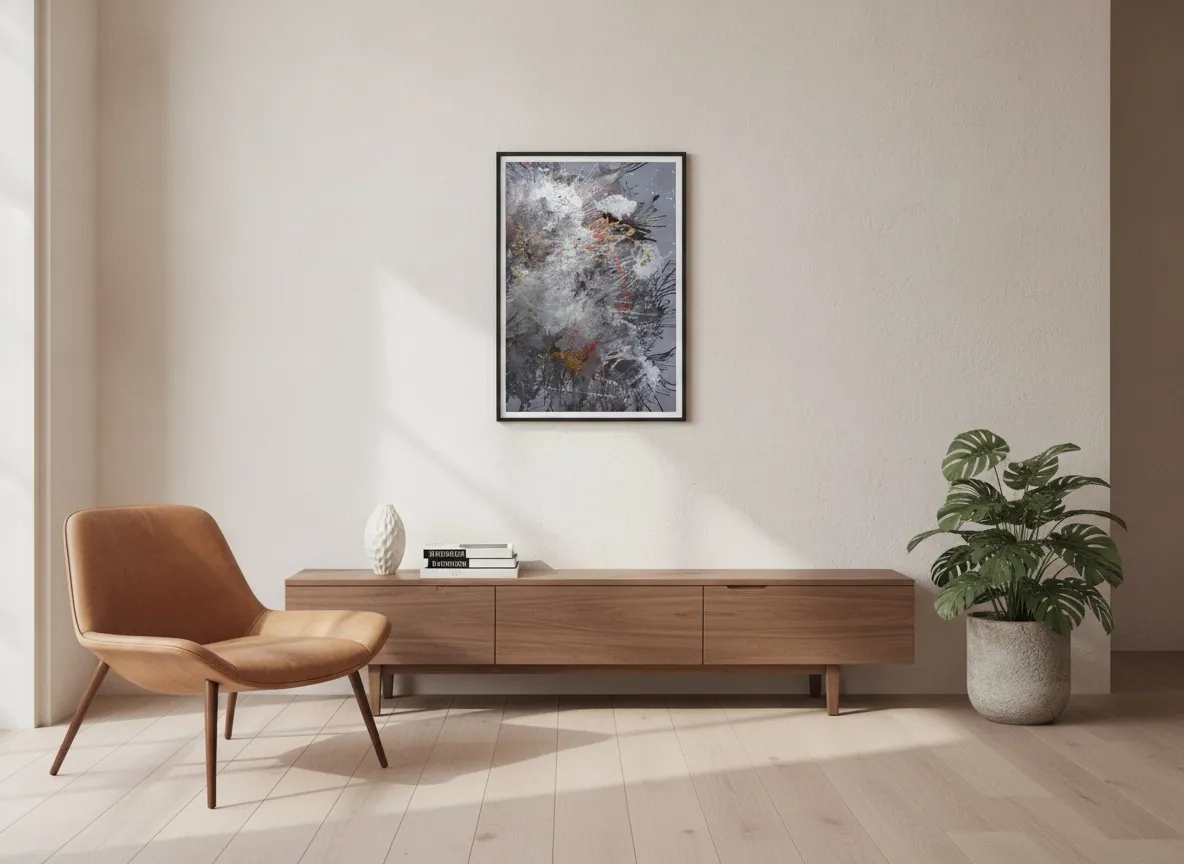
The standard: center at 57 to 60 inches
Most museums follow a centerline of 57 to 60 inches (about 145 to 152 cm) above the floor, which approximates the eye level of an average standing adult [1]. A US framing company gives the same figure for the home: the vertical center, the mid-point between the top and bottom of the frame, at about 57 inches [2].
The rule is about the center, not the top edge and not the hanging hook. A tall canvas and a small one share the same center line; only their edges differ. That is what keeps pieces of different sizes looking related when they share a wall.
How to turn the center into a mark on the wall
Take the center height you want and add half the height of the painting to find the top edge: for a center of 57 inches and a 16-inch frame, the top lands at 65 inches [3]. Subtract half the height to find the bottom edge.
In centimeters, with a painting 80 cm tall and a center at 145 cm, the top edge sits at 185 cm and the bottom at 105 cm. The hook is a separate step: it sits below the top edge by however far the wire or hanger pulls down on the back of the canvas, so measure that distance on the back before you mark the wall. Tape a paper template to the wall first, step back, and only then drill.
When to hang higher or lower
- Seated rooms (living room, bedroom). One framing guide suggests starting at the lower end of its 57 to 62 inch range where people are mostly seated, and a higher height for standing spaces such as kitchens and hallways [4].
- Hallways. Framebridge recommends 60 to 66 inches for hallways, since you pass through them standing and moving [2].
- Above furniture. Furniture becomes the reference. Sources give 6 to 12 inches (about 15 to 30 cm) between the top of a sofa, console or mantel and the bottom of the frame [5] [4], with 7 to 10 inches suggested by one guide [2]. One guide suggests starting at 8 inches and adjusting to the room [4].
- Tall ceilings. Sources disagree here. One says keep the same 57-inch center even in a high room, so you never crane your neck [2]; another allows a center of 60 inches or more with ceilings of 10 to 12 feet [3]. Even then the sources stay close to the standard range; none recommends raising the center far above it. In my experience a very tall wall is better answered with a larger painting than a higher one.
Common mistakes
Hanging too high is a frequent problem in practice. The convention pulls the center back toward the viewer's eye level rather than toward the ceiling. A second mistake is measuring from the floor to the top of the frame and forgetting that the center, not the top, is the reference. The third is ignoring the furniture: a painting hung well above a console reads as floating. When furniture and eye level disagree, let the furniture decide the bottom edge, and choose a taller painting if the gap above still feels empty.
From the studio
From the atelier
I trained as an architect before I painted, so I read a wall as a set of measurements first: floor, furniture line, eye line, ceiling. Take Origin of Light, from the Heart of Chaos series, 60 x 80 cm. Centered at 145 cm it occupies the band from 105 to 185 cm, which is the whole point of the convention: the canvas sits where a standing viewer meets it without lifting or lowering the eyes. A larger piece in the same series, such as Genesis of Flame at 120 x 200 cm, cannot share that arithmetic in the same way. Its center at the same height puts the bottom edge at 45 cm, so the room around it has to be planned with the painting, not after it.
Frequently asked
What is the standard height to hang a painting?
The center of the painting goes at 57 to 60 inches, roughly 145 to 152 cm, from the floor. That range approximates the eye level of an average standing adult and most museums follow a centerline in that range. Always measure to the middle of the canvas, not to its top edge or its hanging hook, so pieces of different sizes line up visually.
How high above a console or sofa should a painting hang?
Leave about 6 to 12 inches, roughly 15 to 30 cm, between the top of the furniture and the bottom of the painting. Published guides give figures such as 6 to 8, 7 to 10 and 6 to 12 inches. At the lower end the painting reads as part of the furniture group; much higher and it starts to float.
Should paintings be lower in a dining room?
Slightly, if at all. One framing guide suggests the lower end of its 57 to 62 inch range for seated spaces such as living areas and bedrooms, and a higher center for standing spaces such as kitchens and hallways. A dining room is a seated room, so staying near 57 inches is reasonable. Stay inside the range and choose by where people actually sit.
How high should a painting hang with a tall ceiling?
Sources split. One says keep the standard 57-inch center even in a high room; another allows 60 inches or more with 10 to 12 foot ceilings. Neither source recommends raising the center far above the standard range. If the wall feels empty, consider a larger painting or a second piece rather than moving the work up.
Do you measure from the center or the bottom of the painting?
Measure from the center. Add half the painting's height to the center height to find the top edge, and subtract half to find the bottom. Then measure how far the wire or hanger sits below the top edge on the back of the canvas, since that decides where the hook goes. Tape a paper template to the wall before drilling.
See how a specific painting sits on your wall
Send the wall height, the furniture below it and the painting that interests you, and we will work out the center and edges together.
Sources
- Fine Art Shippers — 2026-09-30
- Framebridge — 2026-09-30
- Hunker — 2026-09-30
- Tribeca Printworks — 2026-09-30
- Chairish — 2026-09-30
Published on