How much space to leave between paintings on a wall
Leave about 2 to 3 inches (5 to 8 cm) between frames and keep that gap identical at every edge. Tighter than that feels cluttered; wider and the works read as separate objects. A single large painting is the exception: it needs bare wall around it, not a neighbour close by.
The short answer: 2 to 3 inches, and the same everywhere
A common figure in framing guidance is a gap of 2 to 3 inches (about 5 to 8 cm) between frames. Framebridge, a US framing company, says to space frames 2 to 3 inches apart and keep the spacing consistent between each frame [1]. Frameology, another framer, gives 2.5 inches as a default and describes the trade-off plainly: tighter spacing makes a wall feel cluttered, wider spacing makes the frames read as separate objects instead of one display [2].
Notice what Framebridge stresses alongside the number: consistency. Two paintings hung 6 cm apart on one side of a group and 9 cm on the other look like a mistake at once, whereas a slightly generous gap that is identical everywhere looks chosen. The same logic applies whether the group is two works or ten, and whether you are choosing a hook position or a spot on a long wall. For the wider question of layouts with many pieces, see our guide to hanging a gallery wall; this page stays with the gap itself, and with the cases where the answer changes.
Two paintings side by side: working out the hook positions
With two works, the gap becomes arithmetic. MontCarta, a wall-art retailer, gives a formula for multi-panel sets that also works as arithmetic for two separate works, each hung from a single central hook: the distance between hooks equals half the width of the first work, plus the gap, plus half the width of the second [3]. Measure from the centre of each work's hanging point, and check where the hanging hardware actually sits on the back before you mark the wall.
As a worked example only (the collection is made of one-of-a-kind originals, so this is sizing arithmetic, not a pairing suggestion): Crossing Currents and Vegetal Dawn are both 80 × 120 cm. With an 8 cm gap, the hooks sit 40 + 8 + 40 = 88 cm apart, and the pair is 80 + 8 + 80 = 168 cm wide in total. That outer width of 168 cm, not the width of either canvas, is the figure to centre on the wall, on a console, or on a sofa; our guide to sizing art above a sofa covers that last case.
Measure the visible gap between the edges of the frames or canvases rather than between the outer faces of thick mouldings, since frame depth varies and Frameology makes the same point about measuring the gap you actually see [2].
Does the gap change with size and with the number of pieces?
A little, and the sources do not agree to the centimetre. Frameology narrows the range as groups grow: 2 to 2.5 inches for a four-frame grid, 2.5 to 3 inches for clusters of five or six, and about 2.5 inches above a sofa [2]. For canvases sold as multi-panel sets, MontCarta gives a tighter 1 to 2 inches (roughly 2.5 to 5 cm), allowing up to 3 inches for very large sets, and warns that wider gaps risk making the artwork look disconnected [3].
Read together, these are not contradictions so much as a window: roughly 2.5 to 8 cm, tighter when the pieces are meant to read as one image, a little looser when they are independent works that should keep their own identity. A fixed number is a starting point; the test on the wall decides.
One further point from Framebridge concerns grids: try to avoid four corners meeting at a single spot, and spread out the biggest or boldest pieces instead of stacking them together [1].
The exception: a single large painting needs air, not a neighbour
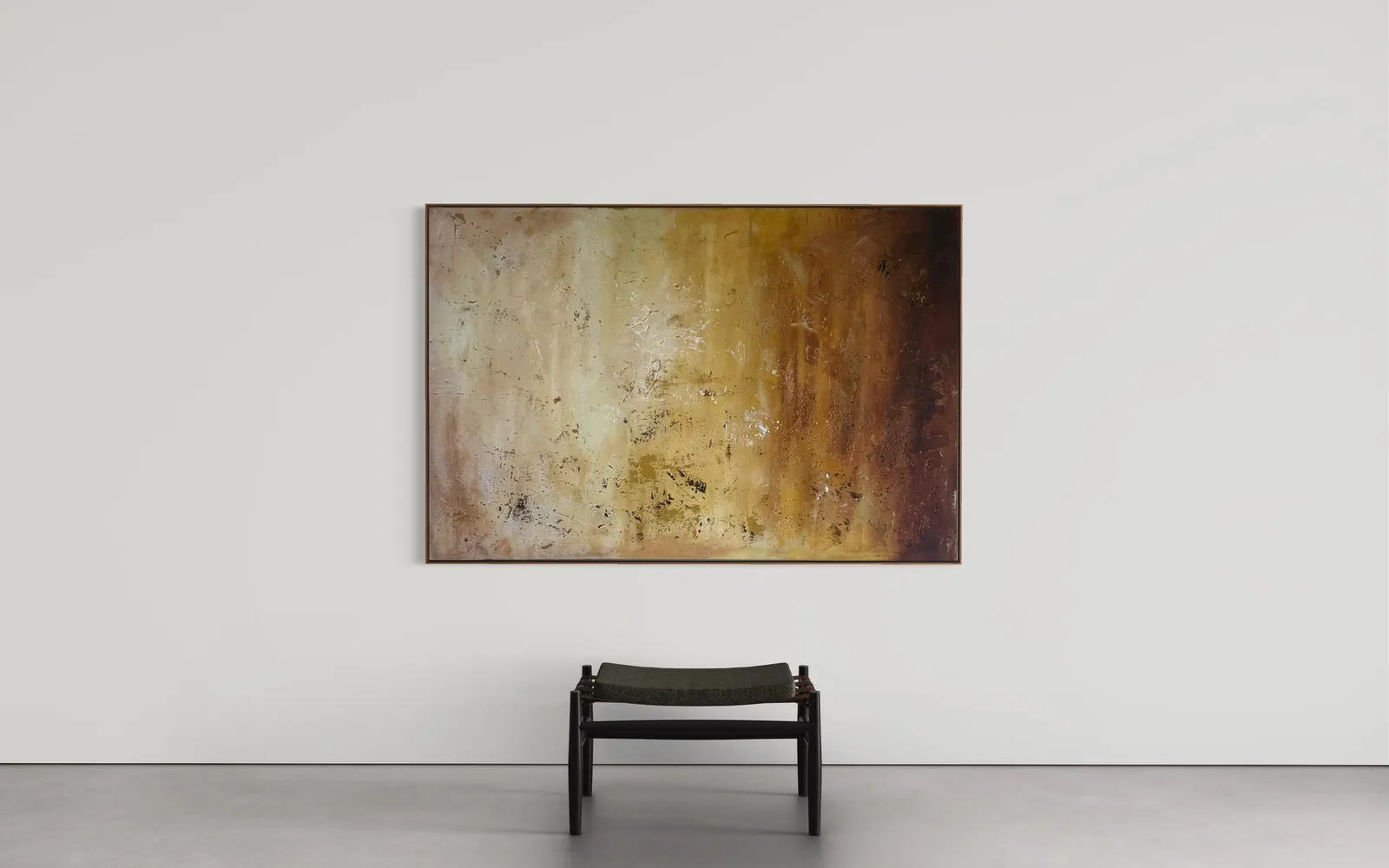
Everything above is about pieces that belong together. A large painting hung alone follows the opposite logic. One design guide recommends at least 6 to 12 inches (about 15 to 30 cm) of bare wall around the frame, in practice about a foot on either side, and treats a substantial canvas as the single anchor of its wall, so that adding sconces, small photographs or shelving beside it makes the wall look cramped [4]. The same guide suggests a gap of 6 to 10 inches (15 to 25 cm) between the bottom of the frame and the furniture below [4].
So the question to ask first is not "how far apart?" but "is this a group or a soloist?". A group wants a tight, even gap. A soloist wants margin. The mistake is applying the first rule to the second situation, pushing a second piece close to a large work to fill the wall. If the wall is wide enough for a second piece, hang it far enough away that it reads as a separate event, or choose a different wall.
Test the spacing before you drill
Cut sheets of paper to the exact size of each work, tape them to the wall with painter's tape at the planned gap, and leave them up for a day. Step back, walk past them, view them from the sofa. A gap that looks right in a plan often looks different at full scale. The adjustment costs nothing at this stage and leaves a hole in the wall afterwards. Our Portuguese guide takes a different angle for two independent paintings, working the gap as a share of the narrower frame's width, which gives a somewhat wider range: quanto espaço deixar entre dois quadros (PT).
From the studio
From the atelier
A painting as wide as Amber Strata (150 × 100 cm, Terra & Ether, 2026) is a useful test of the rule. An 8 cm gap beside a 150 cm canvas is roughly 5 percent of its width: on paper a generous number, on the wall a thin line. Alyne trained as an architect, and architects' drawings work in proportions rather than fixed distances. A useful habit to borrow: measure the gap against the width of the smaller piece, decide whether the two works should read as one conversation or two separate statements, and then hold that number steady.
For a work of this scale the simplest reading is often the best one: one canvas, wide margins, nothing competing with it. The spacing question only begins when a second piece is added, and it is worth asking whether it is needed.
Frequently asked
How far apart should paintings hang?
Framing guidance points to about 2 to 3 inches, or 5 to 8 cm, between frames, kept the same at every edge. Sets of canvas panels are often hung a little tighter, around 1 to 2 inches. The exact figure matters less than consistency: pick one gap, measure it from the visible edges, and repeat it throughout the group.
Should the gap be the same vertically and horizontally?
The guides cited here ask for consistent spacing between each frame and do not set separate rules for rows and columns. The simplest approach is to use one gap for both directions, so the group reads as a single composition. Measure it the same way each time, from visible edge to visible edge.
How much space should I leave for a pair on a wide wall?
Treat the pair as one block. Add the two widths and the gap to get the outer width, and centre that block on the wall or on the furniture below it. Keep the gap consistent between the two works. If the pair shares the wall with nothing else, leave generous bare wall on both sides rather than filling it.
Does the number of pieces or frame thickness change the spacing?
Only a little, and the sources speak of the number of pieces rather than frame size. Frameology gives 2 to 2.5 inches for a four-frame grid and 2.5 to 3 inches for clusters of five or six, while MontCarta allows up to 3 inches for very large sets of canvas panels. Thick frames can make the gap look smaller than it measures, so judge it by the visible space. Above all, keep the same gap everywhere.
How can I test the spacing before drilling?
Cut paper to the size of each work, tape the sheets to the wall at the planned gap with painter's tape, and leave them up for a day. View them from where you usually sit and stand. If the gap looks too tight or too loose, move the paper, not the nail. Mark the hook positions only once the layout feels settled.
Planning a wall around one of our works?
Send a photo of the wall and its width in centimetres, and we can help think through whether it suits one work or a pair, and how to space them.
Sources
- Framebridge — 2026-09-30
- Frameology — 2026-09-30
- MontCarta — 2026-09-30
- MontCarta — 2026-09-30
Published on