How to choose art for a rental apartment
In a rental, choose for portability first and the wall second. Pick a work you can fix reversibly or simply stand on a console, shelf or floor, in a size one person can carry, with enough presence that it does not depend on the landlord's wall colour. A mid-sized canvas moves with you; a very large one needs a plan.
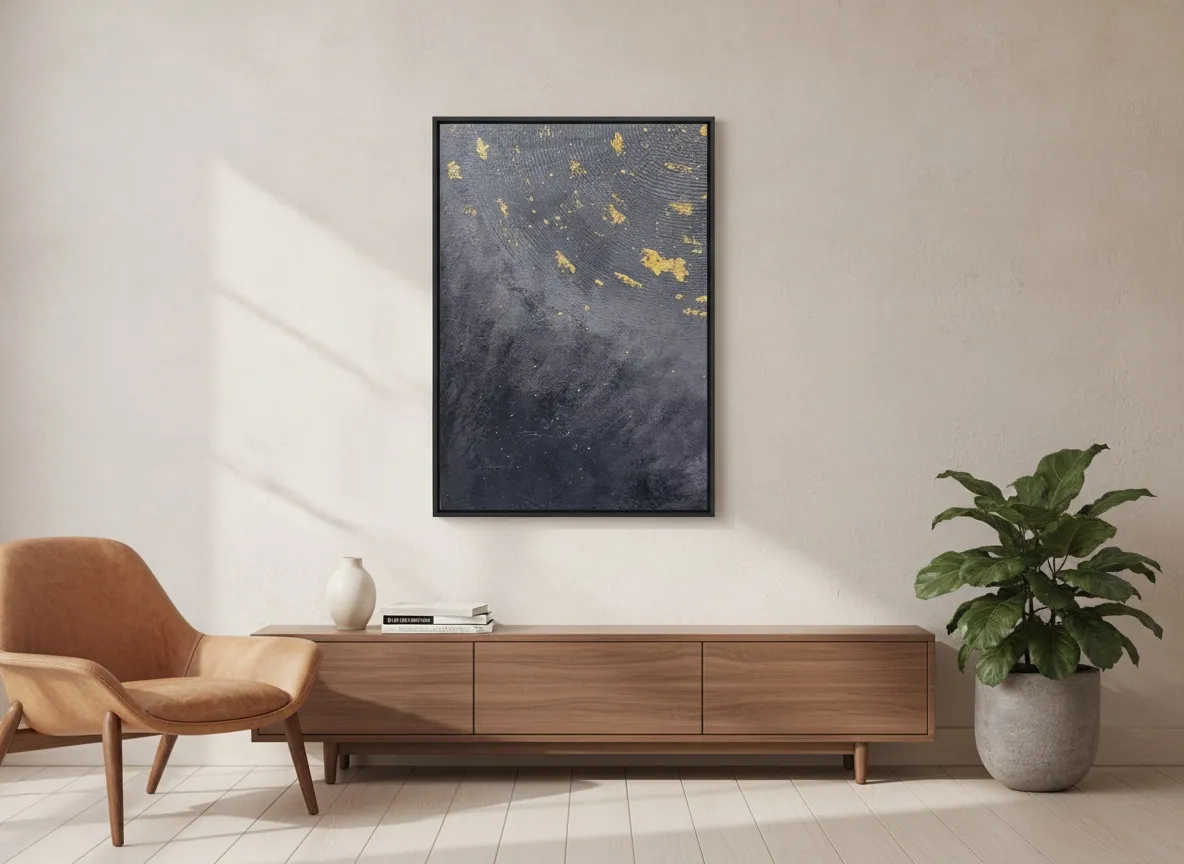
Decide how it will stand before you decide how it will look
The usual order of buying art, image first and wall later, is the wrong way round when the wall is not yours. Start with the constraint: what your lease allows, what the wall is made of, and whether you are willing to hang anything at all. Those three answers narrow the choice more than taste does.
If hanging is allowed, a smaller, lighter canvas is the easiest to fix in a reversible way. Removable adhesive hooks and strips exist for light pieces, but each product has its own rated load, so read the figure on the packaging and weigh the work, frame included, before you trust it. If hanging is not allowed, or the piece is heavy, there is nothing second-rate about not hanging it. A painting can stand on a console or a deep shelf, or on the floor against the wall, and many interiors are better for the looseness of it. For a heavier canvas on a wall you are allowed to drill, the guide to hanging a heavy painting on drywall explains the fixing in more detail.
Choose a size that survives the next address
A rental is, by definition, a temporary wall. The apartment after this one will have a different ceiling height, a different run of blank wall and, often, a different light. A work that fits one specific alcove is a risk; a work that sits well on an ordinary wall is not.
In practice, that argues for mid-sized formats and for vertical or square proportions, which adapt to a sofa wall, a bedroom or a hallway without much rethinking. In the current catalogue, the smaller formats start at 50 × 70 cm, for example Celestial Plan (Black & Gold, 2025). Larger canvases, such as the 100 × 100 cm works, carry more presence but need a clear wall and a plan for the car, the lift and the stairs when you move. Catalogue dimensions are listed as width × height, so check the orientation before you measure your wall. For how big is big enough on a given wall, see what size painting to hang above a sofa.
Let the painting do the work the room cannot
Rental interiors tend to arrive fixed: a wall colour you did not choose, flooring you cannot change, a light fitting you did not pick. That is a good argument for a work with its own depth, texture or tonal range, so it gives the room a centre without asking you to repaint anything.
A few working rules from the studio, offered as observation rather than law: look at the work in the room's real light, at the hour you are actually home; choose a palette that talks to what you already own and will take with you, such as furniture, textiles and rugs, rather than to the wall; and prefer one work that is right over several that are merely acceptable. A single considered piece is easier to move, and easier to live with, than a wall of compromises.
Is an original worth it when you do not own the walls?
The case for an original in a rental is practical rather than financial. Unlike a built-in shelf, a painted wall or a kitchen, a painting belongs to you and leaves with you. It is one of the few decorative objects that make a temporary address feel specific. That is a reason to buy; it is not a promise of anything else. No one can say what a work will be worth later, and the studio does not suggest otherwise.
What is worth settling before you buy is the logistics: your lease terms, the piece's size and weight, how it will stand on day one, and how it will travel on the day you leave. Prices at Perfeito Studio currently run from R$ 2,400 to R$ 8,800, and every work is an original, unique piece sold directly by the artist. If you are also thinking about a smaller or changing space, see how to choose art when downsizing to a smaller home.
From the studio
From the studio
I trained as an architect, and I still read a room the way an architect does: first the fixed things, then the things that can move. In a rental the fixed list is long, and a painting belongs firmly on the other list. People who rent often hesitate over original art because they treat it as a wall decision, when it is closer to a furniture decision.
A work like Celestial Plan, 50 × 70 cm, with its textured surface and gold leaf, carries its own presence and does not depend on the wall behind it. The useful questions are how long you expect to stay and which wall you actually have. A work that suits three future apartments is a better choice than one that suits only the current one.
Frequently asked
Can I hang art without damaging walls?
Often yes, for lighter works. Removable adhesive hooks and strips are made for this, but each product has a stated maximum load, so check it against the real weight of the work with its frame before using one. Heavier canvases are safer not hung at all: stand them on a console, a deep shelf or the floor against the wall. Check your lease first, since some landlords restrict even adhesive fixings.
Is original art worth it in a rental?
It can be, for practical reasons: a painting is portable, it belongs to you rather than the building, and it makes a temporary address feel particular. It is not a financial promise, and nobody can say what a work will be worth later. Treat it as something to live with, and settle its size, its weight and how it will stand on day one before you buy.
What size works for temporary spaces?
In the studio's experience, mid-sized, vertical or square formats adapt best, because they sit well on a sofa wall, in a bedroom or in a hallway at the next address. The smaller works in the current catalogue start at 50 × 70 cm. Very large canvases are impressive but need a clear wall and a plan for the stairs, lift and vehicle when you move.
How do I move art between rentals?
Keep it upright rather than flat, protect the corners, and wrap it so nothing touches the painted surface directly. Remove any hanging wire or hardware that could scratch the work or frame before packing. This is general practice from the studio's experience, not a technical specification. For a larger work, plan the route through doors, stairs and the lift before moving day.
Should I lean art on a shelf?
Yes, it is a legitimate way to display a painting, and many interiors benefit from it. In the studio's practice, and as general guidance rather than a technical specification, use a surface deep and stable enough to hold the canvas without tipping, keep it away from edges where it could be knocked, and avoid spots near heat sources or strong direct sun. A slight tilt back against the wall is usually enough. It also keeps the wall untouched.
Ask about a piece for a rental
Tell Alyne about the wall, how long you expect to stay and whether you can hang at all, and ask about sizes and pieces in the catalogue.
Published on