How to compare prices between two artists before buying
To compare two artists fairly, put both works on the same terms before looking at the price: dimensions, materials, year, what the price includes. Then divide by area for a first filter, and let materials, process, documentation and shipping explain any gap. Ask both artists the same questions.
Start with a price you can actually compare
Two prices are only comparable when they describe the same thing. A painting at one figure and a painting at another figure tell you nothing until you know what each includes: the canvas size, the materials, the year, whether it is framed, whether a certificate and packing are part of the price. Before you weigh the artists, weigh the offers.
So the first move is administrative, not aesthetic. Write the same short list for both works: height and width in centimetres, medium, year, what is included, and where it ships from. If an artist cannot or will not fill in one of those lines, that gap is already part of your comparison.
Normalise by size, then read the number with care
Price per square metre is the simplest common ruler. Multiply height by width in metres, divide the price by that area, and two works of different sizes land on one scale. A purely illustrative example: a 60 x 80 cm work covers 0.48 m²; a 100 x 100 cm work covers 1.0 m². If the first is quoted at R$ 3,000 and the second at R$ 5,200, the figures are roughly R$ 6,250 and R$ 5,200 per square metre. The larger work is the cheaper one by area, though it is the more expensive one in total.
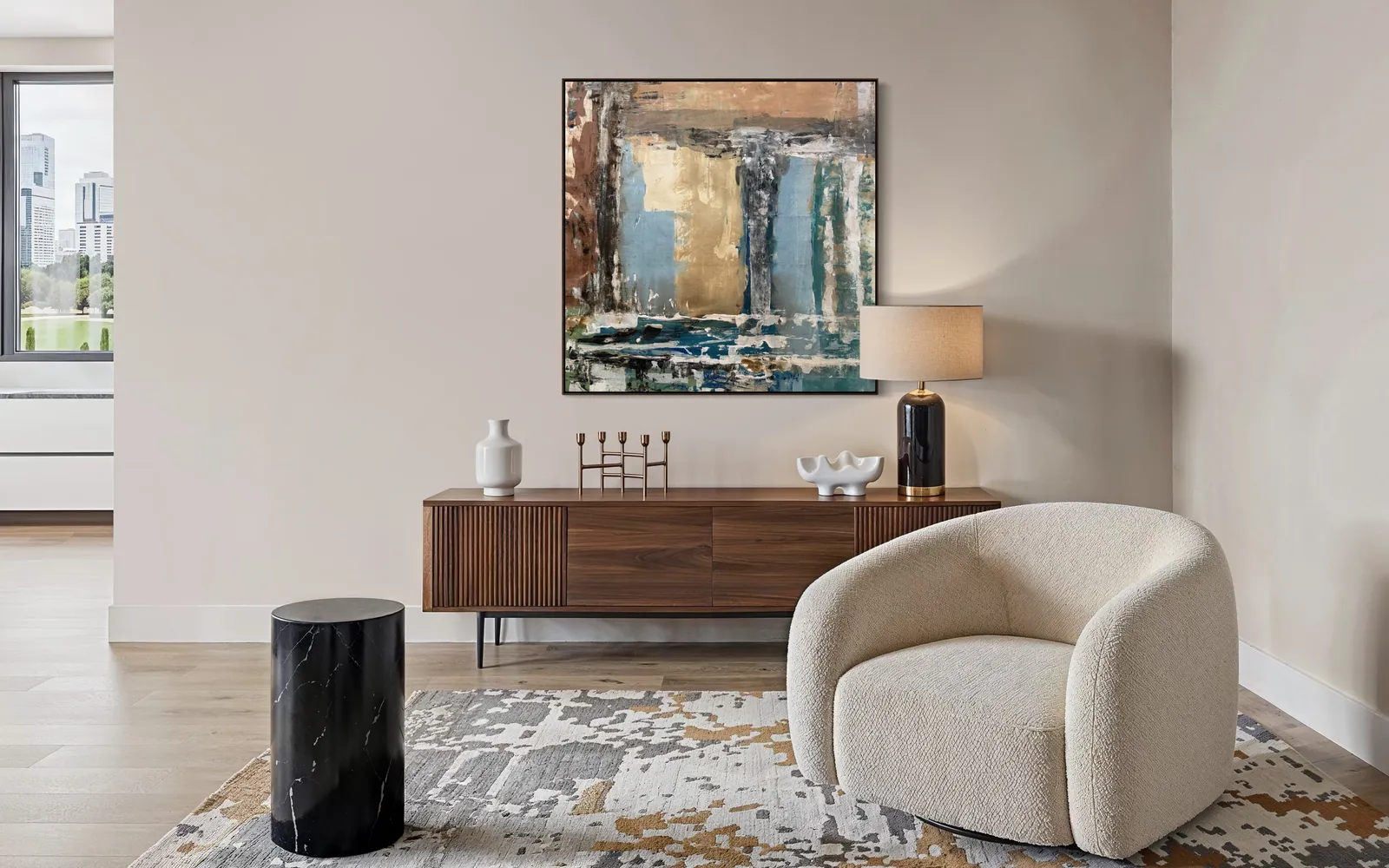
For a real reference, the studio's own Patina Field measures 100 x 100 cm and is listed at R$ 5,200, which is R$ 5,200 per square metre. Works at the studio currently range from R$ 2,400 to R$ 8,800, so size and complexity clearly move the figure.
Treat the result as a filter. It tells you whether two artists are in the same neighbourhood. It does not tell you which one is the better choice, and the figure per square metre tends to run differently for small and large canvases, so compare works of similar size when you can.
What else explains a gap between two artists
When the per-area figures differ, work through the remaining criteria one at a time rather than reaching for a verdict.
- Materials and technique. Acrylic on canvas, oil on linen, mixed media with texture and heavy layering: each has a different cost and a different handling requirement.
- Time and process. A surface built, scraped back and rebuilt carries more hours than a single pass, even at equal size.
- Documentation. A signed certificate, a numbered archive entry and a care guide cost time to produce and are worth having in writing.
- Packing and shipping. Ask how the work will be packed and whether freight, insurance and any import duties are included in the price or quoted as separate lines.
- Channel. A direct sale from the studio and a sale through an intermediary are structured differently, so ask who sets the price and who receives it.
Where two artists give you a different answer to the same line, you have found the real reason their prices differ.
Ask the same questions of both artists
The cleanest comparison is a short, identical message to each artist. Ask for the final dimensions, the materials, the year, what is included in the price, how the work will be packed and shipped to you, and what documents arrive with it. Ask how they set prices across a body of work, and whether the work has been sold or shown before.
Then put the answers in two columns. You will usually find that the decision stops being about price and becomes about fit: which surface you want to live with, which documentation you trust, which conversation you enjoyed more. Price is one column among several, and none of this tells you how a work will be valued by anyone else later.
From the studio
From the studio
I trained as an architect, and I tend to read a price the way I read a floor plan: by what it has to hold up. A 100 x 100 cm square like Patina Field is a good example of how I think about it. It is a modest footprint on the wall, but the surface carries layers I applied, scraped back and applied again, and that time is part of the number.
If you are comparing my work with another artist's, the list I would ask for is the same one: size, materials, what is included, and how it travels. I would rather a collector choose the work that suits their wall than the one that looks cheapest per square metre. In my practice, price per area is where the conversation starts, never where it ends.
Frequently asked
Is price per square metre a fair comparison?
It is a fair first filter and a poor final verdict. Dividing price by area puts two works of different sizes on one scale, which is useful. But area is not effort or intent: a dense, heavily layered surface and a sparse one can share a size and differ in material, hours and risk. Use the figure to see whether two prices are in the same neighbourhood, then let the other criteria explain any gap.
Does career stage change price?
It can, and it is reasonable to ask how an artist arrived at their numbers. Some artists price from long exhibition histories, others from materials, time and scale. Neither approach is wrong, but they answer different questions. Ask each artist what their prices are based on, and compare the answers rather than assuming a longer résumé or a shorter one makes the work better or worse value for your wall.
What else besides size drives price?
Materials and technique, the number of layers and hours behind a surface, framing or stretcher quality, documentation, packing and shipping, and whether the sale is direct or through an intermediary. Two works of the same dimensions can differ on every one of these. Ask for each item to be stated, because a price you cannot decompose is a price you cannot compare.
Can I negotiate?
You can ask, politely and directly. Some studios keep a fixed scale so that every buyer pays the same; others offer a payment arrangement. Do not open with a counter-number. Ask whether there is flexibility, and what is included at the stated price. A clear no from a fixed-scale studio is information, not rudeness.
What do I ask the artist?
Ask for the full dimensions, the materials, the year, and what documentation comes with the work. Ask whether the price includes a certificate, packing and delivery, and whether the work has been shown or sold before. Ask how the artist sets prices across a series. Send the same list to both artists, so the answers line up and the comparison is honest.
Compare on equal terms
Tell me which work you are weighing and I will send size, materials, what is included and shipping to your country, so your comparison starts from the same list.
Published on