How to protect a painting from sunlight and fading
To protect a painting from fading, keep direct sun off the surface and cut total exposure. Conservation bodies advise filtering UV with window film or glazing, controlling daylight with blinds, and hanging away from windows. UV filtering alone is not enough, since visible light also fades sensitive pigments, and the damage is cumulative.
Why light damage is a slow, one-way process
The Canadian Conservation Institute (CCI), part of the Government of Canada, states plainly that "the effect of light is cumulative and irreversible." Fading is not something a painting recovers from when the sun moves on: each hour of exposure adds to the total. CCI also notes that cutting the duration of exposure by half has the same effect as halving the light level, so time and intensity both count.
Museums Galleries Scotland, a Scottish museum-sector development body, says the same in its guidance on caring for paintings: light damage is cumulative and irreversible. That is why the advice below is about reducing the total dose rather than about any single dramatic afternoon.
Filter the window before you move the painting
Both institutions point to the glass. Museums Galleries Scotland advises applying UV-absorbing film to windows to reduce ultraviolet in daylight, aiming to exclude UV completely, and controlling daylight with window blinds. CCI lists UV-absorbing films on window panes and UV-absorbing acrylic glazing in front of the artwork as ways to bring UV down toward its limit of 75 microwatts per lumen.
There is an important caveat. CCI says these films do not mitigate the fading caused by visible light. A filtered window still lets light in, so film is one layer of protection, not a licence to hang a painting in direct sun. Our companion guide on solar-control film and artwork (in Portuguese) looks at what the film specifications do and do not tell you.
Where to hang: distance, wall position and the sun's path
UGallery, an online art retailer, gives the practical version for a home: hang art away from windows and use curtains or shades during peak sunlight hours. Museums Galleries Scotland adds a related caution in its guidance on storing paintings: avoid stacking them under windows or near doors and radiators.
A simple check follows from this. Look at the wall at different times of day and across seasons, since the sun's path changes. If direct sun reaches the canvas at any time of year, that wall is worth treating with a blind, a film or a different painting position, since the guidance above is to keep direct sun off the surface and reduce total exposure. Museums Galleries Scotland also advises against hanging paintings above heat sources, because the rising hot air carries dirt, a separate problem from light.
Pigments, rotation and what you can actually control
How quickly a painting fades depends heavily on its pigments. Just Paint, the technical bulletin of Golden Artist Colors, explains that colour stability in acrylics depends primarily on the lightfastness of the pigment, and that only pigments rated I or II under the ASTM scale qualify as suitable for archival paints. It also notes that some special colours, such as fluorescents, are not lightfast. See lightfastness in painting pigments (in Portuguese) for the detail.
CCI gives a sense of scale for the most vulnerable materials: highly sensitive lake pigments and aniline dyes begin to fade noticeably within 1.5 to 20 years at 50 lux, and within a few months to two years at 500 lux. For owners, the lever is the same in every case: less light, for less time. UGallery adds that periodically swapping displayed pieces with stored ones limits continuous exposure of any single work; see also how to rotate artwork at home.
From the studio
The atelier's view: the studio photograph is not the sun on your wall
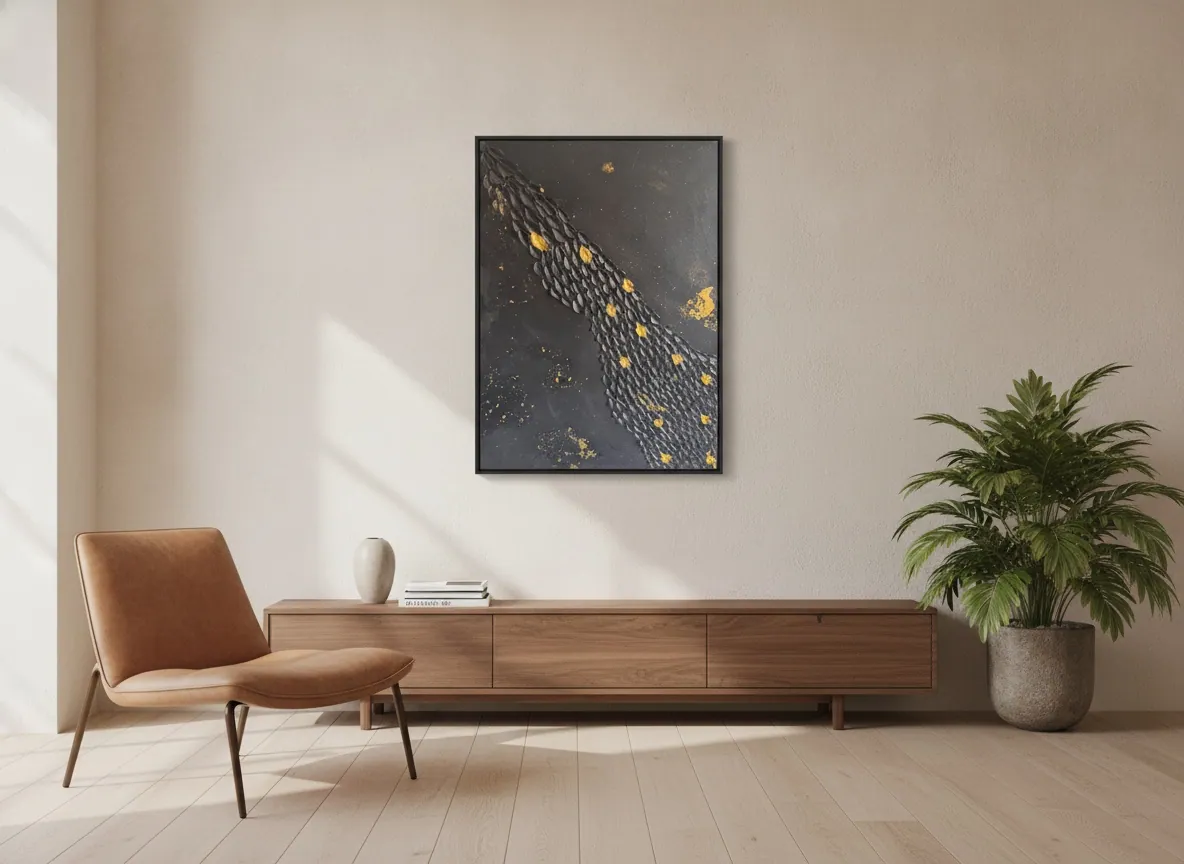
Golden Passage (60 × 80 cm, Black & Gold, 2025) appears on this page in a room with daylight sweeping across the wall and floor, and I chose this image because it shows the problem honestly. The light here lands beside the painting, but at another time of year that same patch could sit squarely on the canvas. A photograph freezes one hour of light; a wall receives the whole year of it.
As an architect by training, I read a room by walking it in the morning and again in the late afternoon before deciding where a work will hang. It costs nothing, and it is the step most buyers skip. For questions about a specific work, write to the atelier, and see how to light a textured painting for the artificial-light side.
Frequently asked
Does sunlight fade acrylic paint?
It depends on the pigments. Golden Artist Colors' technical bulletin Just Paint says colour stability in acrylics depends primarily on the lightfastness of the pigment, and that only pigments rated I or II under ASTM qualify as archival. Some special colours, such as fluorescents, are not lightfast. Whatever the paint, the Canadian Conservation Institute says the effect of light is cumulative and irreversible.
Is UV film worth it?
Conservation bodies recommend it as one layer of protection. Museums Galleries Scotland advises UV-absorbing film on windows, aiming to exclude UV completely, and CCI lists UV-absorbing films and acrylic glazing as ways to limit UV. CCI also says such films do not mitigate fading caused by visible light, so blinds and wall position still matter.
How far from a window should art hang?
The sources give no fixed distance in centimetres. UGallery advises hanging art away from windows and using curtains or shades at peak sunlight hours, and Museums Galleries Scotland advises against stacking paintings under windows or near doors and radiators when storing them. The practical test is whether direct sunlight ever reaches the canvas at any hour or season.
How do I limit light exposure without taking the painting down?
Use blinds or curtains during peak sun, add UV-absorbing film to the glass, and keep the wall free of direct beams. CCI notes that halving the time a painting is lit has the same effect as halving the light level, so switching off lights when a room is empty also helps.
Should I rotate paintings to limit exposure?
UGallery suggests periodically swapping displayed pieces with stored ones so no single work receives continuous sun exposure. This follows the logic CCI describes, where shorter total exposure reduces the cumulative effect of light.
Questions about a Perfeito Studio work
Write to the atelier about a specific piece and where it would hang.
Sources
- Canadian Conservation Institute (Government of Canada), CCI Notes 10/4, Environmental Guidelines for Paintings — 2026-10-01
- Museums Galleries Scotland — 2026-10-01
- UGallery — 2026-10-01
- Just Paint (Golden Artist Colors) — 2026-10-01
Published on