How to unpack a large painting safely
To unpack a large painting safely, open it in the room where it will live, with a second person, cutting only the tape and the opening the shipper marked, and keeping long blades away from the canvas. Keep the packaging, photograph anything unusual before you touch the work, and keep hands off the canvas face.
Choose the room and the hour before you cut anything
Unpack where the painting will be hung, or as close to it as the route allows, with the floor cleared and the doors already opened. A large canvas is awkward to carry once it is out of its protection, so the fewer rooms it crosses unwrapped, the better.
Timing matters too. The Hammer Museum describes keeping a painting crated for a minimum of 24 hours at its destination so the work and its crate can adjust to the new surroundings, because rapid exposure to a different environment can make materials contract or expand and, over time, crack. It calls this common museum practice. A museum is a controlled case, but the logic carries over to a painting that has just spent days in a truck or a warehouse: let the closed package rest in the room first.
There is one exception, and it is the damaged package. An art-insurance handling guide advises that when a shipment looks suspect or damaged you note it on the waybill, take photos, unwrap immediately and save the wrapping. Resting is for a package that looks sound; if it does not, do not wait.
Crate or box: open only what the shipper intended to open
A crate and a carton fail in different ways, so they are opened differently.
Crate. Look for the side marked for opening before reaching for a tool. One art-shipping company's published instructions say to remove only the screws on that designated side, to leave every nail alone, to lift the panel away carefully, and, if internal support bars are present, to support or hold the artwork in place while the bars come off so it cannot tip. In the studio's experience, there is no reason to take down more of the crate than the painting needs to come out.
Cardboard box. Here the hazard is the blade. A canvas can sit very close to the cardboard, so in the studio's experience the safe habit is to cut only the tape and the seams of the flap, with a blade set short, never across the broad face of the box and never pointing inward. This is practical advice rather than a published standard. If the packaging carries FACE and TOP markings, which the insurance guide above recommends writing on packaging to show the face of the work and its correct orientation, stand the box that way before opening it.
Whichever you have, keep every screw, lid, foam block and wrap until the painting has been fully inspected. Those materials show how the work was packed if a question arises later.
Tools and habits to avoid
- Long utility blades and anything used with force. In the studio's experience, a slipped blade or pry bar travels toward the canvas. A screwdriver for screws, a short blade for tape.
- Removing nails from a crate. The crate instructions above are explicit about leaving them.
- Pulling at material stuck to the surface. If wrap or paper does not release, stop, photograph it and ask the seller or a conservator. This is the studio's own rule of thumb, not a standard.
- Bare hands on the work. The Canadian Conservation Institute advises clean, well-fitting, lightweight cotton or latex gloves, and notes that it is important to avoid touching the viewed edges of a painting.
- Bubble wrap against the paint. The insurance guide says bubble wrap can leave marks on all but glassy surfaces and, if it is used, should not touch any part of the artwork.
Lifting it out
Large paintings are not one-person objects. The Canadian Conservation Institute states that multiple handlers are required for large-scale contemporary art. Agree in advance who lifts, which way the work will face, where it will be set down and who opens the doors on the way. In the studio's experience, the safest grip is on the stretcher bars at the back, with no hand pressing on the canvas itself. Set the painting down on a clean, padded base, with nothing touching its face.
Once it is out, in the studio's practice, lean it upright against a wall on a protected base rather than hanging it on the spot. Take a few minutes to look at it, which is covered step by step in the arrival checklist (in Portuguese). This guide is also available in Portuguese.
Inspecting it, and what to do if something is wrong
Inspect straight away, while the packaging is still on hand and the delivery is recent. The insurance guide advises noting the condition of each package as it is received. If you cannot inspect a package at the door, it suggests writing "un-inspected" on the receipt or waybill, so the signature does not read as an all-clear. Compare the work with the certificate and the images you saw when you bought it, looking at the surface with light raking across it from the side, which in the studio's experience shows dents in texture more readily than flat, frontal light.
If you find damage, do not attempt a repair. Photograph the packaging and the damaged area, keep every layer of wrapping, and contact the seller the same day. The full sequence is in what to do if a painting arrives damaged.
From the studio
The studio's view: measure the route, then the wall
As an architect by training, I tend to read a delivery as a floor plan. A canvas of 120 x 200 cm, the size of Genesis of Flame, has to get through a front door, a lift or a stairwell, and around at least one corner before it reaches its wall. The unpacking goes more calmly when that route has been measured and cleared beforehand.
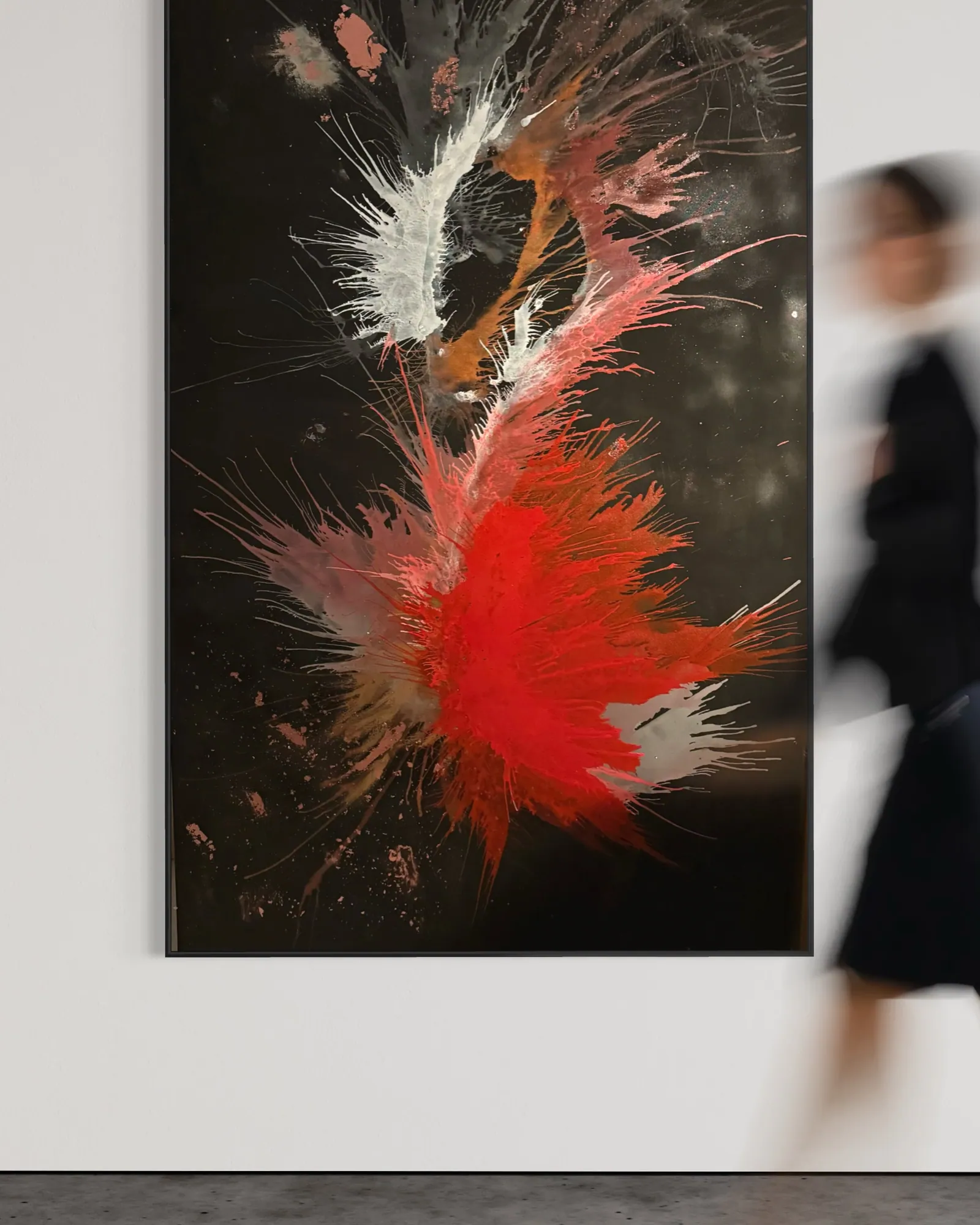
Genesis of Flame alternates high-gloss and matte finishes, and a high-gloss area is simply easier to see a mark on than a matte one. That is one more reason, as a matter of care rather than rule, to keep blades short, gloves on and the work leaning upright in a calm room, rather than rushing it onto a wall on the day it arrives.
Frequently asked
How do I open a crate or box holding a canvas?
For a crate, find the side marked for opening, remove only the screws on that side, leave any nails alone, and lift the panel away while someone steadies the painting. Take down only as much of the crate as you need. For a cardboard box, cut only tape and flap seams with a short blade, away from the broad face. If you are unsure how your piece was packed, ask the seller before cutting anything.
What tools should I avoid?
Avoid long utility blades, pry bars and anything that needs force, since a slip travels toward the canvas. A screwdriver suits screws and a short blade suits tape. Do not remove nails from a crate, and do not pull wrap or paper that has stuck to the surface. Gloves should be clean, well-fitting and lightweight, in cotton or latex, according to the Canadian Conservation Institute.
Should I inspect the painting right away?
Yes. Note the condition of the packaging on arrival, then inspect the painting once it is out, while the wrapping is still within reach. If you cannot check the package at the door, an art-insurance handling guide suggests writing "un-inspected" on the receipt. Look at the surface from the side under raking light, compare it with your certificate and the images you saw when you bought it, and photograph anything that looks different before moving the work again.
What if I find damage?
Stop and do not attempt a repair. Photograph the packaging and the damaged area, keep all the wrapping and the crate, and write to the seller the same day with the pictures. An art-insurance handling guide advises noting damage on the waybill, taking photographs, unwrapping immediately and saving the wrapping. Do not wait: the sequence is laid out in our guide to what to do if a painting arrives damaged.
How long to leave it before hanging?
There is no published waiting period between unpacking and hanging. The one figure we cite concerns the closed crate: the Hammer Museum describes at least 24 hours crated at the destination as common museum practice. After that, in the studio's practice, hanging is a separate step. Lean the work upright, inspect it, and hang it once the wall, fixings and a second person are ready, not because the box is empty.
Not sure how your painting should be opened?
Write to the studio before you cut anything. Professional packaging is included with each work, and we can tell you what to expect when yours arrives.
Sources
- Canadian Conservation Institute (CCI Notes, Basic Handling of Paintings) — 2026-10-02
- Hammer Museum (UCLA), blog, 2009 — 2026-10-02
- Chubb, Getting Smart About Moving Your Art — 2026-10-02
- Convelio Help Center, How do I open a wooden crate safely? — 2026-10-02
Published on