How does Argentina treat an original painting imported from Brazil?
Argentina has a specific regime for works of art. Under Decree 279/1997, as modified in 2024, works in positions 9701 to 9703 pay VAT at 50% of the general rate, and the buyer or importer files a sworn declaration with customs. The pages read state no duty for paintings; that depends on the tariff line, which a broker can confirm.
Does Argentina treat an original painting differently from ordinary goods?
Yes, in the rules read for this page. Argentina has a specific decree for works of art, Decree 279/1997, which applies to items classified in positions 9701, 9702 and 9703 of the Mercosur tariff nomenclature. Under its current text, sales and imports of works in those positions are charged VAT at 50% of the general rate, instead of the full rate. The decree was modified in November 2024 by Decree 1037/2024, which also amended Law 24.633 on the international circulation of works of art and states that works of art, whether by Argentine or foreign artists, may circulate freely.
The pages consulted do not state a customs duty percentage for paintings, and the text of Decree 1037/2024 contains no duty percentages. For that reason this page does not say whether a painting from Brazil pays duty or enters duty-free: that depends on the tariff line and any Mercosur preference, neither of which was confirmed in an official source read here.
What does the importer have to declare?
To obtain the reduced VAT rate, the current text of Decree 279/1997 requires the buyer or importer to file a Declaración Jurada de Aplicación de Franquicia with the customs directorate of ARCA, the Argentine tax and customs agency. According to the decree, the declaration identifies the buyer and importer, the works concerned and the price or value of the operation. Before 2024 this declaration went to the Secretariat of Culture (the version set by Decree 1044/1998); Decree 1037/2024 moved it to customs and repealed articles 4 and 5 of the 1997 decree, which dealt with delivering an authenticated copy of the declaration and registering it with the tax authority. The original 1997 text had required the owner to commit to lending the work to museums for at least 60 days within five years; that requirement had already been replaced by the 1998 decree.
In other words, the franchise declaration under Decree 279/1997 is filed by the person buying or importing the work. Separately, article 11 of Law 24.633, as replaced by Decree 1037/2024, makes the importer or exporter responsible for the value declared to ARCA customs, and treats that declaration as a sworn statement that customs may audit after release.
Does a painting sent by courier follow the same rules?
ARCA's notice of 2 December 2024 on the postal and courier regime (Resolución General 5608) raised the value limit for these shipments to USD 3,000 FOB. It also says that the first USD 400 per shipment are free of tariffs when the goods are for personal use, and that such goods then pay only VAT. The notice does not mention works of art, so it does not settle how a painting of any value is treated within that regime, or whether the art-specific VAT reduction can be combined with it. That is a question for the courier or a customs broker to answer for the specific shipment.
Two other points are not covered by the sources read: how a painting is valued at the border, and whether a direct sale from an artist is handled differently from a purchase through a platform.
Who pays, and what does the studio provide?
Perfeito Studio ships internationally, quotes international shipping on request, and the buyer pays shipping and any import duties or taxes in the destination country. How a broker prepares an entry is described, in the US context, in the customs broker guide; the route out of Brasília is covered in shipping original art internationally from Brazil, and the question of local representation in whether a foreign buyer needs a local representative.
Every acquisition includes a fiscal invoice or official receipt and a signed Certificate of Authenticity carrying the full technical record and the Archive ID. Rates, limits and forms change, and the current position for a given shipment is something the carrier or an Argentine customs broker can confirm.
This text is informational and is not tax or customs advice.
From the studio
What the studio writes down for a painting that crosses a border
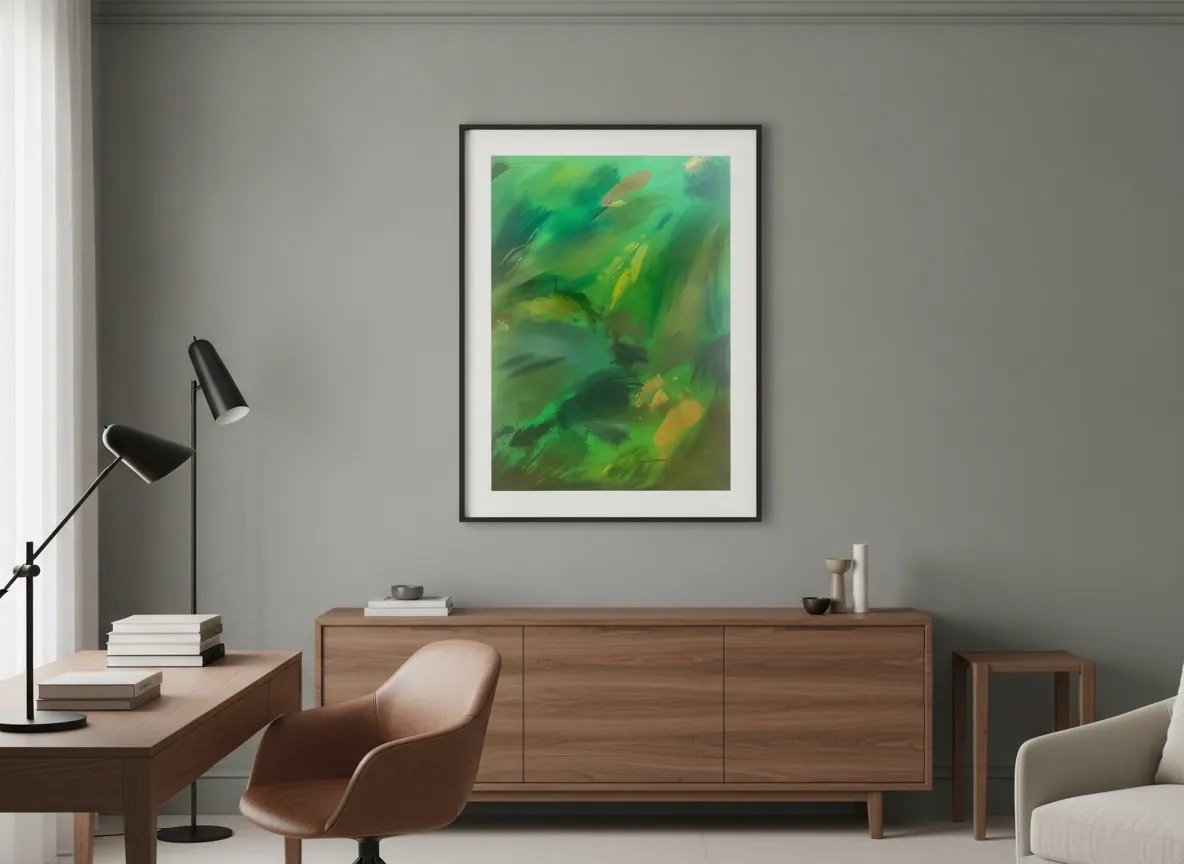
I paint Vegetal Dawn, from the Terra & Ether series, as an 80 x 120 cm acrylic on canvas, dated 2026 and catalogued as AP-TAE-2026-003. In the studio, those are the facts recorded for each painting: medium, dimensions, year and Archive ID. They sit on the technical record that goes with the work, so whoever prepares a declaration has them in one place and does not need to reconstruct them. See Vegetal Dawn or the full catalogue.
Frequently asked
Does Argentina charge import taxes on an original painting imported from Brazil?
Under Decree 279/1997, as modified by Decree 1037/2024, imports of works of art in positions 9701, 9702 and 9703 are charged VAT at 50% of the general rate. The official pages read do not state a customs duty percentage for paintings, so whether duty applies depends on the tariff line and any preference, which a customs broker can confirm. This is general information, not tax or customs advice.
Is an original painting treated differently from a print when it enters Argentina?
Law 24.633, as amended by Decree 1037/2024, defines works of art as hand-made works and lists paintings in oil, acrylic and other media alongside original engravings, prints and lithographs, and it excludes mechanical or photomechanical procedures. The sources read do not say which of tariff positions 9701, 9702 and 9703 applies to each type of work, so how a particular print or painting is classified is decided by the declarant and customs.
Who declares the painting to ARCA customs: the buyer, the seller or the carrier?
For the reduced VAT rate, the current text of Decree 279/1997 has the buyer or importer file a Declaración Jurada de Aplicación de Franquicia with the customs directorate of ARCA. How the carrier handles the entry for a given shipment is for the carrier to confirm.
What documents usually accompany a painting entering Argentina?
The sworn declaration names the buyer and importer, the work and its price or value, so an invoice with an accurate description is the base. Every acquisition from the studio includes a fiscal invoice or official receipt and a signed Certificate of Authenticity with the technical record. Which documents a given shipment needs is for the carrier or a customs broker to confirm.
Do I need a customs broker to receive a painting in Argentina?
The sources read do not say whether a broker is required. Article 11 of Law 24.633, as replaced by Decree 1037/2024, states that works of art may move freely on the commercial terms the exporter or importer agrees with the carrier, including as parcel (encomienda), with no limit on the number of works. ARCA also describes a postal and courier regime with a USD 3,000 FOB limit, but its notice does not mention works of art. A broker or the courier can say which route applies to a specific painting.
Buying from Argentina?
Tell the studio which work you have in mind and where it is going, and ask for an international shipping quote.
Sources
- ARCA (ex-AFIP), Biblioteca Electrónica — 2026-10-09
- Government of Argentina, Información Legislativa (InfoLEG) — 2026-10-09
- ARCA (ex-AFIP), Biblioteca Electrónica — 2026-10-09
- ARCA (ex-AFIP), Servicios con Clave Fiscal — 2026-10-09
Published on