Does Japan charge consumption tax or duty on an original painting imported from Brazil?
According to Japan Customs, paintings executed entirely by hand (tariff heading 97.01) carry a general duty rate of "Free", but consumption tax is a separate charge that applies, in general, to all goods imported into Japan. How the painting is declared depends on the route: international post, courier or general cargo.
Is an original painting subject to customs duty in Japan?
Japan's customs tariff schedule groups works of art in Chapter 97, titled "Works of art, collectors' pieces and antiques." Heading 97.01 covers "paintings, drawings and pastels, executed entirely by hand," excluding hand-painted manufactured articles. In the schedule edition dated 1 April 2026, the General duty rate shown for that heading is Free, and the same applies to the other agreement columns listed on the page. Heading 97.02 (original engravings, prints and lithographs) and 97.03 (original sculpture and statuary) also show Free.
Japan Customs also publishes a reference table of duty rates for major products, dated 1 April 2026, which lists "Paintings by hand, engravings and sculptures (Chapter 97)" as Free. That page states the table is for reference only and that the actual rate depends on the goods and their origin, so the classification of a specific piece is something the customs office or a broker confirms at declaration. The wording of heading 97.01 is why "executed entirely by hand" matters: it describes how the work was made, not how large or how valuable it is.
What does consumption tax change?
A zero duty rate is not the same as a zero bill. Japan Customs states that consumption tax is imposed at 10% (standard rate) or 8% (reduced rate) on, in general, all goods imported into or manufactured in Japan, and that the tax is calculated on the Customs value of the goods plus any Customs duty payable and, where applicable, other excise taxes. For a painting whose duty rate is Free, the duty component in that formula is zero.
For international postal items, Tokyo Customs states that all imported postal items, whether for commercial or personal use, are subject to duty and taxes, meaning national consumption tax and local consumption tax, and that the recipient pays before the parcel is handed over. Which rate applies to a given purchase, and how the declared value is determined, is for Japan Customs to assess on the documents presented.
Who declares the painting, and how?
Japan Customs describes three routes for personal imports, depending on how the goods are transported.
- International post. Items with a customs value under ¥200,000 are inspected by customs; where tax is due, customs sends a "Notice of Assessment for International Mail" through Japan Post, and the recipient pays either on delivery or at a bank or post office, depending on the case the page describes. Items above ¥200,000 require a general import (tax) declaration; the recipient prepares the invoice and other documents and can make the declaration in person at the customs office or commission Japan Post or a customs broker.
- International courier. Per Japan Customs, a customs broker clears the goods for you, and you pay for their services in addition to duties and taxes.
- General cargo. The importer prepares the import declaration, invoice and bill of lading and goes to the customs office, or asks a customs broker to file on their behalf.
For post items above ¥200,000 and for general cargo, Japan Customs states that the declaration is made by the importer, either personally or through a licensed customs broker; for postal items, Tokyo Customs adds that the recipient (importer) is the taxpayer. For how a broker works in practice, see what a customs broker does when art crosses a border; that page describes the United States, so the Japanese procedure above is the reference for this destination.
What the studio provides, and where it stops
Perfeito Studio ships internationally, quoted on request and paid by the buyer, as are any import duties or taxes in the destination country. Each acquisition is direct from the artist and includes the original painting, a signed Certificate of Authenticity with the technical record and the internal Archive ID, a fiscal invoice or official receipt, and professional packaging. Those are the documents that describe the work as a unique, hand-made original. The studio does not quote Japanese duty or tax figures and does not file declarations in Japan. For shipping in general, see shipping original art internationally from Brazil and the studio's shipping guide for the United States and Europe.
This text is informational and is not tax or customs advice.
From the studio
From the studio
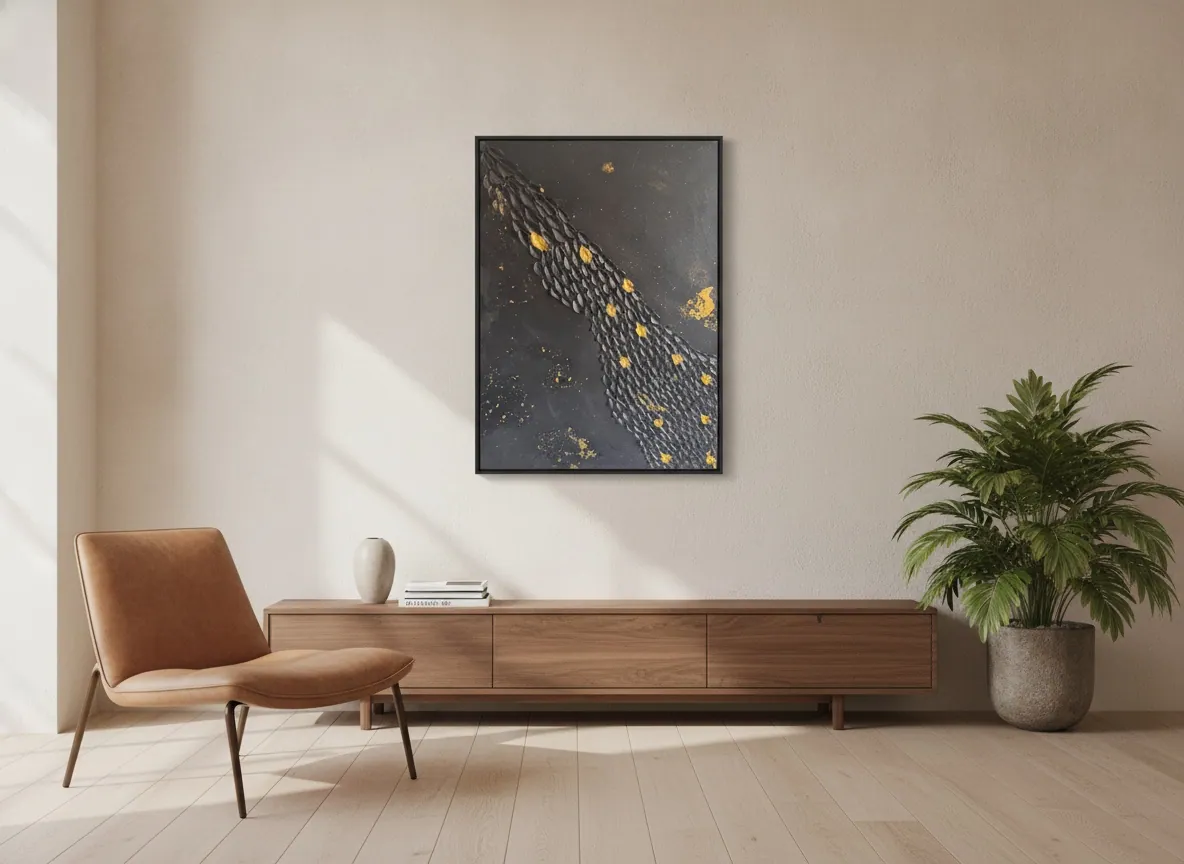
Golden Passage, in the Black & Gold series, is 60 x 80 cm: mixed media, texture paste and imitation gold leaf on canvas, built layer by layer by hand. When I read the wording of the Japanese heading, "executed entirely by hand," it is that process I recognise, and it is why I record the medium and dimensions precisely in the certificate rather than in loose terms. I am not a customs broker and I do not tell a buyer in Japan what will be charged on arrival; I can describe the object accurately, and the customs office or a broker applies the rule.
Frequently asked
Does Japan charge consumption tax on an original painting imported from Brazil?
According to Japan Customs, consumption tax is imposed at 10% (standard) or 8% (reduced) on, in general, all goods imported into Japan, calculated on the Customs value plus any duty payable. Chapter 97 paintings carry a duty rate of Free, but that does not remove consumption tax. Which rate applies and on what value is assessed by customs at declaration.
Is an original painting treated differently from a print when it enters Japan?
The tariff schedule uses different wording for each. Heading 97.01 covers paintings executed entirely by hand, while 97.02 covers original engravings, prints and lithographs, and both show a General duty rate of Free in the April 2026 edition. How a particular piece is classified is decided at declaration; Tokyo Customs notes that taxation can be difficult when the descriptions on the declaration form and invoice are incorrect or inaccurate.
Who declares the painting to Japan Customs: the buyer, the seller or the carrier?
For postal items, Tokyo Customs describes the recipient as the importer and the taxpayer. In practice the declaration is made by the recipient or a commissioned broker for post items above ¥200,000, by a customs broker for courier shipments, and by the importer or a broker they appoint for general cargo.
What documents usually accompany a painting entering Japan?
Japan Customs says it examines the customs declaration and price documents such as the invoice to assess duty and tax, and that supporting documents accompany a general import declaration. From the studio, each acquisition includes a fiscal invoice or official receipt and a signed Certificate of Authenticity with the technical record and Archive ID.
Do I need a customs broker to receive a painting in Japan?
It depends on the route. Japan Customs says that for courier shipments a customs broker clears the goods and charges for the service, while for general cargo the importer may file personally or ask a broker. For post items above ¥200,000 a general import declaration is needed, which the recipient can file in person or commission a broker to file.
Considering a piece for a home in Japan?
Tell us the work and your destination city. We will confirm the documents that come with the painting and quote shipping before you decide.
Sources
- Japan Customs (Ministry of Finance) - Customs Tariff Schedule, Chapter 97 — 2026-10-07
- Japan Customs (Ministry of Finance) - 1204 Duty Rates for Major Products — 2026-10-07
- Japan Customs (Ministry of Finance) - Outline of Tariff and Duty Rates System — 2026-10-07
- Japan Customs (Ministry of Finance) - 3002 Import Clearance Procedures for Personal Import — 2026-10-07
- Japan Customs (Ministry of Finance) - 6101 Outline of Customs Procedures for International Postal Items — 2026-10-07
- Tokyo Customs (Japan Customs) - Why were duties and taxes assessed on my parcels? — 2026-10-07
- Japan Customs (Ministry of Finance) - 1301 Payment of Customs Duty — 2026-10-07
Published on · Updated on