How does Qatar treat an original painting imported from Brazil?
Qatar's General Authority of Customs publishes a tariff schedule that lists hand-painted originals under heading 97.01 at a 5% ad valorem duty. The painting is declared in a customs declaration by its owner, an authorised representative or a licensed broker, with a detailed invoice unless the Chairman allows otherwise. This explains the mechanism; it is not advice.
What duty rate does Qatar's tariff list for a hand-painted original?
Qatar applies the Integrated GCC Customs Tariff, and the General Authority of Customs (GAC) publishes the schedule on its own site. In the schedule PDF that the GAC publishes (GAC tariff schedule, read on 10 October 2026), Chapter 97 covers works of art, collectors' pieces and antiques. Heading 97.01 begins "Paintings, drawings and pastels, executed entirely by hand", and its "Other" subheading for paintings (97 01 91 00 00 00) shows a duty rate of 5%, with the unit given as value. The line for paintings more than 100 years old (97 01 21 00 00 00) also shows 5%, and so does heading 97.02, original engravings, prints and lithographs. The schedule's own page header refers to the 2022 edition of the tariff, while the GAC site titles the file 2026.
"Value" means ad valorem: the Customs Law defines duties as either a percentage of the value of the goods or an amount per unit (Article 8). Invest Qatar, the state investment promotion agency, describes the general 5% tariff as applied to the cost, insurance and freight (CIF) value of the invoice. For a painting, that points to the invoice price plus freight and insurance as the base, but the customs officer values the goods under the Customs Law's valuation rules, not under a general description.
Two cautions from the same sources. First, duties are those in force on the date the customs declaration is registered, unless the decree amending the tariff provides otherwise (Article 10), so a rate read today is not a rate guaranteed for a later shipment. Second, Chapter 98 of the schedule contains separate special-provision lines with their own rates, for example 0% for diplomatic missions and for the personal effects of people arriving to reside. It also has a line for goods of value under SR 1,000 transferred by express transport, shown at 0% and marked "(optional heading)", without further conditions in the line itself. Whether any of these applies to a purchased painting is for whoever files the declaration to decide.
Does Qatar add a value-added tax on top of duty?
The GAC page and tariff above cover customs duty only. For other taxes the relevant authority is the General Tax Authority (GTA). On 10 October 2026, its Taxes in Qatar section listed the global minimum tax, income tax, capital gains tax, withholding tax and excise tax. Its laws page lists the GCC Unified VAT Agreement and says each member state is to incorporate its provisions into its own domestic laws. It did not list a Qatari VAT law.
That is a reading of what the authority publishes, not a statement about the future: the agreement exists at regional level and says VAT is levied on the import of goods, so the position can change. Whether any sales or consumption tax applies at import is a question the broker or courier can answer close to the shipping date. The Customs Law also provides for service charges (Part 9), set separately from duty; the amounts are not covered here.
Who declares the painting, and what does customs read?
Under the Customs Law, a detailed customs declaration is submitted whenever goods are cleared, even if they are exempt from duty (Article 46). Declarations are accepted from the owner of the goods or their authorised representative who meets the Chairman's requirements, or from a licensed customs broker (Article 109). A broker is defined as a person who prepares, signs and submits the declaration and completes clearance on behalf of others (Article 108). The carrier has a separate job: it files the manifest of what it brought in (Articles 28, 35 and 37). This page only describes the structure the law lays out; who acts in a given shipment is arranged between buyer, courier and broker.
For value, the law requires an original or electronic detailed invoice with each declaration, although the Chairman may allow clearance against a guarantee or written undertaking to submit it later (Article 25), lets customs ask for contracts or correspondence, and lets it request an Arabic translation of a foreign-language invoice (Article 25). Imported goods are also subject to proof of origin under the rules of origin in force (Article 23). Duty is levied on the contents of the declaration, and if physical inspection shows a difference, duty follows what was found (Article 57). Goods are released once clearance is completed and duty paid (Article 62), although the law allows release against guarantees under conditions set by the Chairman (Article 65).
Inspection is selected by risk-management criteria (Article 51). It takes place in the presence of the owner or a representative (Article 53), although customs may open packages if they do not attend after being notified (Article 54), and moving goods to the place of examination and unpacking and repacking them are at the owner's expense (Article 52). For a crated canvas, that last point is practical: moving the crate to the place of examination, and unpacking and repacking it, are at the owner's expense. GAC operates the Al Nadeeb electronic single window, which connects customs with importers, exporters and clearance agencies (GAC, About Al Nadeeb). The GAC's list of goods prohibited in the tariff (a page headed with the 2017 edition of the Unified GCC Customs Tariff) names 27 commodities, such as narcotics, electronic cigarette devices and asbestos products, and paintings are not among them. The Customs Law also refers to restricted goods, which may enter only with approval from the competent authorities (Article 21), and this page does not assess whether a restriction applies to a given work.
What the studio provides and what the buyer arranges
Perfeito Studio ships internationally from Brasília. International shipping is quoted on request, the buyer pays shipping and any import duties or taxes in the destination country, professional packaging is included, and transit insurance is available. The studio has not documented a shipment to Qatar, so nothing here describes a past delivery. Every acquisition includes a fiscal invoice or official receipt and a signed Certificate of Authenticity with the full technical record and Archive ID, which give whoever files the declaration an invoice and a technical record of the work (medium, size, year, series and Archive ID).
On the Brazilian side, the export paperwork is covered in shipping original art internationally from Brazil, the role of the intermediary in what a customs broker does (written for the United States), and the separate trade document in what a certificate of origin is.
This text is informational and is not tax or customs advice.
From the studio
What a plain record is worth at the border
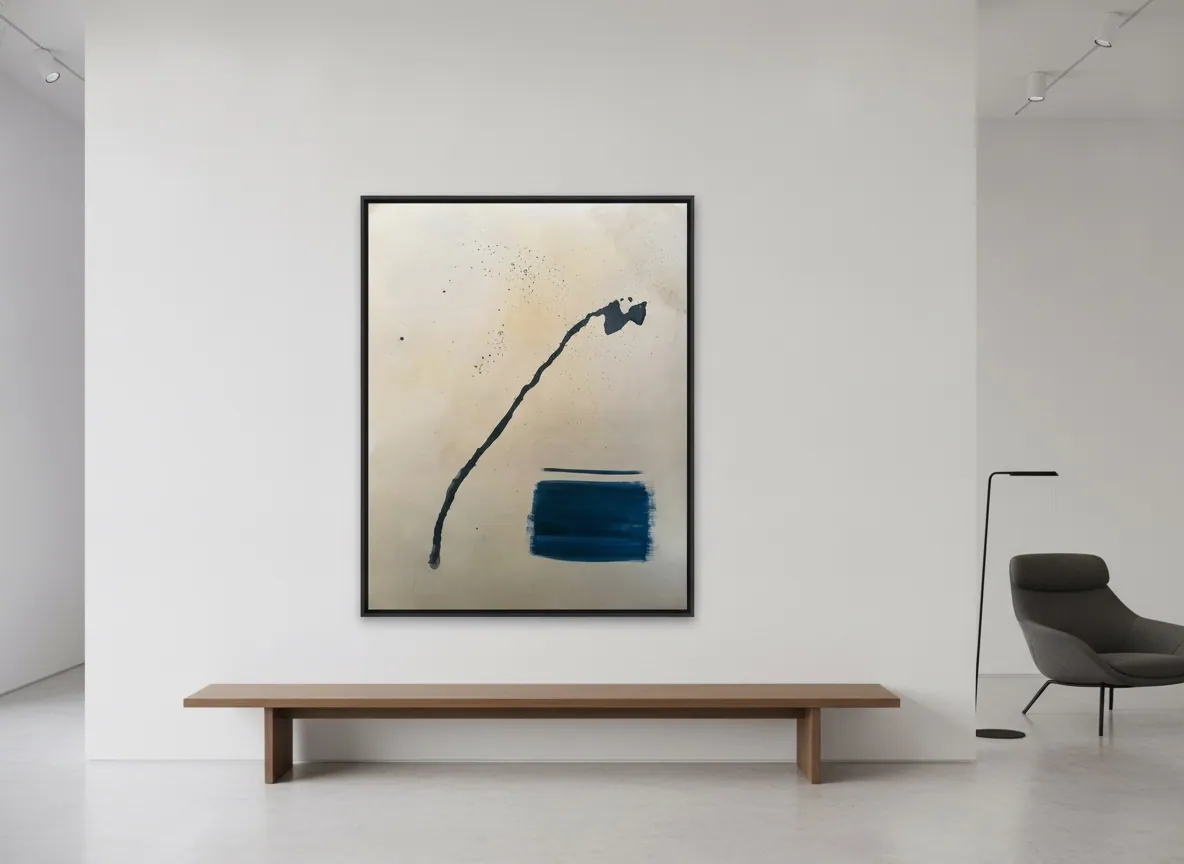
Silent Interval is a 120 x 160 cm mixed-media painting with acrylic on canvas, dated 2026 and catalogued as AP-MAS-2026-003 in the Matter & Silence series. In the work, one dark gesture descends through a field of warm bone-white and a block of blue anchors the lower edge. Its record is just as plain: medium, size, year, series, Archive ID. For a customs declaration, that plainness is useful: whoever files the entry has to describe the goods, and this record gives them medium, size, year, series and Archive ID to work from. In the studio, I see that record as part of the work: each painting is catalogued with its Archive ID and photographed in detail before it leaves.
See Silent Interval or the available works.
Frequently asked
Does Qatar charge customs duty on an original painting imported from Brazil?
In the tariff schedule published by Qatar's General Authority of Customs, hand-painted paintings under heading 97.01 show a duty rate of 5% on value. The schedule shows one rate column and no Brazil-specific line, but origin is a declaration question and rates change by decree (Customs Law, Articles 9 and 10), so the rate that applies is the one in force when the declaration is registered. A broker or the customs authority can confirm the rate in force.
Is an original painting treated differently from a print when it enters Qatar?
The tariff gives them separate headings. Heading 97.01 covers paintings executed entirely by hand, and heading 97.02 covers original engravings, prints and lithographs as the chapter notes define them. Both show 5% in the schedule read on 10 October 2026. The chapter notes exclude mass-produced reproductions from some of these headings, so a reproduction is a different classification question, and the declarant and customs decide it from the description of the goods.
Who declares the painting to GAC Qatar customs: the buyer, the seller or the carrier?
The Customs Law accepts the declaration from the owner of the goods or their authorised representative, or from a licensed customs broker (Article 109). The carrier files a separate manifest of what it carried. The law does not name the seller as declarant. Who acts in a particular shipment depends on how the buyer, courier and broker arrange it.
What documents usually accompany a painting entering Qatar?
The law requires an original or electronic detailed invoice with each declaration (the Chairman may allow clearance against a guarantee or undertaking to submit it later) and allows customs to request other documents, including an Arabic translation of a foreign-language invoice (Article 25). Goods are also subject to proof of origin (Article 23). Invest Qatar lists a longer set for commercial imports, including an import licence and a bill of lading. The studio issues a fiscal invoice or official receipt and a Certificate of Authenticity with each sale.
Do I need a customs broker to receive a painting in Qatar?
The Customs Law accepts declarations from the owner or an authorised representative who meets the requirements, or from a licensed broker (Article 109), so a broker is one route and not the only one the text names. Whether a courier or handler files the entry on the buyer's behalf is arranged between them and the broker; this text is informational and is not tax or customs advice.
Buying from Qatar?
Tell the studio which work you have in mind and where it is going, and ask for an international shipping quote.
Sources
- General Authority of Customs, State of Qatar (Integrated GCC Customs Tariff schedule PDF) — 2026-10-10
- General Authority of Customs, Customs Law, Part 2 — 2026-10-10
- General Authority of Customs, Customs Law, Part 4 — 2026-10-10
- General Authority of Customs, Customs Law, Part 3 — 2026-10-10
- General Authority of Customs, Customs Law, Part 6 — 2026-10-10
- General Authority of Customs, Customs Law, Part 5 — 2026-10-10
- General Authority of Customs, Customs Law, Part 10 — 2026-10-10
- General Authority of Customs — 2026-10-10
- General Authority of Customs — 2026-10-10
- Invest Qatar — 2026-10-10
- General Tax Authority, State of Qatar — 2026-10-10
- General Tax Authority, State of Qatar — 2026-10-10
- General Authority of Customs, Customs Law, Part 9 — 2026-10-10
Published on