Abstract art for an industrial loft: brick, concrete and big walls
Design guidance for industrial lofts points the same way: scale, texture and weight. Raw brick and concrete tend to swallow small, flat pieces, so choose fewer, larger originals with a physical surface (layered paint, texture paste, metallic or gold leaf) and a palette strong enough to hold against masonry, leaving some wall bare around them.
Why a loft wall is a different problem
The loft as a way of living began as an improvisation. By the mid-1960s landlords in SoHo were left with empty lofts too small for manufacturing, artists moved in, and in January 1971 New York's Board of Estimate made it legal for certified artists to live in SoHo's manufacturing buildings [1]. The bare structure that later became a style began as the leftovers of a factory.
That origin explains the design problem. A loft wall is not a neutral backdrop: brick, poured concrete and steel already carry texture, colour and age. Art placed against them either holds its own or disappears into them, and the usual failure is a piece that is too small and too smooth for the surface behind it.
Scale: fewer, larger, usually vertical
Designer guidance for industrial interiors is consistent on size. One gallery retailer warns that small or medium canvases look "dwarfed and lost" on a 14-foot concrete wall and recommends oversized vertical pieces or multi-panel groupings to fill tall spaces [2]. Another suggests art covering roughly two-thirds of the wall space above furniture, and pieces of at least 40 by 60 inches for the main walls of high-ceilinged lofts [3]. Treat these as retail design rules of thumb, not standards, but they point the same way.
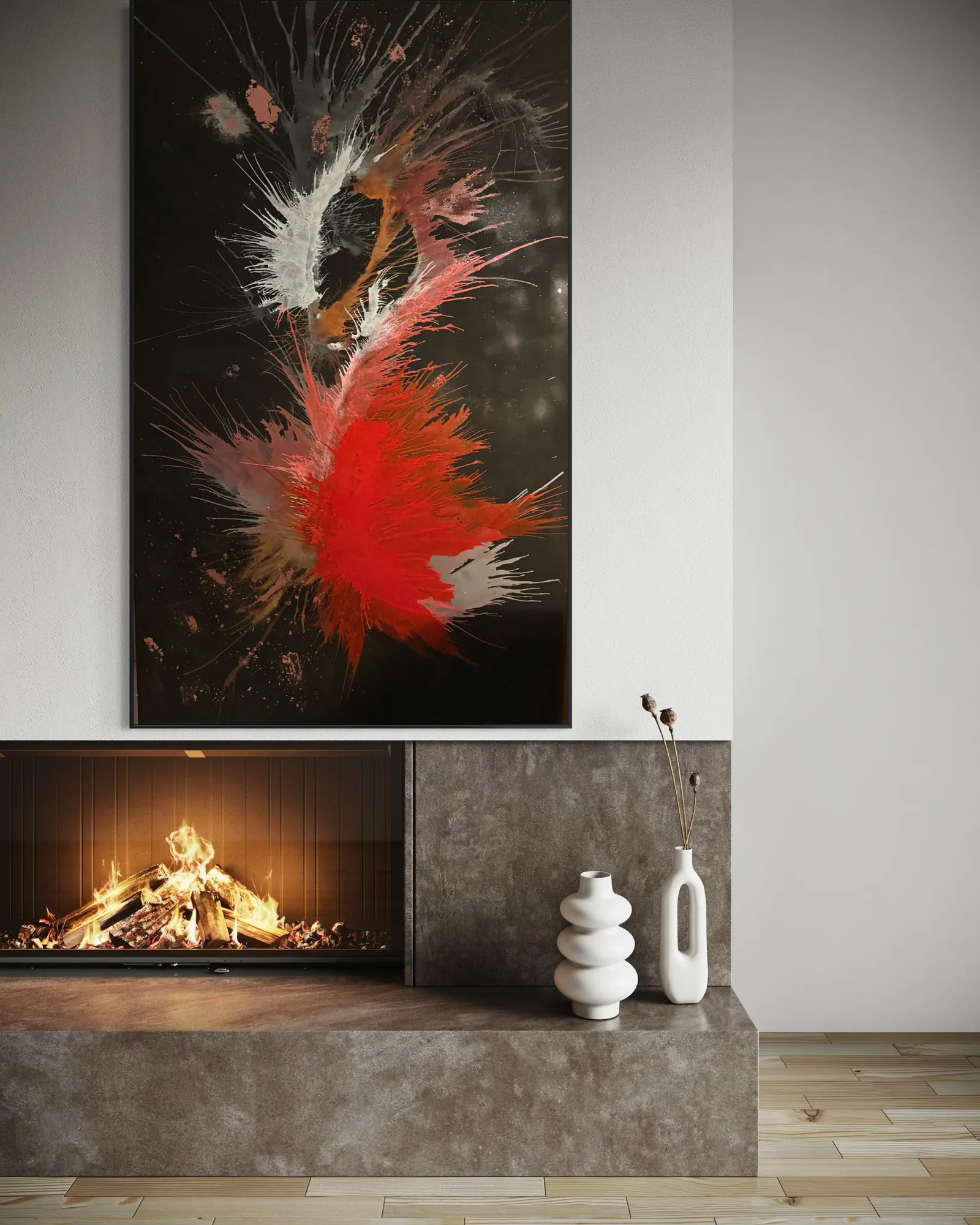
In the Perfeito Studio collection, the largest vertical original is Genesis of Flame (120 × 200 cm / 47 × 79 in, mixed media on canvas, Heart of Chaos series, R$ 8,800). At 47 × 79 inches it clears that 40 by 60 inch threshold. Smaller originals have a place too, on a narrow stretch of wall between windows or beside a doorway, but not as the single statement on a main wall. For a deeper look at height and placement on tall walls, see art for a double-height wall.
Texture and colour against brick and concrete
The same sources agree that surface matters as much as size. A smooth, flat print is described as being swallowed by the uneven texture of raw brick, while heavy palette-knife layers cast small shadows that echo the roughness of the wall [2]. On colour, the advice is high contrast against red-brown masonry (rich blacks, stark whites, metallic gold leaf, deep primaries) and warm, high-energy hues such as burnt orange or fiery red against grey concrete [2]. The same guidance advises leaving some brick exposed around a piece rather than covering the architecture [3].
Two works in the studio's catalogue fit that description on paper, and neither is a loft-specific commission. Genesis of Flame pairs red and metallic pigment on a dark ground, in acrylic with high-gloss and matte finishes. Golden Passage (60 × 80 cm / 23.6 × 31.5 in, Black & Gold series, R$ 3,500) uses texture paste and imitation gold leaf on canvas; at that size it suits a secondary wall or a bay between structural elements better than a main wall. Looking closely at how such surfaces work is its own skill, covered in how to look at an abstract painting.
Hanging on brick or concrete
Masonry changes how a painting is mounted, and the right fixings depend on the wall, the weight of the canvas and the hardware's manufacturer ratings, none of which this page can judge for your wall. The studio's guide to hanging a painting on a concrete or masonry wall covers the method. For a large canvas, having a professional installer assess the wall is the safer course.
An original, not a print
Everything on this site is a unique original: each painting is signed and catalogued under an internal Archive ID. An acquisition is made directly from the artist and includes a signed Certificate of Authenticity, a fiscal invoice or official receipt, an Artwork Acquisition Agreement, an artist dossier, conservation guidance and professional packaging. The studio ships within Brazil and internationally; freight is quoted per destination and paid by the buyer, as are any import duties or taxes abroad. Domestic delivery takes up to 15 business days depending on destination. The full process is in how to buy a painting from Perfeito Studio, and a related question of scale in a social room is addressed in large abstract painting for a living room.
From the studio
From the studio
I trained as an architect, so I tend to read a wall before I read a painting. Genesis of Flame is 120 × 200 cm, mixed media with acrylic, metallic pigment and both high-gloss and matte finishes, and its surface was made for close looking rather than for any particular wall. I have not placed it against a specific brick or concrete wall, so I would not promise how it reads there. In a loft I would start from the wall's height and width before choosing any work.
Frequently asked
What art looks good on exposed brick?
Design guidance for brick walls favours pieces with their own physical surface and enough contrast to stand apart from red and brown masonry: deep darks, strong whites, metallic or gold leaf accents and saturated colour. Smooth, flat work tends to be lost against the wall's irregular texture. Scale matters as much as palette, and leaving some brick visible around the frame keeps the architecture from being covered. These are design rules of thumb rather than fixed standards.
Do industrial lofts need oversized art?
Not always, but tall, open walls usually reward larger pieces. Retail design guides suggest oversized vertical canvases for high ceilings and a minimum of roughly 40 by 60 inches on main walls, and they warn that small canvases look lost on large concrete surfaces. Smaller works still suit narrow stretches of wall between windows or beside doorways, as a supporting element rather than the statement piece.
What is the difference between buying an original and a print for this?
An original is a single, unique object made by hand, with a physical surface of layered paint, texture paste or leaf that interacts with a rough wall. Perfeito Studio sells originals only. Each painting is signed and catalogued under an Archive ID and comes with a signed Certificate of Authenticity and an Artwork Acquisition Agreement. The studio does not sell prints and does not set or quote secondary-market values.
How does Perfeito Studio ship an original painting?
The studio ships within Brazil and internationally. Freight is quoted per destination, by postcode within Brazil, and is paid by the buyer, as are any import duties or taxes in the destination country. Professional packaging is included, and transit insurance is available. Domestic delivery takes up to 15 business days depending on destination; international shipping is quoted on request.
What comes with an original from Perfeito Studio?
Every acquisition is made directly from the artist and includes the original painting, a signed Certificate of Authenticity with the full technical record and Archive ID, a fiscal invoice or official receipt, an Artwork Acquisition Agreement covering ownership, copyright and image use, an artist dossier, conservation and care guidance, and professional packaging. The certificate carries a QR code linking to the work's official page.
Planning art for a loft wall?
Send the wall's dimensions and a photograph, and the studio will say whether a work suits it.
Sources
- Urban Omnibus — 2026-10-10
- Trend Gallery — 2026-10-10
- Rossetti Art — 2026-10-10
Published on · Updated on