Replacement value or fair market value: which number should a painting's appraisal use?
They answer two questions. Replacement value is what it would cost to get the painting again today, and insurers use it to set coverage. Fair market value is what a willing buyer would pay a willing seller, and the IRS uses it for donations. Order the appraisal that matches the person asking.


One painting, two people asking for a value
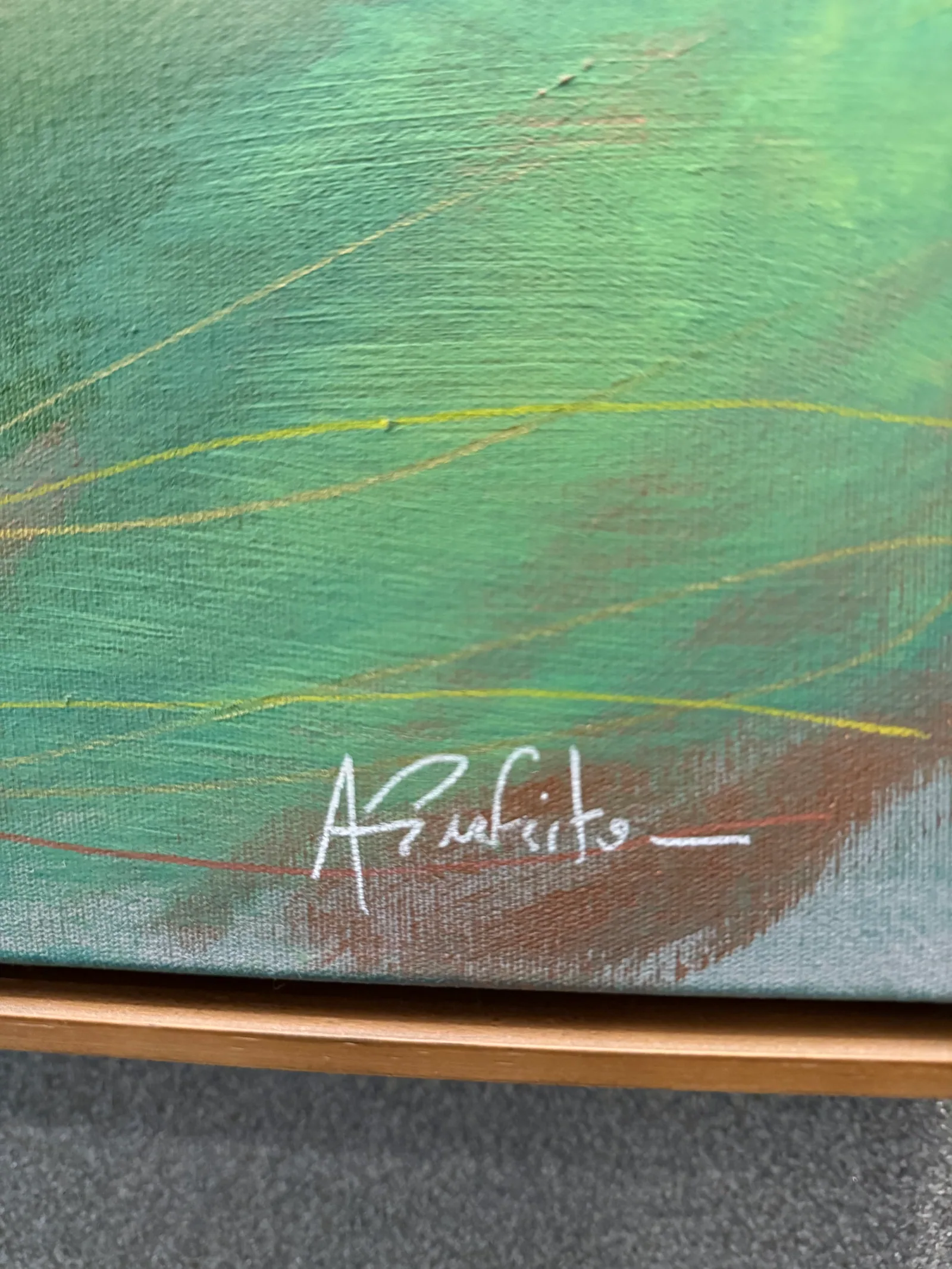
Golden Passage is a 60 × 80 cm canvas from 2025: mixed media, texture paste and imitation gold leaf (metallic leaf) laid over rows of black relief. Say you bought it, and within a year your insurer asks what it is worth. Then your accountant asks the same thing about a planned donation.
They want different numbers. The insurer wants to know what a claim would cost to settle. The tax authority wants to know what the painting would fetch if it changed hands. An appraiser can write either report, and the first thing a good one will ask is who will read it.

What fair market value means for the IRS
IRS Publication 561, which covers the value of donated property in the United States, says it plainly: "FMV is the price that property would sell for on the open market." The test is a sale between a willing buyer and a willing seller who both know the relevant facts and are not forced into the deal.
The same publication addresses replacement cost directly. "In most cases, there is no relationship between the replacement cost and the FMV," and when replacement cost is used at all there must be a reasonable relationship between the two. Its worked example is a piece of jewellery: the insured value "does not reflect what a willing buyer and willing seller would pay" and reflects only the replacement cost on the day of the appraisal.

Why the insurance figure usually comes out higher
Replacement value prices the act of getting a comparable work back. For an original painting that can mean buying a comparable work at retail and paying to ship it home. Fair market value looks at the other side of the trade: what you could realistically sell it for, which tends to be lower than what you would pay to replace it.
A standard home policy is the second reason the number matters. The Insurance Information Institute notes that the theft limit for valuables in a standard policy is "generally about $1,500" and that a separate floater, scheduling each item, gives "the broadest protection for valuables". Before a floater is written, the items "must be professionally appraised". The III page names jewellery and collectibles; ask your own insurer how it treats paintings.
Which appraisal to order
For insurance, ask for a replacement value appraisal and keep a copy with the policy. For a charitable donation in the United States, the IRS asks for fair market value: Publication 561 says a deduction of more than $5,000 for art must be supported by a qualified appraisal, and for a deduction of $20,000 or more the appraisal itself has to be attached to Form 8283. An insurance appraisal cannot stand in for the tax one.
Give the appraiser the same file every time: purchase invoice, certificate, photographs of both sides with the signature visible, and the measurements. The tax rules above are US federal rules; outside the United States, or when your case is unusual, ask your accountant or lawyer.

For those about to acquire
Every acquisition from the studio is direct from the artist and includes a signed Certificate of Authenticity with the technical record, the internal Archive ID and a QR code to the work's official page; a fiscal invoice or official receipt; and an Artwork Acquisition Agreement covering transfer of ownership, copyright and image use (see acquisition and the certificate). The invoice gives an appraiser a dated purchase price, and the Archive ID ties each document to one canvas.
Elemental Veins (R$ 6,400, AP-TAE-2025-001) is 1.4 m tall, mixed media with acrylic and metallic fragments; a raking light picks up the fragments. Vibrant Awakening (R$ 5,900, AP-LMR-2025-003) is 1.5 m tall and reads best from across a dining table. Golden Passage (R$ 3,500, AP-BNG-2025-001) fits above a sideboard. Tape the rectangle on the wall before deciding.
Shipping is quoted per destination and paid by the buyer, with professional packaging included and transit insurance available; international shipping is quoted on request (see shipping). Other works are in the gallery.

Available works
-
 Golden Passage
60 x 80 cm (23.6 x 31.5 in) · R$ 3.500
-
 Golden Passage
60 x 80 cm (23.6 x 31.5 in) · R$ 3.500
-
 Vibrant Awakening
100 x 150 cm (39 x 59 in) · R$ 5.900
-
 Vibrant Awakening
100 x 150 cm (39 x 59 in) · R$ 5.900
-
 Elemental Veins
90 x 140 cm (35 x 55 in) · R$ 6.400
-
 Elemental Veins
90 x 140 cm (35 x 55 in) · R$ 6.400
From the studio
From the studio
The Archive ID printed on the certificate matches the work's page: AP-BNG-2025-001 is Golden Passage, 60 × 80 cm, with imitation gold leaf sealed with a spray sealant. An appraiser who reads the medium line will see metallic leaf there, and the studio writes it that way on every document.
Frequently asked
What is fair market value for a painting?
IRS Publication 561 defines fair market value as the price property would sell for on the open market, between a willing buyer and a willing seller who both know the relevant facts and are not forced into the deal.
Why is an insurance appraisal usually higher than fair market value?
An insurance appraisal estimates what it would cost to replace the painting, which can include buying a comparable work at retail and shipping it home. Fair market value estimates what it would sell for. IRS Publication 561 notes that in most cases there is no relationship between replacement cost and fair market value.
Can I use my insurance appraisal for a tax deduction?
In the United States, no. IRS Publication 561 treats an insured value as replacement cost, which is a different figure from fair market value. A donated artwork claimed at more than $5,000 needs a qualified appraisal, attached to Form 8283 when the deduction is $20,000 or more. Talk to your accountant.
Is the purchase invoice enough for insurance?
The invoice dates the purchase and the price, and it belongs in the file. For a scheduled floater, the Insurance Information Institute says items must be professionally appraised first, so ask your insurer what it requires.
A painting with its paperwork ready
Each work leaves with a signed certificate and an invoice or receipt. Send the studio your wall size and destination.
Sources
- Internal Revenue Service — 2026-11-26
- Insurance Information Institute — 2026-11-26
- Perfeito Studio — 2026-11-26
- Perfeito Studio — 2026-11-26
- Perfeito Studio — 2026-11-26
- Perfeito Studio — 2026-11-26
Published on
Edited and reviewed by: Alyne Perfeito, architect and visual artist · CAU A1023098
Alyne Perfeito is a trained architect and visual artist with a studio in Brasília, Brazil. She edits and reviews the Journal from her painting practice. See Alyne's works →