Oversized abstract painting: carrying, hanging and living with a statement piece
An oversized abstract painting is a three-part job: plan the route before it arrives, carry it with two people, and choose fixings for its weight before you choose a height. Then give it one wall and clear space around it. At Perfeito Studio, the largest original is 120 × 200 cm.
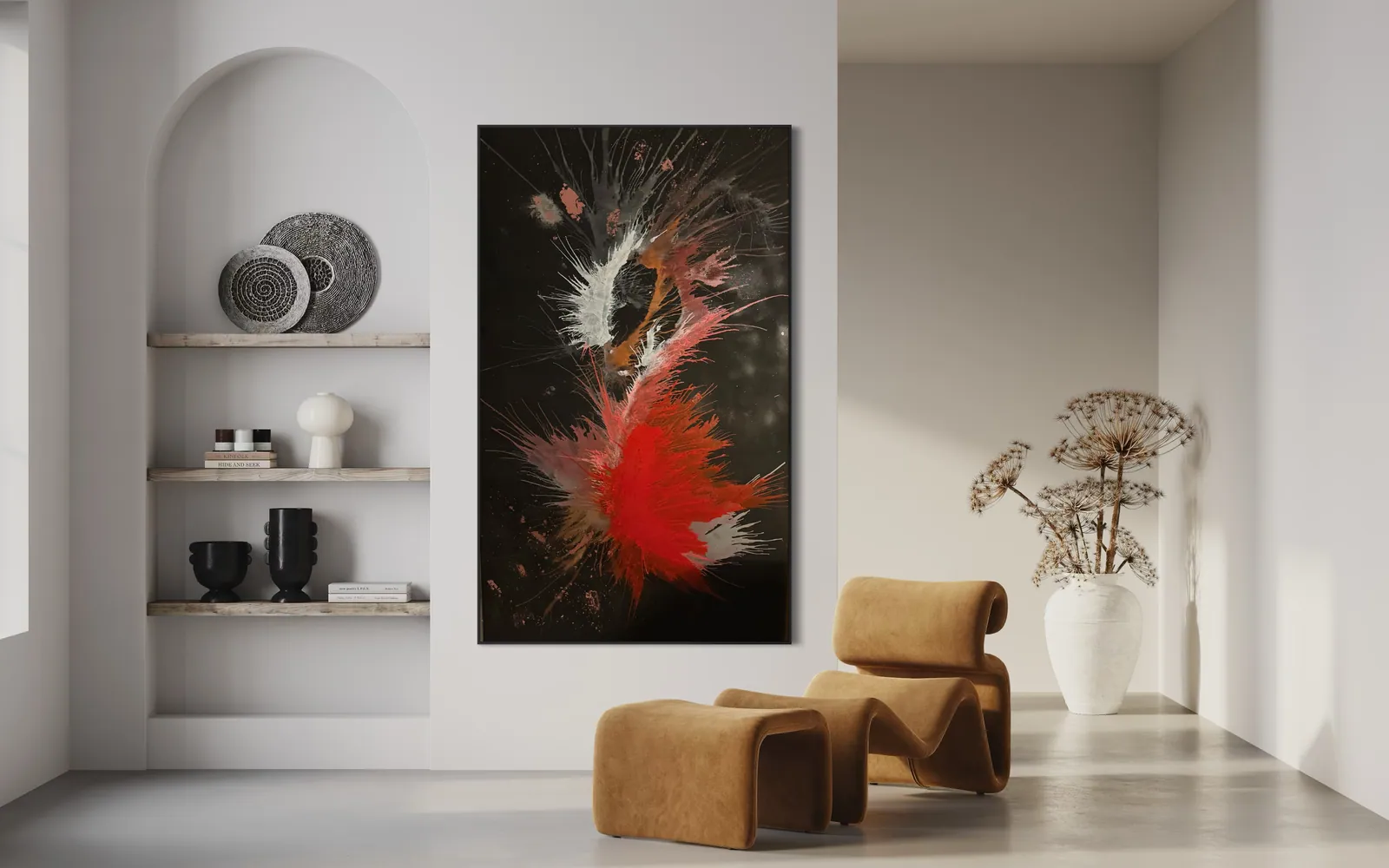
Start with the route, not the wall
Most trouble with a very large canvas happens before it reaches the wall. The Canadian Conservation Institute lists underestimating a painting's weight and not seeking help with lifting and moving among the most common causes of handling damage, and asks handlers to confirm that the intended route will accommodate the painting, the frame and the people carrying it [1]. For an oversized work that means measuring the whole path: the entrance, each doorway, the corridor, any turn, the lift or the stairwell, and the final room.
Take three numbers for the painting and three for the route. For the painting: width, height and depth. At the studio those figures are in the work's page, for example Genesis of Flame at 120 × 200 cm (47 × 79 in) and Silent Interval at 120 × 160 cm (47.2 × 63 in). For the route: the narrowest clear opening, the tightest turn, and the lowest ceiling the painting has to pass under while tilted. The diagonal logic, and what to do when a stairwell is the limit, is worked through in will a large painting fit in the lift and up the stairs.
Carrying: two people, hands on the edges
The same Institute guidance says a minimum of two people are needed to carry an easel-sized painting, and that larger paintings need multiple handlers and spotters [1]. It describes a grip in which each handler places one hand along the lower edge or bottom corner and the other along one side toward the top corner, with the painting carried so that its front surface faces the carriers. It also says never to carry a painting by its hanging wire, by the top of its frame or by any one side alone [1].
For heavy or oversized works the Institute prefers moving equipment such as an A-frame trolley, and recommends supporting frames built for handling, travel and storage for oversized paintings, especially unframed ones or those with sensitive, high-impasto surfaces [1]. That is museum practice, and a home move does not need a museum's kit. It does explain why a large canvas should not be a one-person carry, and why the route should be clear of furniture before anyone lifts.
Hanging: choose the fixings before the height
A large piece asks more of the hardware than a small one, and the strain of a hanging wire can pull a D-ring out of the frame. One practical guide on heavy pictures advises against wire and D-rings for very heavy works, and describes hanging the picture's rings or loops straight over two static, robust hooks on the wall, with no wire or chain involved [2]. The wall decides the rest. For specific wall types, see drywall, plaster and concrete. For a work this large, confirm what is behind the wall before marking any hole.
Height comes second. A common gallery rule puts the centre of the artwork at 57 inches (about 145 cm) from the floor, to match average eye level [3]. On a 200 cm tall canvas that rule is plain arithmetic: the bottom edge sits near 45 cm from the floor and the top near 245 cm, so confirm that the ceiling clears that height with the hardware. Over a sofa or console the rule yields, and the same source suggests keeping the bottom edge a few inches above the furniture [3]. The full height guide is here, and the stair-wall variant is here.
Living with it: one wall, some air, and the light
A statement piece works when it is given the room's attention. In the studio's experience, an oversized abstract painting reads best as the only large element on its wall, with furniture kept low enough that the lower edge stays visible and enough bare wall around it that the eye can rest. A second large piece on the same wall splits the attention, and a gallery arrangement is a different project, covered in how to hang a gallery wall of art. For sizing against a sofa, see choosing a large abstract painting for a living room.
Light matters more for textured surfaces. In our experience, side light from a window crosses the relief of a worked surface and changes how it reads through the day, so it is worth watching the wall at morning and at evening before you commit. Because the surface is physical, with texture, pigment and gloss or matte areas, in the studio's experience the work is also best seen from two distances: across the room for the composition, and close up for the surface. How to approach it slowly is set out in how to look at an abstract painting.
From the studio
What I check before a large work leaves the studio
I trained as an architect, so I read the route into a house the way I read a plan: where the work enters, where it turns, where it is lifted. When someone is considering one of the larger paintings, such as Genesis of Flame or Silent Interval, I would rather ask about the stairwell and the lift than discover a problem on delivery day.
Most of my works ship unframed, with the gallery edges finished, so there is no extra frame to weigh on the wall. I will not give a weight figure here, because I do not publish weights for individual pieces, so measure the route and the wall before you decide.
Frequently asked
How do you get an oversized painting through a door?
Measure the narrowest opening on the whole route, the tightest turn and the lowest ceiling, then compare them with the painting's width, height and depth. A canvas can often pass tilted when it cannot pass flat, but stairwell turns and lift doors set the real limit. If you are weighing one of the larger works, you can send the studio photos and measurements and talk it through before deciding.
Can an oversized painting hang without a frame?
Yes. Most works from Perfeito Studio ship unframed, with the gallery edges finished and ready to hang, so no external frame is needed. Whether to add one is a design choice about the room rather than a requirement. If you are considering it, how to choose a frame for a contemporary painting sets out the options. The hardware still has to suit the weight of the piece.
What is the difference between buying an original and a print for this?
Perfeito Studio sells original paintings only. Each is unique, signed and catalogued with an Archive ID, and it comes with a signed Certificate of Authenticity and an artist dossier. The surface you see is the one the artist made: layers of texture, pigment and, in one series, gold leaf. That documentation and the physical surface are what an original adds to the image itself.
How does Perfeito Studio ship an original painting?
The studio ships within Brazil and internationally. Shipping is quoted per destination and paid by the buyer, as are any import duties or taxes in the destination country. Professional packaging is included and transit insurance is available. Domestic delivery takes up to 15 business days depending on destination, and international shipping is quoted on request. Collection in person after purchase is also possible.
What comes with an original from Perfeito Studio?
Every acquisition is direct from the artist and includes the original painting, a signed Certificate of Authenticity with the technical record and Archive ID, a fiscal invoice or official receipt, an Artwork Acquisition Agreement, an artist dossier, conservation and care guidance, and professional packaging. The certificate carries a QR code linking to the work's page on perfeitostudio.com, so provenance can be checked at any time.
Considering one of the larger works?
Send photos of the entrance, the narrowest point on the route and the wall, with measurements. We can talk through whether it is likely to fit before you decide.
Sources
- Canadian Conservation Institute (Government of Canada), CCI Notes 10/13 Basic Handling of Paintings — 2026-10-12
- Making a Mark (art blog) — 2026-10-12
- Park West Gallery — 2026-10-12
Published on