Quiet luxury and abstract art: what restraint looks like on a wall
In a quiet luxury interior, the abstract painting that fits is a single original with a tonal field and a surface worth reading, hung with empty wall around it. The trend is defined by what it leaves out: visible logos and other open markers of wealth. What follows for art is a design judgement, not a rule.
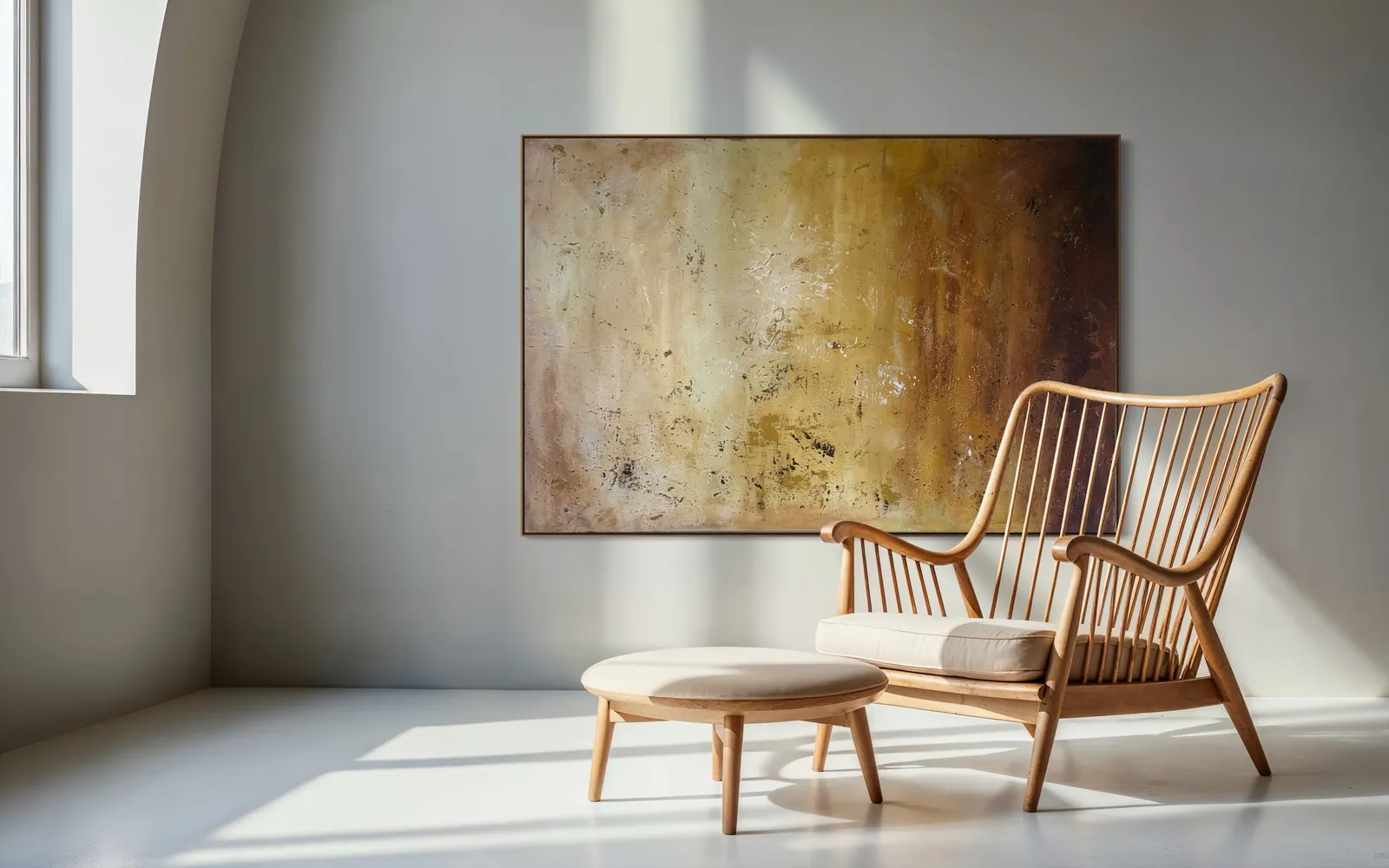
What "quiet luxury" means, and where the term comes from
Quiet luxury is a fashion and consumption term. Wikipedia's entry describes it as an aesthetic of dress and consumption marked by understated elegance, high-quality materials and timeless styling, with no visible logos or other open markers of wealth. An article in the Berkeley Technology Law Journal places its rise to prominence in the fashion industry in 2023 and describes products marketed without logos, or with low-key ones, in muted colours and sustainable materials.
Interior design writing now uses the same label, and the writing around it is loose. Decorilla, an online interior design service, frames it as quality over quantity, where the worth lies in craftsmanship, materials and design rather than in a logo, and pairs it with a neutral palette and textured natural materials. The furniture retailer City Home describes a neutral foundation of beige, cream, grey and soft taupe, with tactile richness layered on top.
Decorilla's article does not discuss wall art, so everything below about paintings is design judgement built from those descriptions, not a claim any of them makes. A related but different idea is the minimalist room, which asks how few objects a room needs; the studio's guide to minimalist interiors and abstract art covers that question. Quiet luxury asks something narrower: what a single object does when it is not allowed to announce itself.
Restraint on a wall: tone, surface and empty space
If the principle is that worth should sit in the material and not in a mark of ownership, three things follow for a painting.
- Tone before colour. The palettes described are neutral and tonal. A canvas built from one narrow family, such as bone, sand, umber or stone, sits inside that vocabulary. Saturated colour is not forbidden, but it has to be rationed: a single accent inside a quiet field can hold, while a canvas whose main field is one saturated hue becomes the subject of the room, which is the opposite of quiet.
- Surface where a logo would be. If a quiet room is judged by material and finish, a painting can carry its weight the same way: through how it was made, in relief, layered pigment or a worked ground, rather than through an image that is understood in a second and then finished.
- Empty wall as part of the picture. One considered work with room around it reads as a decision. A crowded wall reads as accumulation, which is what the style sets itself against.
Surface only helps if light reaches it. The National Gallery defines raking light as lighting a painting from one side only, at an oblique angle to its surface. The same entry adds that the technique is used to reveal a painting's surface texture: raised paint facing the light is lit, and paint facing away creates shadow. Whether your wall gets side light of that kind is something only your own room can answer. How to use that on your own wall is covered in how to light a textured painting.
Three works from the studio, three kinds of quiet
The three paintings below are listed in the studio's collection. Prices are in Brazilian real and are set by the studio. They show three different ways a painting can stay restrained.
- By relief: Echo of Silence (Matter & Silence, 2025; 50 × 70 cm; sculpted texture on canvas; BRL 2,400). A monochrome white surface with concentric reliefs and organic folds. There is no colour to manage: what the eye reads is the relief itself.
- By one gesture: Silent Interval (Matter & Silence, 2026; 120 × 160 cm; mixed media with acrylic on canvas; BRL 7,900). A warm bone-white field, one dark line descending through it and a single block of blue near the lower edge. The blue is the one saturated note, and it holds because the bone-white field around it is so large; the painting asks for a wall wide enough to leave quiet space on both sides.
- By tonal depth: Amber Strata (Terra & Ether, 2026; 150 × 100 cm; mixed media with acrylic on canvas; BRL 6,700). Ochre, bone and oxidised umber in horizontal passages. It is the most colourful of the three and still stays in one family of tones, which is why it sits easily in a room of warm neutrals.
None of the three is neutral because it is empty. Each is restrained because its decisions are few and its surface carries the rest. For choosing a size against furniture, see choosing a large abstract painting for a living room.
Original or print: where the material argument leads
Tate's glossary defines an edition as a copy or replica of a work of art made from a master, most commonly a series of identical impressions printed from the same surface. Prints have their place. The point here is narrower: if the worth of a quiet room lies in material and craft, then relief and layered pigment are the things a flat reproduction cannot carry, because they are physical features of the surface, which a reproduction printed flat does not have.
Perfeito Studio sells originals only. Each painting is unique, signed and catalogued under an Archive ID, and every acquisition is direct from the artist.
Before you buy: look at the painting on your own wall
Measure the free width of the wall, photograph it at the hours the room is actually used, and note where the daylight comes from. A quiet painting depends on its surroundings more than a loud one does, because there is less in it to compete with the room.
The work can be seen in person in Brasília by appointment. For a buyer elsewhere, the studio sends additional detail photographs and video of a specific work on request through WhatsApp, which is the closest substitute for watching a relief change under your own light. The full catalogue is on the gallery page.
From the studio
From the studio
I am an architect by training, and I made Amber Strata (150 × 100 cm, mixed media with acrylic on canvas, 2026) to stay inside a narrow range: ochre, bone and oxidised umber, built in horizontal passages. The dark marks settle across the field like mineral debris, and the gold is only small flecks that catch the light at irregular intervals.
Gold is a risk in a restrained room. Here it appears only in small flecks, which is why they are found rather than seen. That is what I mean by quiet: the painting adds depth to a room of few tones without adding a new colour.
Frequently asked
What is quiet luxury in home decor?
Quiet luxury is a trend term that rose to prominence in fashion, where it describes logo-less, understated, high-quality goods. In interiors, design writing uses it for a neutral palette, natural and tactile materials, and craftsmanship in place of a visible logo. There is no single formal definition for homes, so treat it as a direction of taste, not a checklist.
What art suits a quiet luxury interior?
As a design judgement, one original abstract painting with a narrow tonal palette and a visible surface, such as relief, layered pigment or a worked ground, tends to suit the style, with empty wall around it. A canvas dominated by one saturated colour or a crowded arrangement works against the restraint. Check the size against the free width of the wall and look at the work in your own light.
What is the difference between buying an original and a print for this?
An original is a single, physically made object; a print reproduces an image, and Tate describes an edition as a copy made from a master. In a quiet room the surface matters most, and relief or layered pigment are physical features that a flat reproduction does not have. Perfeito Studio sells originals only: each is unique, signed and catalogued with an Archive ID.
How does Perfeito Studio ship an original painting?
The studio ships within Brazil and internationally. Shipping is quoted per destination and paid by the buyer, as are any import duties or taxes in the destination country. Professional packaging is included and transit insurance is available. Domestic delivery takes up to 15 business days; international shipping is quoted on request. This text is informational and is not tax or customs advice; confirm with the customs authority or a broker.
What comes with an original from Perfeito Studio?
Every acquisition is direct from the artist and includes the original painting, a signed Certificate of Authenticity with the technical record and Archive ID, a fiscal invoice or official receipt, an Artwork Acquisition Agreement, an artist dossier, conservation and care guidance, and professional packaging. The certificate carries a QR code linking to the work's official page, so provenance can be verified at any time.
Looking for one restrained piece for a quiet room?
Send a photo of the wall and the light it gets, and the studio will tell you which works suit it.
Sources
- Wikipedia — 2026-10-10
- Berkeley Technology Law Journal (Devangini Rai) — 2026-10-10
- Decorilla (Katarina Skipic, 1 Jul 2026) — 2026-10-10
- CITY HOME — 2026-10-10
- The National Gallery, London — 2026-10-10
- Tate — 2026-10-10
- Perfeito Studio — 2026-10-10
Published on