What does 'hand-embellished' mean on a canvas listing?
"Hand-embellished" usually means a printed canvas to which paint, gel or leaf has been added by hand. The base is a reproduction; the hand work is an addition. It is not, by itself, an original painting. How much was added varies widely, so the useful move is to ask the seller to describe it.
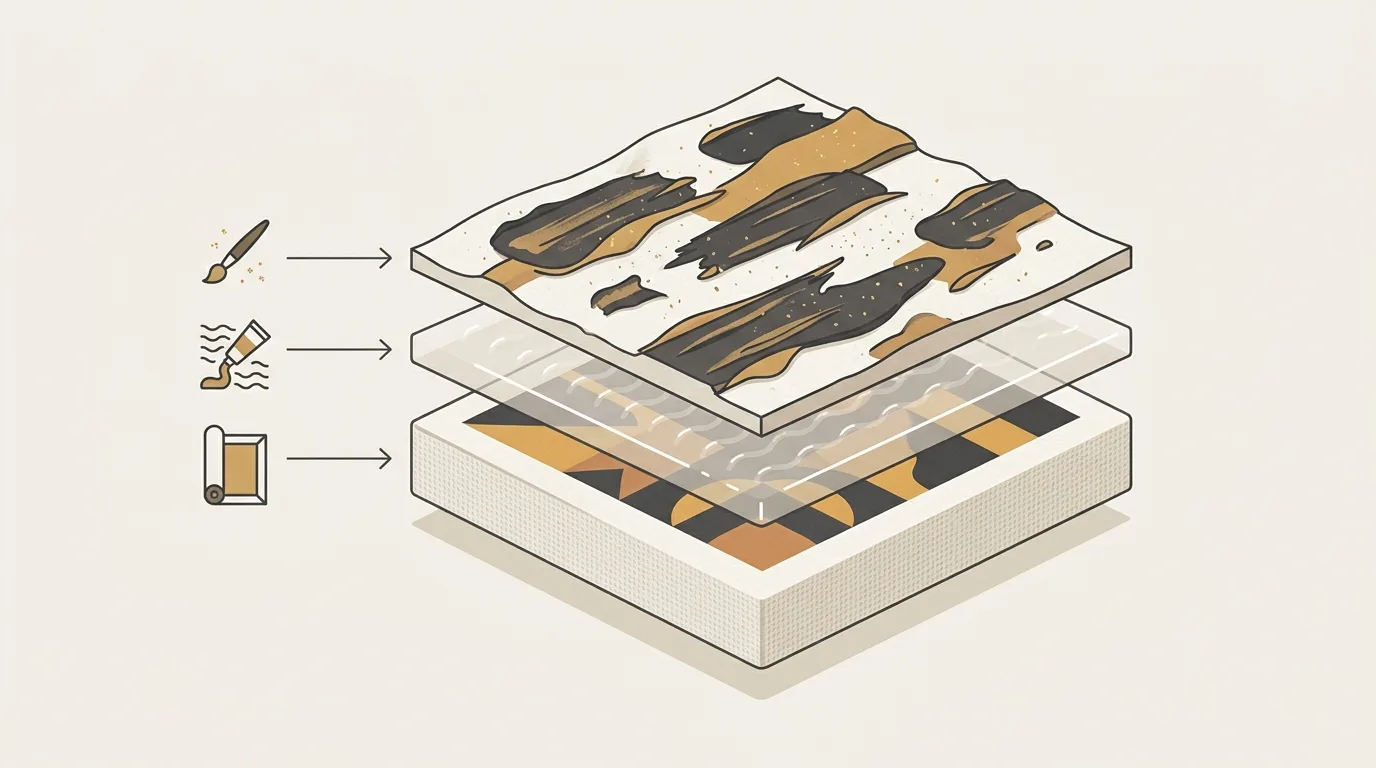
What the term usually means
Dealer glossaries describe a hand-embellished canvas as a digital print, commonly a giclée, that an artist or a skilled craftsperson then enhances by hand, adding detail, texture or accents. One glossary names coloured acrylic paint and clear acrylic gel; another adds gold leaf, oil paint and texture medium. A third describes the process as painting over areas of the image to enhance colour or add brush strokes.
None of the sources consulted treats the word as a defined or regulated term, and the glossaries here come from sellers rather than from a museum or a standards body. Treat them as a description of common trade usage, not as a legal definition.
Three layers, and where the question lies
It helps to picture the object as three layers, as in the diagram above: the printed image on canvas; a transparent gel or medium; and the paint or leaf applied by hand on top. Any of the three can be thin or substantial, and a listing rarely says which.
The sources consulted give no fixed proportion. One describes embellishment as running from a thin layer of paint to a great deal of texture. That range is the point: the phrase can cover a few touched-up highlights or extensive overpainting, and the word alone does not tell you where a given piece sits.
Original, print or something in between?
Per the glossaries, the base image is a reproduction, so the piece is a print with hand work added. Tate defines an edition as a copy made from a master. A painting made directly on a blank canvas, with no printed image underneath, is a different object: it is the single physical work. For that distinction in more detail, see original painting vs. decorative print from a store.
Embellishment is not inherently misleading. It becomes a problem only when the wording suggests more hand work, or more singularity, than the piece has.
Editions, and what Tate says about them
Tate notes that since the late nineteenth century print runs have typically been capped and labelled a limited edition, and that editioned prints are usually signed and numbered, a run of twenty-five being numbered 1/25 and so on. A listing that says "limited edition" should therefore state the size of the run. For more on how to read this, see edition or unique work.
What to ask the seller
Concrete questions replace a vague word. Is the base a giclée or another print, and on what substrate? What was added by hand: paint, gel, leaf? Roughly what share of the surface was touched? Who did the hand work? Is the piece part of a numbered edition, and what is the size of the run? What documentation comes with it? A seller who can answer these in writing is giving you what you need to compare listings. For a wider checklist, see how to read an art listing line by line.
Nothing here suggests that an embellished piece will gain or hold value; judge the price against what the object is.
From the studio
From the studio
The studio sells original paintings only, made directly on canvas, so we come at this question from the other side. Take Golden Passage, from the Black & Gold series: 2025, mixed media, texture paste and imitation gold leaf on canvas, 60 x 80 cm. Every layer in it, from the paste to the leaf, is built on the one canvas, and nothing sits on top of a printed image.
Because each work is unique and documented with a certificate and an Archive ID, the description can stay plain: what it is made of, how large it is, when it was painted. Listings are easier to compare when sellers do the same. You can see the original paintings in the gallery; prices run from R$ 2,400 to R$ 8,800.
Frequently asked
Is a hand-embellished canvas an original painting?
Usually not. The glossaries describe it as a print, commonly a giclée, enhanced by hand afterwards, so the base image is a reproduction of a work that exists elsewhere. The hand work is real, but it is added to a print. A painting made directly on blank canvas, with no printed image underneath, is a different object. If a listing leaves this unclear, ask in writing what the base layer is.
How much of it is actually painted?
There is no standard answer. One source describes embellishment as anything from a thin layer of paint to a great deal of texture, and none of the glossaries consulted gives a fixed proportion. The term can cover a few touched-up highlights or extensive overpainting. Ask the seller what was added, with what materials, and roughly how much of the surface was touched.
Is it a limited edition?
It can be. Some sellers offer embellished pieces as part of a numbered edition, but the word embellished does not say so by itself. Tate notes that editioned prints are usually signed and numbered, a run of twenty-five being numbered 1/25 and so on. A trustworthy listing states the run size and the number of your copy. Ask for both, and for whether the piece is signed.
Does hand-embellished add value?
It adds work, but nothing in the sources supports a claim that it holds or raises value later. Resale is unknowable, and this page suggests no outcome. Judge the price against what the object is: a reproduction with hand additions, in a stated edition, with the documentation you were promised, rather than against an original painting.
How do I ask a seller to describe it?
Ask specific questions and ask for the answers in writing. What is the base print and the substrate? What was added by hand, and who did it? Roughly how much of the surface? Is it numbered, and what is the run size? What documentation comes with it? A plain, complete reply lets you compare listings on the same terms.
Looking for a painting made directly on canvas?
Each work is unique and comes with a signed certificate of authenticity. Write to the studio about a specific work, or ask for detail photographs.
Sources
- Choice Fine Art (dealer glossary) — 2026-10-17
- Frances Yvette Art (artist site) — 2026-10-17
- ArtShop NC — 2026-10-17
- Tabor Gallery (dealer glossary) — 2026-10-17
- Tate — 2026-10-17
- Perfeito Studio (src/data/obras.json) — 2026-10-17
Published on · Updated on