What happens when customs opens the crate holding a painting?
Customs authorities may select a shipment, open the crate and check the contents against the declaration. In the United States and Canada the agency says the importer must make the goods available and cover related handling costs; the UK’s HMRC publishes its own powers. Opening a crate is routine control, not a verdict on the painting.
Why a crate is opened at all
An inspection is a control of what the shipment contains against what was declared. The agencies read here describe the power in their own terms. U.S. Customs and Border Protection (CBP) states that it has a right to examine any shipment imported into the United States, and that no distinction is made between commercial and personal shipments. In the United Kingdom, HMRC’s published policy on its examination powers says it can examine goods away from ports and require the premises operator to open or unpack a container. The Canada Border Services Agency (CBSA) describes examinations as conducted thoroughly but efficiently, so as not to impede the free flow of goods.
Selection is the agency’s decision. None of these sources lists a rule that singles out paintings, so a crate holding a canvas is treated, for selection purposes, as any other shipment.
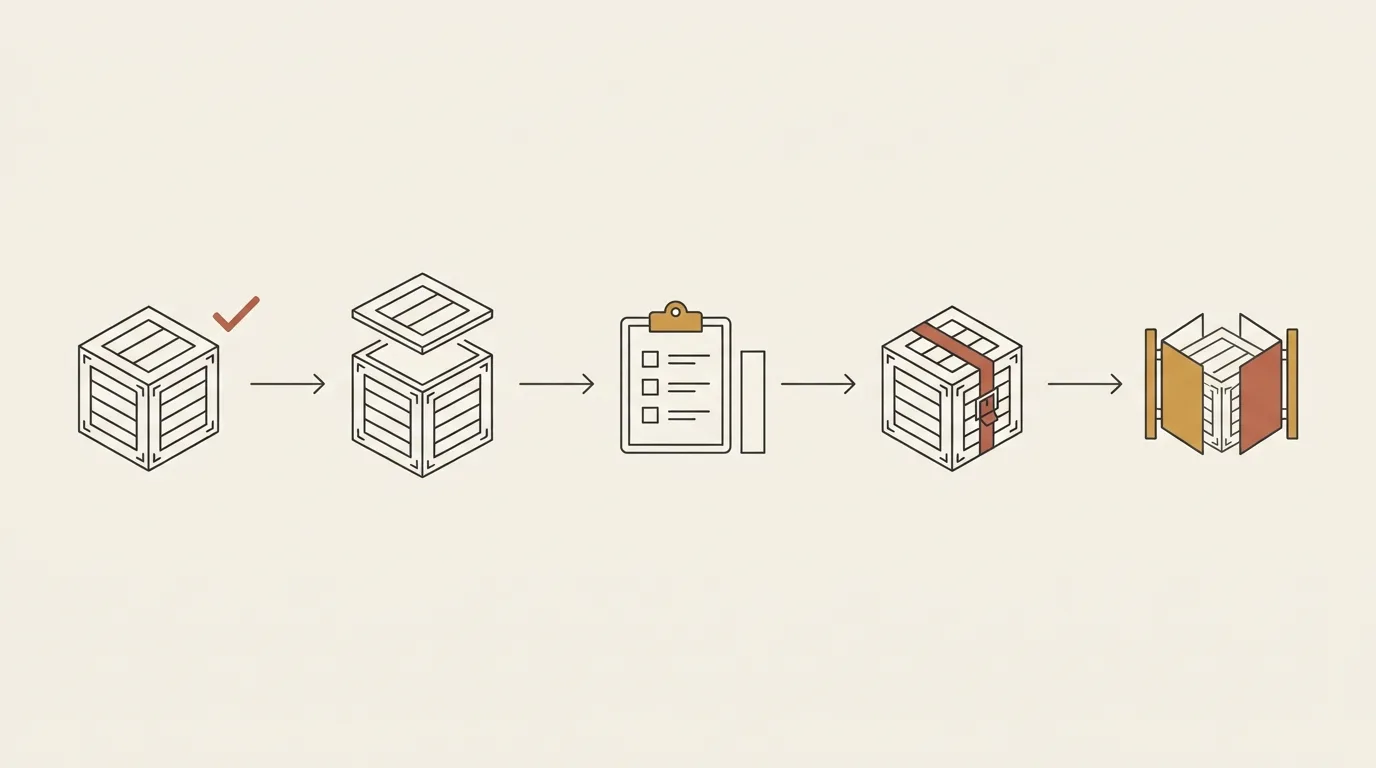
What happens, step by step
The sources describe the stages in different places, so the sequence below is a composite, and the detail varies by country and port.
- Selection. The agency picks the shipment. At U.S. ports, CBP says a selected shipment will generally be moved to a Centralized Examination Station (CES).
- Presentation. The goods are made available for examination. This is the importer’s responsibility: CBP quotes the regulation that the importer bears any expense involved in preparing the merchandise for examination, and the CBSA says its importers are responsible for presenting goods, including the costs incurred to do so.
- Opening and checking. The crate is opened and the contents are compared with the declaration. In the UK, HMRC’s published policy says it can require the premises operator to open or unpack a container.
- Reloading and release. At a U.S. CES, CBP says the facility unloads the shipment and reloads it after the exam, billing the importer for those services. The sources reviewed do not describe how a fine-art crate is repacked, so this page does not say.
Who pays for the handling
On the point of cost, the two North American agencies are explicit. CBP states that in the course of normal operations it does not charge for cargo examinations, but that there may still be costs for the importer: the examination station typically bills for unloading and reloading, and transport and storage can add to it. The CBSA likewise says it does not apply any charges to importers for examinations, while the facility operator bills the shipping line, which passes the cost to the importer.
This is a mechanism, not an estimate. None of the sources gives a figure or a timeline for a crated painting, and this page will not suggest one. Duties and taxes are a separate subject, covered in the guides on what a customs broker does when art crosses a border and on import rules by country. For the studio’s shipments, any import duties or taxes in the destination country are paid by the buyer.
Damage, insurance and delays
The agencies read for this page do not promise that an examination will leave a painting untouched, and they do not set delivery dates. HMRC’s internal complaints manual says it reimburses the cost of repair or replacement for property damaged in its examinations, provided the goods are not subject to seizure, and points damage arising from Border Force checks to its complaints guidance. That is an internal manual of one agency, not a general rule, and it should not be read as a guarantee for any particular claim.
The CBSA says many factors affect examination time, among them transit to the facility, offloading and reloading, and weekends and holidays. For what transit insurance does and does not cover, see what insurance covers a painting during international transit. For how the crate itself is built to be opened and closed again, see how a crate is built for an international art shipment.
This text is informational and is not tax or customs advice.
From the studio
From the studio
A large work such as Quartz Seam, from the Terra & Ether series (mixed media with acrylic and imitation gold leaf on canvas, 98 x 152 cm, 2026) is the kind of piece that travels in a crate rather than a tube. Its surface carries relief and imitation gold leaf, so for a shipment abroad it is worth asking in advance how the crate is built and what documentation travels with it. Alyne is a trained architect, and the studio includes professional packaging and the work’s documentation with every acquisition. Buyers weighing a shipment abroad can write to the studio with questions about the crate and the paperwork before deciding. The original paintings are in the gallery.
Frequently asked
Why would customs open a crate with a painting inside?
Because the agency may examine any shipment, in the words CBP uses for the United States, and checks the contents against the declaration. The sources read here describe no rule that targets paintings, and selection is the agency's decision.
Can a painting be damaged during a customs inspection?
The sources do not promise that it cannot. They also do not describe how often damage occurs. HMRC's complaints manual says it reimburses repair or replacement cost for property damaged in its examinations, unless the goods are subject to seizure. That is one agency's internal guidance, and any specific case would depend on its own facts.
Who repacks the painting after inspection?
For U.S. exams, CBP says the CES unloads the shipment and reloads it after the exam and bills for those services. The sources reviewed do not say how a fine-art crate is closed again, which depends on the port and the handler, so this page does not state it.
How long can an inspection delay delivery?
No source gives a duration for a crated painting. The CBSA lists factors that affect examination time, including transit to the facility, offloading and reloading, weekends and holidays. Any number of days would be a guess, so none is given here.
Does insurance cover damage that happens during an inspection?
That depends on the policy and its terms, which this page does not assess. Transit insurance is available for the studio's shipments, and what such cover includes is explained in the separate guide on insurance for international transit. This text is informational and is not tax or customs advice.
Planning a shipment abroad?
Write to the studio with questions about a specific work, its crate and the documentation that travels with it.
Sources
- U.S. Customs and Border Protection — 2026-10-17
- Canada Border Services Agency — 2026-10-17
- HM Revenue & Customs (GOV.UK) — 2026-10-17
- HM Revenue & Customs, Complaints and Remedy Guidance (GOV.UK) — 2026-10-17
- Perfeito Studio (internal fact file) — 2026-10-17
Published on · Updated on