What is the difference between an invoice and a certificate of authenticity for customs purposes?
The two documents answer different questions. An invoice records the sale — who sold what to whom, and at what price — while a certificate of authenticity records the identity of the artwork. Brazil's export declaration is built on the invoice, and the US and UK rules quoted below treat it as the document that carries the price.
Two documents, two jobs
In an international art purchase the paperwork splits along a simple line. The invoice is a record of a transaction: the parties, the goods, the price. The certificate of authenticity is a record of an object: which work it is, who made it, how it is catalogued. One is a commercial and fiscal document; the other is a document about the work itself, whatever its price; what a certificate does and does not prove is covered in what a certificate of authenticity proves.
At Perfeito Studio every acquisition comes with both, as separate items: a signed certificate carrying the full technical record and the internal Archive ID, and a fiscal invoice or official receipt. Nothing about customs merges them. The rest of this page follows what the official sources say each one is used for.
What customs reads from an invoice
Customs valuation is built on price paid, and the invoice is where that price lives. The UK's guidance defines transaction value as the price paid or payable by the buyer to the seller for the goods when sold for export to the UK, and tells importers to use the seller's invoice, or whatever document they use to ask for payment, as evidence. That evidence has two conditions: its authenticity cannot be in doubt, and it must carry enough detail to show that the declared value is the total amount paid or payable.
The United States regulation on invoice contents, 19 CFR § 141.86, lists what an imported-goods invoice must set out: the port of entry, when, where, by whom and to whom the goods are sold, a detailed description including the name by which each item is known, the quantities, the purchase price of each item in the currency of the purchase, itemised charges such as freight and insurance, and the country of origin. The list in that paragraph does not include a certificate of authenticity. Before the sale is final, buyers sometimes receive a preliminary version of the same document; see the pro forma invoice explainer.
Where the invoice sits on the Brazilian side
Before a painting reaches any foreign customs office it has to leave Brazil, and there too the invoice is the base document. The Receita Federal states that the DU-E, Brazil's single export declaration, takes as its base the nota fiscal that supports the export operation, except where the governing legislation dispenses with issuing one. When the nota fiscal is electronic, its data on issuer, recipient and goods are imported into the declaration automatically; where a paper invoice or none is used, the declarant supplies that information by hand. The same guidance adds that if an electronic invoice's description is incorrect for the item, the invoice has to be replaced; if it is merely incomplete, a complementary description field can be used.
Whether a work needs any export authorisation at all is a separate question, covered in the export-permit guide. A certificate of origin, a third document people often confuse with both of these, is explained in its own page.
Where the description of the artwork itself matters
The certificate does not travel into the customs file by default, but the identity of the work still matters, because it drives classification. In the US, CBP's informed-compliance publication on works of art, dated May 2006 and expressly not a substitute for the regulations, says original paintings must be declared and that heading 9701 covers paintings executed entirely by hand. Whether a canvas meets that description is a statement about the object, and 19 CFR § 141.86 requires the invoice to describe each item. The same publication says most such paintings enter the US duty-free under heading 9701; because it dates from 2006, current tariff treatment should be checked with CBP. The UK adds a parallel point: the commodity code on the import declaration determines the duty rate.
The same CBP publication shows where an authorship or originality statement becomes a required document. Under 19 CFR § 10.48, invoices for works under headings 9702 and 9703, which cover original engravings, prints, lithographs, sculptures and statuary, must show whether the items are originals, replicas, reproductions or copies and name the artist, unless the customs officer is satisfied the statement is unnecessary, and a declaration by the artist, seller, shipper or importer is filed with the entry, though the port director may waive the declaration in certain instances. That is a declaration in the form the regulation prescribes, not a certificate of authenticity, and it applies to those headings, not to paintings under 9701. This describes the mechanism; what a specific shipment needs is confirmed with the destination customs authority or a licensed broker (see how a customs broker handles an art shipment).
This page is general information drawn from the official sources listed below; it is not customs, legal or tax advice. Rules, rates and classifications change and differ by destination, so confirm what your shipment needs with the destination customs authority or a licensed customs broker before you ship.
From the studio
The studio's view: one work, two records
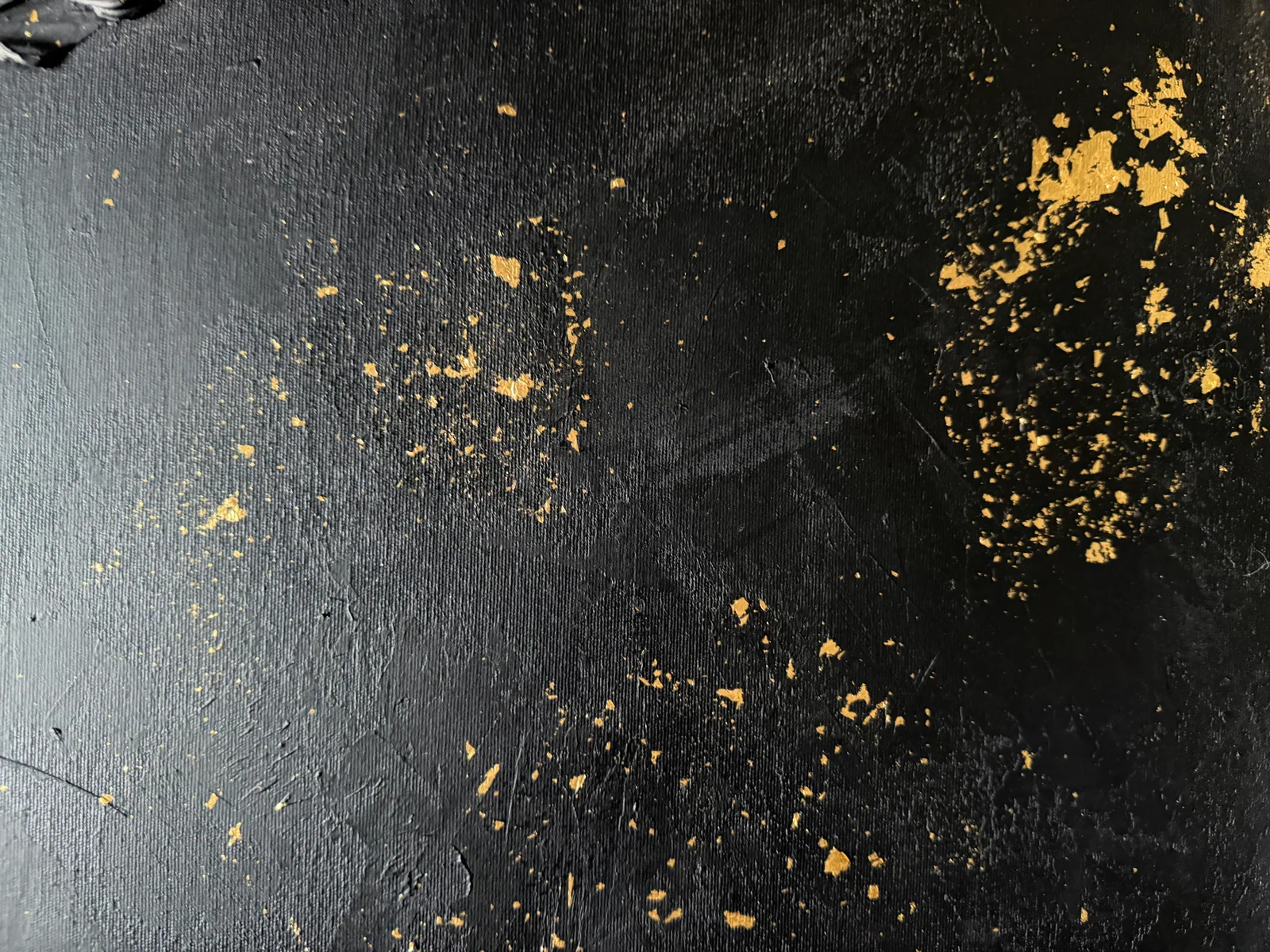
Take Golden Passage, 60 × 80 cm, from the Black & Gold series, made in 2025 in mixed media, texture paste and gold leaf on canvas. A buyer abroad is really holding two records of that one painting. The certificate says which work it is: the technical record and the Archive ID, AP-BNG-2025-001, tied to a QR code that leads to the work's official page. The invoice says what changed hands and for how much. In our reading of the sources above, that is also why the two are kept apart: a customs office needs the second to work out value, and the first is an answer to a different question, the one the buyer asks years later. What each destination asks for at the border is decided by that country's customs authority, not by the studio.
Frequently asked
Can a certificate of authenticity replace an invoice at customs?
The official sources cited on this page tie value and description to the invoice, not to the certificate. Brazil's DU-E is based on the nota fiscal, the UK asks for the seller's invoice or payment request as evidence of the price paid, and the US invoice regulation lists price, description and origin among its required contents. A certificate records the identity of the work, and the studio issues it as a separate document from the invoice or receipt.
Which document determines the duty a buyer pays, the invoice or the certificate?
Duty depends on two things: the customs value and the classification. On the UK side, the customs value starts from the price paid or payable, evidenced by the invoice, and the commodity code determines the duty rate. The certificate is not the source of either figure in that guidance. The rates themselves differ by destination and change over time, so the destination's own customs page is the authority; the studio does not quote duty.
What does Brazil need before a painting can leave the country?
The Receita Federal describes the DU-E, the single export declaration, as based on the nota fiscal that supports the export operation, unless legislation dispenses with issuing one. If the nota fiscal is electronic, its data flows into the declaration automatically. A separate question, whether a work needs cultural-heritage clearance, is handled by IPHAN and is covered in the studio's export-permit guide.
Why can a US customs file ask for an artist's declaration if the certificate is not required?
Under 19 CFR § 10.48, works classified in headings 9702 and 9703, meaning original engravings, prints, lithographs and sculptures, need an invoice stating whether they are originals and naming the artist, in the form the regulation prescribes and subject to the waivers it provides, plus a declaration in a prescribed form by the artist, seller, shipper or importer. That is a regulatory declaration for those headings. It is a different instrument from a certificate of authenticity and does not describe original paintings.
Which documents come with a purchase from Perfeito Studio?
Every acquisition is direct from the artist and includes the signed Certificate of Authenticity, with the full technical record and the Archive ID, and a fiscal invoice or official receipt, among the other documents. Shipping is quoted per destination, and import duties or taxes in the destination country are paid by the buyer. The studio does not advise on customs treatment; the destination authority or a licensed broker does.
Questions about documents for a shipment abroad?
Tell the studio which work and which country; the certificate and invoice are described from the studio's side, and customs treatment is confirmed with the destination authority.
Sources
- Receita Federal do Brasil — 2026-09-30
- 19 CFR § 141.86 (Legal Information Institute, Cornell Law School) — 2026-09-30
- HM Revenue & Customs (GOV.UK) — 2026-09-30
- HM Revenue & Customs (GOV.UK) — 2026-09-30
- U.S. Customs and Border Protection — 2026-09-30
- Perfeito Studio (src/data/studio-facts.json) — 2026-09-30
- Perfeito Studio (FAQ de frete da pagina da obra; src/data/site.json) — 2026-09-30
Published on