What to do if a canvas painting is torn or punctured
Lay the painting flat or lean it face out where nothing can reach it, and touch neither the tear nor the back of the canvas. Photograph the damage, keep any loose fragments in a labelled envelope and call a paintings conservator soon. The Canadian Conservation Institute warns that broken threads left too long may become impossible to realign.



The first hour: stop, photograph, collect
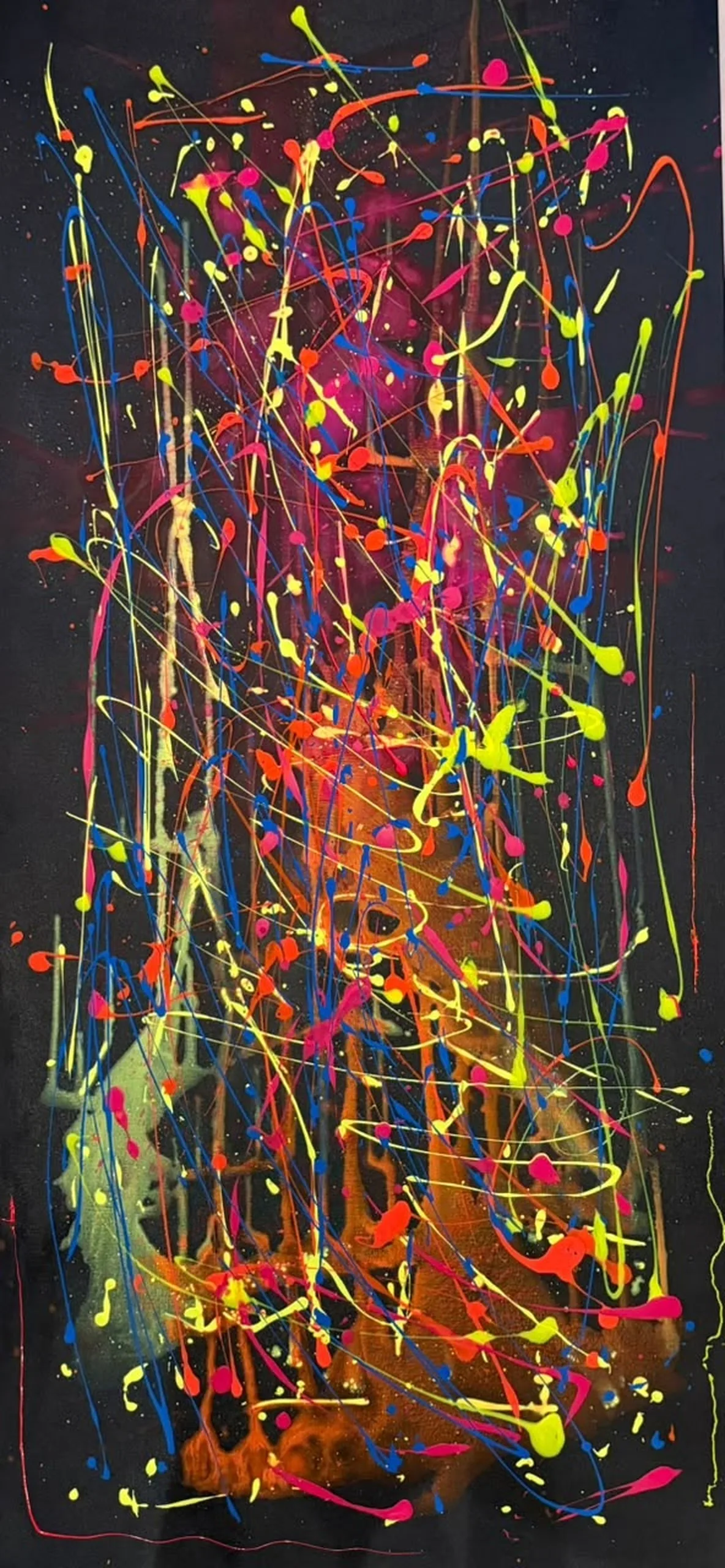
Electric Nocturne is acrylic on canvas, 80 × 170 cm. Its lines of fluorescent yellow, magenta and cobalt were thrown onto a black ground, and where they landed thinly the weave of the canvas still shows through. That weave carries the whole painting. As practical advice, take care with knives during unpacking and keep chair backs and furniture corners clear of it.
The Canadian Conservation Institute (CCI) says to record how the damage happened, to collect and identify any detached pieces, and to take photographs, then send all of it to a qualified conservator. The US National Park Service handbook gives similar advice for damage that is not caused by water: touch as little as possible, move the painting only far enough to get it out of a precarious spot, such as the edge of a table or a crooked hook, and contact a conservator as soon as you can.

Why a tear should not wait
A punctured or torn canvas keeps moving. The stretched fabric pulls the cut edges apart, and the CCI's guide to basic care says tears should be dealt with relatively quickly, because the canvas can become misaligned until the broken threads are difficult or impossible to realign. The National Park Service puts it more bluntly: tears in the canvas only get worse without conservation treatment.
While you wait for an appointment, keep pressure off the canvas. The same CCI guide says not to apply any pressure, even a finger, to the back of a canvas, and its handling note adds that hands should never press on the canvas from the front or the back when an unframed painting is lifted by its stretcher. Look at the frame bars too: the CCI notes that loose stretcher keys often fall behind the bars when a painting is moved, where they can press into the canvas.

Tape, glue and iron-on patches
Most home repairs go on the back: packing tape, a fabric patch, a dab of glue. The National Park Service tells owners not to attempt to mend a ripped painting, because they can increase the damage. In its list of conservation work, the same handbook includes removing old patches and tape from the back of a canvas when they are contributing to the painting's deterioration. Any tape or patch you add may later be one more thing a conservator has to remove.
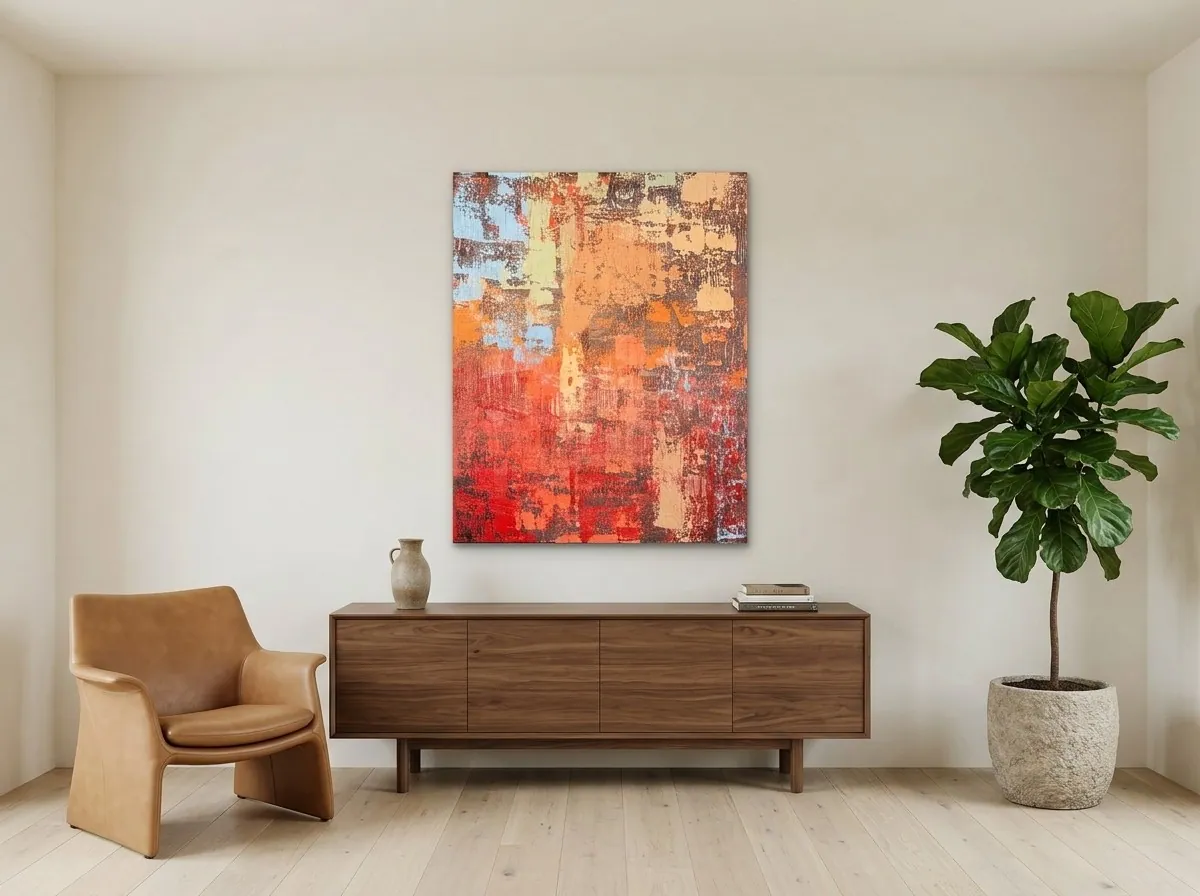
Paint layers raise the stakes. Terracotta Weft (acrylic on canvas, 80 × 100 cm) is built from opaque layers dragged thin over a dark ground, with ridges and beads of paint standing in relief. As a practical precaution, avoid pressing anything against the back of a heavily layered canvas like Terracotta Weft, whose ridges stand in relief on the front. Leave the area as it is and keep the painting dry and level until someone qualified has seen it.

What a conservator can do
Among the usual stabilising treatments, the National Park Service lists minor canvas repairs that remove dents or bulges and patch small holes, and lining, which attaches new fabric to the back of the original canvas for support. Retouching comes after: conservators fill losses in the ground and inpaint them so they are not obvious, usually with paints that can be removed later.
For tears there is also thread-by-thread mending. Matthew Hayes, writing in the Getty Conservation Institute's 2023 volume Conserving Canvas, describes the method published by Winfried Heiber in 1996, carried out under a binocular microscope and widely used in the German-speaking world. Some colleagues, he notes, see it as tedious or too time-consuming. Icon, the UK conservation body, says to ask for a written treatment proposal submitted with the estimate, and that the final report normally includes photographs taken before, during and after the work.
Backing boards and other ways to prevent it
The CCI's note on backing boards, revised in 2016, opens with the line that all paintings should have one as a preventive measure. A rigid sheet screwed to the back of the stretcher protects the canvas from puncture and tear from behind, keeps dirt from collecting along the bottom bar and reduces vibration in transit. The note ranks corrugated twinwall plastic with a matboard liner first and tempered hardboard of at least 3 mm last, and warns that in long damp periods a sealed board can raise the risk of mould, so plastic boards with ventilation holes are preferred in humid climates. The CCI's care guide adds that fitting one can damage the paint if it is done incorrectly, which makes it a job for a conservator or a conservation framer.
One more rule from the National Park Service: paintings with holes or tears should not travel, so arrange treatment near where the work hangs before any move.
For those acquiring a work
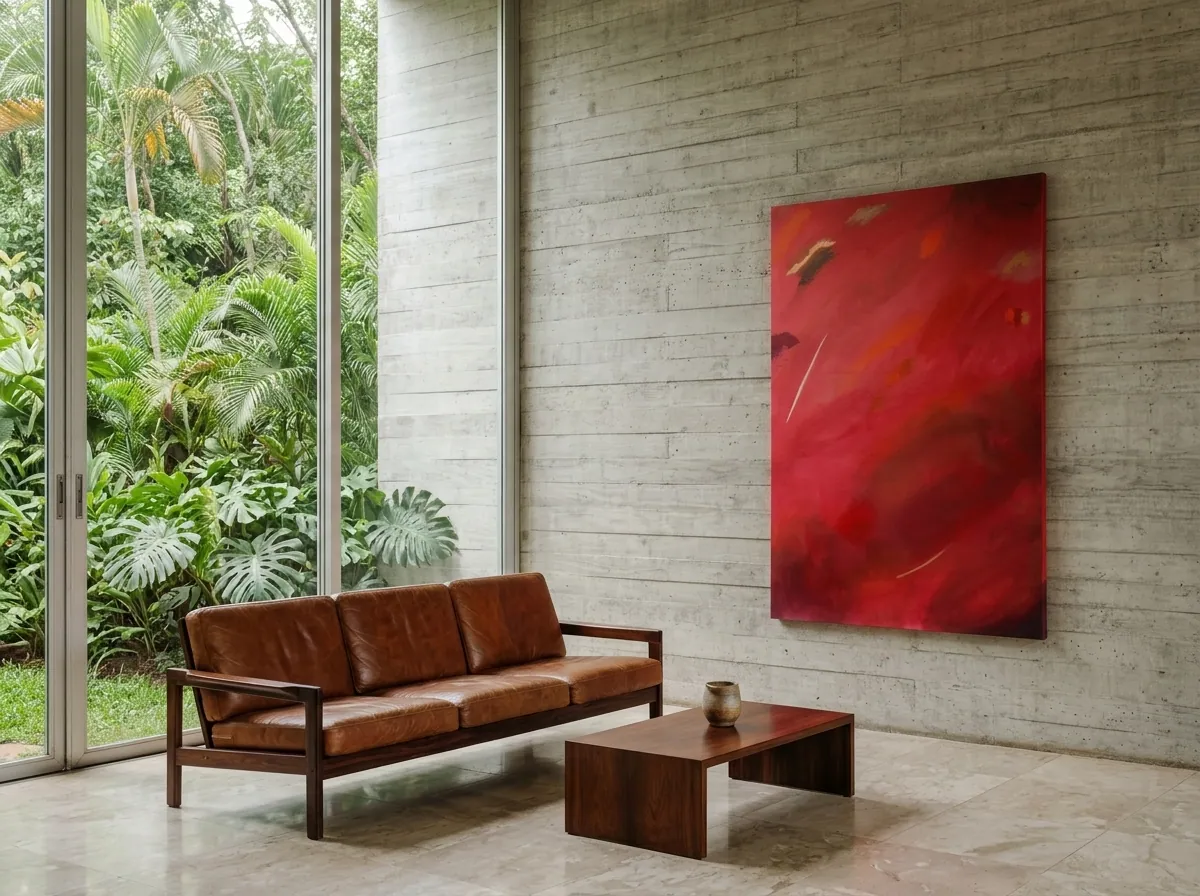
Electric Nocturne (80 × 170 cm, R$ 5,200, Archive ID AP-HOC-2026-004), Fire of Devotion (100 × 150 cm, R$ 5,700, AP-HOC-2026-003) and Terracotta Weft (80 × 100 cm, R$ 4,200, AP-TAE-2026-011) are acrylic on canvas, painted in 2026, each unique with no editions or reproductions. A practical precaution: choose a wall away from door swings, chair backs and corridors where furniture is carried, and mark the size with tape first. At 1.70 m, Electric Nocturne needs a wall with clear floor space in front of it. Any conversion from BRL is approximate.
Every acquisition comes directly from the artist with a signed Certificate of Authenticity carrying the Archive ID, a fiscal invoice or receipt, an Artwork Acquisition Agreement, an artist dossier and care instructions. Professional packaging is included; shipping is quoted per destination and paid by the buyer, and transit insurance can be added to the quote. See shipping.
Available works
-
 Electric Nocturne
80 x 170 cm (31.5 x 66.9 in) · R$ 5.200
-
 Electric Nocturne
80 x 170 cm (31.5 x 66.9 in) · R$ 5.200
-
 Fire of Devotion
100 x 150 cm (39.4 x 59.1 in) · R$ 5.700
-
 Fire of Devotion
100 x 150 cm (39.4 x 59.1 in) · R$ 5.700
-
 Terracotta Weft
80 x 100 cm (31.5 x 39.4 in) · R$ 4.200
-
 Terracotta Weft
80 x 100 cm (31.5 x 39.4 in) · R$ 4.200
From the studio
From the studio
Alyne Perfeito is a Brazilian visual artist, trained as an architect, based in Brasília. If one of these canvases is ever damaged, the certificate already gives a conservator the medium, size, year and Archive ID in one document, and we can send detail photographs of the undamaged surface on request so the repair has a reference.
Frequently asked
Can I tape the back of a torn canvas?
Avoid it. The US National Park Service tells owners not to mend a ripped painting themselves because it can increase the damage, and it lists removing old tape and patches from the back of a canvas as conservation work. Keep the painting flat, photograph the tear and call a paintings conservator.
Can a tear be repaired invisibly?
Conservators fill and inpaint losses so they are not obvious, usually with paint that can be removed later (National Park Service). For the tear itself, thread-by-thread mending under a binocular microscope is one method described in the Getty's Conserving Canvas. Ask for photographs before and after so you can judge the result.
What is a backing board and does it prevent punctures?
It is a rigid sheet screwed to the back of the stretcher. The Canadian Conservation Institute says it protects the canvas from puncture and tear from behind and reduces vibration in transit. It does not protect the painted face, and fitting it badly can damage the paint, so have a conservator or conservation framer do it.
Does a repair change what the painting is worth?
A conservator records condition and treatment; for a valuation Icon advises consulting an auction house or a valuation expert. Keep the treatment report with the certificate and invoice. The CCI also notes that many fine art insurance policies do not cover damage caused by unskilled handling, so check your policy before anyone touches the work.
See the canvas up close
Ask the studio for detail photographs of Electric Nocturne, Fire of Devotion or Terracotta Weft and a shipping quote to your address.
Sources
- Canadian Conservation Institute — 2026-11-19
- Canadian Conservation Institute — 2026-11-19
- Canadian Conservation Institute — 2026-11-19
- US National Park Service, Museum Handbook Part I, Appendix L — 2026-11-19
- Getty Conservation Institute — 2026-11-19
- Icon, The Institute of Conservation — 2026-11-19
- Perfeito Studio — 2026-11-19
- Perfeito Studio — 2026-11-19
- Perfeito Studio (src/data/obras.json and studio-facts.json) — 2026-11-19
- Perfeito Studio (src/data/obras.json) — 2026-11-19
Published on
Edited and reviewed by: Alyne Perfeito, architect and visual artist · CAU A1023098
Alyne Perfeito is a trained architect and visual artist with a studio in Brasília, Brazil. She edits and reviews the Journal from her painting practice. See Alyne's works →