Where do interior designers buy art? Galleries, consultants, platforms and artists' studios compared
Interior designers buy art from galleries and dealers, art consultants, online platforms, fairs and events, and directly from artists' studios. Published designer accounts name several at once. The channels differ in who selects the work, who holds the paperwork and how scale in the client's room can be checked, and those are the points to compare.
Five channels, as designers describe them
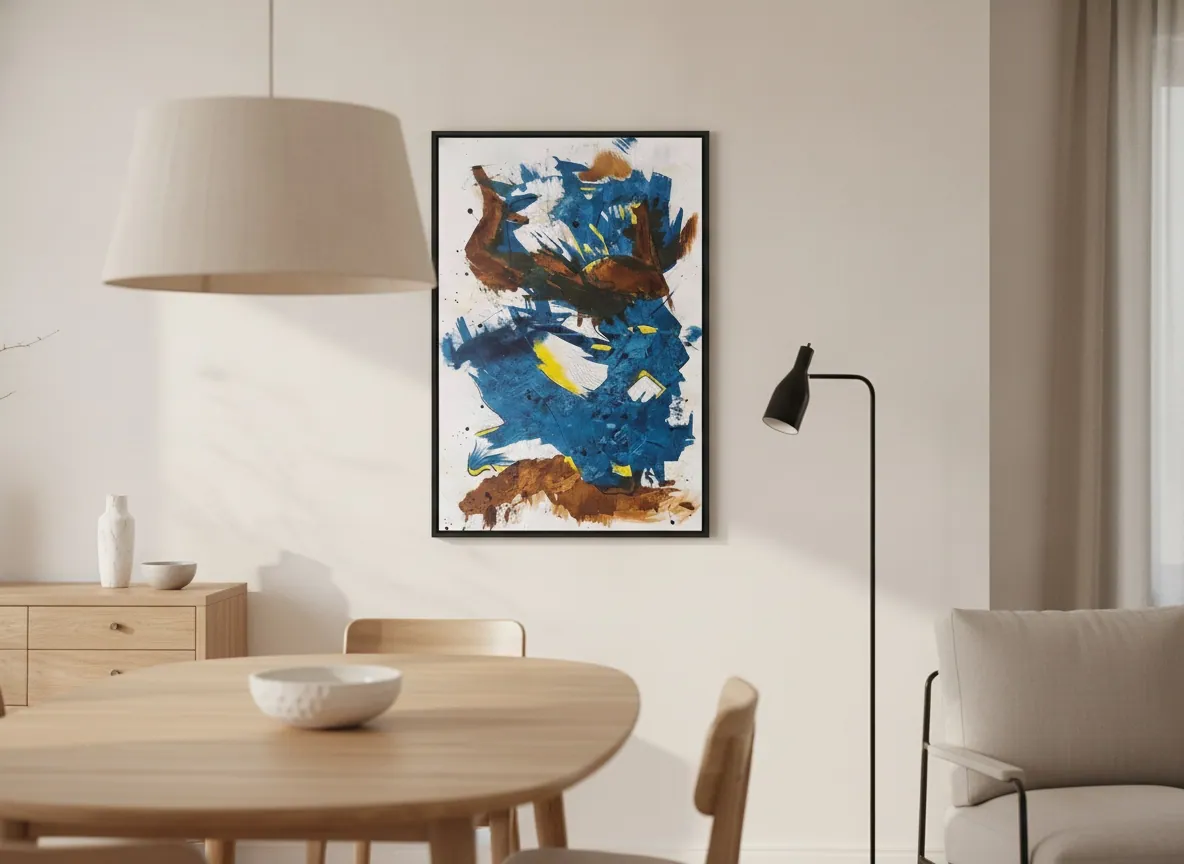
Crossing Currents (Terra & Ether, 2025, 80 × 120 cm) is mixed media with acrylic and texture paste on canvas, with fields of deep blue crossed by earthy browns and flashes of yellow and white, according to its catalogue text. A designer who puts a painting like this in a proposal has reached it through one of a few channels, and published accounts describe the same handful.
A DesignDash article (15 July 2025) lists the routes designers use: a trusted gallery or an independent art advisor; commissioning an artist directly; online marketplaces, naming Saatchi Art, Uprise Art and Tappan Collective; art the client already owns; the client's own art adviser; artists in the local community; and fairs, art walks and similar events. It also names the weak point of each. Relying on one gallery leads to repetition, direct commissions run into lead times and unclear expectations, and marketplaces make scale and texture hard to judge without seeing the piece.
Business of Home (26 August 2022) asked four design firms where they look, and each named more than one source:
- Nomita Joshi Interior Design (New Orleans): local gallery shows, secondhand shops, online sites such as 1stDibs and Lumas, and museum stores.
- Jackson Warren Interiors (Houston): trusted art dealers to narrow the search, then galleries or the artists themselves.
- Blair Burton Interiors (Austin): local artists and Instagram; the firm said it has never used an art consultant.
- B+G Design (Miami): a broker who represents various artists, and fairs such as Art Basel Miami and Design Miami.
Works cited in this text


Galleries, dealers, consultants and platforms: who selects, who sells
Galleries and dealers. DesignDash quotes Melissa Grove of Laura U Design Collective describing a common habit: finding a gallery they like and returning to it for major pieces. The article names the cost of that habit: repetition, and little local context or price flexibility.
Consultants and advisors. Art Services Network describes advisory work as defining collection goals, identifying acquisitions and coordinating framers, shippers and conservators. It lists hourly, retainer, project and commission fees, and tells buyers to confirm whether the advisor represents the buyer, the seller or both; commissions are acceptable, it says, when disclosed. Our page on what an art advisor does sets out the roles.
Online platforms and trade programs. Saatchi Art's trade page has one tier for interior designers, decorators and design professionals working primarily on single-family residential spaces and another for national design firms and for property owners and developers who specialise in hospitality, commercial and multi-family projects. It lists complimentary curation and art advisory, tiered trade discounts and discounts on large orders, and special commissions and custom sizes. Arthaus lists preferential pricing scaled to project and volume, and one point of contact for curation, sizing, sampling and timelines. Saatchi Art's page does not say whether its works are originals or prints, and Arthaus describes "original works and limited editions" without saying which applies to a given piece, so that is the first thing to ask.
Fairs, Instagram and direct: what the collector data shows
The Art Basel and UBS Survey of Global Collecting 2025 sampled 3,100 high-net-worth collectors in ten markets, Brazil among them, with data through the first half of 2025. In it, 58% made purchases linked to art fairs (up from 39% in 2023), 51% bought through Instagram (up from 43%), and participation in buying directly from artists more than doubled against the previous survey, while participation and spending at auction fell.
These are collectors, not designers, and the survey does not say how many of those purchases were made for a client project. It does show that fairs, Instagram and the artist's own studio are routes at scale, and Business of Home's designers use the same ones. Direct buying removes one party from the transaction; it also moves the work of checking scale, light and documents to the designer, which the last section covers.
The artist's studio as one channel: what Perfeito Studio publishes for designers
Perfeito Studio is one example of the direct route, and its page for architects and interior designers states what the studio offers. The studio proposes works for a space from a floor plan, reference images and lighting context, responding to scale, sightlines and atmosphere. When reference photography is provided, it prepares custom renders or mockups of the work in the actual space, sized for client presentations. It offers a per-project dossier and technical documentation for client decks and project archives, and coordinates hanging height, lighting angle and conservation guidance with the project team.
On commercial terms the studio publishes one line on that page: "Conditions for repeat collaborations available upon request — designed for studios that bring multiple acquisitions per year." No percentage is published; the listed price on each work's page is the reference. Our page on trade discounts on Brazilian art covers that question, so it is not repeated here.
Patina Field (Terra & Ether, 2026) shows what the record looks like: acrylic on canvas, 100 × 100 cm (39.4 × 39.4 in), BRL 5,200, Archive ID AP-TAE-2026-006. Its catalogue text describes pigment applied, scraped back and applied again, until the surface reports wear rather than gesture.
The full list is on the page for architects and interior designers.

For those acquiring: what to ask any source, and what a studio can show
Scale. Ask for dimensions in centimetres and inches, set against the furniture on that wall. Crossing Currents is a vertical 80 × 120 cm (31 × 47 in), BRL 4,400, Archive ID AP-TAE-2025-002; Vegetal Dawn is also 80 × 120 cm (31.5 × 47.2 in), acrylic and imitation gold leaf (metallic leaf) on canvas, BRL 4,900, Archive ID AP-TAE-2026-003; Amethyst Ground is a square of 100 × 100 cm (39.4 × 39.4 in), BRL 5,200, Archive ID AP-TAE-2026-005. In the visualisation below, Vegetal Dawn hangs above a wood sideboard in a room with a desk.
Medium and light. Ask for the medium as the maker states it, and whether the surface carries metallic leaf or texture, since finish varies from work to work and detail photographs show it. The studio's technique for each work is written on its page, and for buyers outside Brasília, additional detail photographs and video of a specific work are available on request over WhatsApp.
Documents. Every acquisition from the studio is direct from the artist and includes the original, unique painting; a signed Certificate of Authenticity with the technical record and Archive ID; a fiscal invoice or official receipt; an Artwork Acquisition Agreement covering transfer of ownership, copyright and image use; an artist dossier; conservation and care guidance; and professional packaging. The certificate carries a QR code to the work's official page (acquisition). Ask any other source for the equivalent list.
Shipping. The studio ships within Brazil and internationally. Freight is quoted per destination and paid by the buyer, as are any import duties or taxes in the destination country; professional packaging is included and transit insurance is available. Domestic delivery takes up to 15 business days; international shipping is quoted on request (shipping). Our page on specifying Brazilian art for a client project remotely covers the remote workflow.

From the studio
From the studio: reading a room as an architect
Alyne Perfeito is a Brazilian visual artist and trained architect based in Brasília, and the studio's intake for architects and designers asks for what an architect would: a floor plan, reference images of the room and the lighting context. Two catalogue texts show how differently a work can sit on a wall: Patina Field is described as settling a room rather than animating it, and Crossing Currents as a composition of forces that collide and find temporary balance.
Most works are large-format mixed media built in layers of texture and mineral pigment, and the record that travels with each is the same: unique, signed, catalogued under an Archive ID and photographed in detail before it leaves the studio.
Frequently asked
Where do interior designers usually source original art?
Published accounts name galleries and dealers, art consultants or brokers, online platforms, fairs, Instagram, local artists and artists' studios, and most firms use more than one. A DesignDash article lists a trusted gallery or independent advisor, direct commissions, marketplaces, the client's own collection and community artists. Business of Home's four firms each named several sources, from local gallery shows to Art Basel Miami.
Do designers get trade terms when buying art?
Some sellers publish them. Saatchi Art lists tiered trade discounts and discounts on large orders, and Arthaus lists preferential pricing scaled to project and volume. Terms are set seller by seller. Perfeito Studio's page for architects says conditions for repeat collaborations are available upon request and publishes no percentage; the price on each work's page is the reference.
How do designers source art from another country?
Perfeito Studio ships within Brazil and internationally. Freight is quoted per destination and paid by the buyer, as are any import duties or taxes in the destination country. Professional packaging is included and transit insurance is available. International shipping is quoted on request, so the designer should ask for the quote for the project's destination before giving the client a date or a total.
What should a designer ask a studio before proposing a work to a client?
Ask for dimensions in centimetres and inches, the medium as the maker states it, the Archive ID and the price. Ask what documents travel with the work: at Perfeito Studio, a signed Certificate of Authenticity, an invoice or receipt, an acquisition agreement, an artist dossier and care guidance. Ask for detail photographs, and for the shipping quote to the project's destination.
Can a studio send mockups of the work in the client's room?
Perfeito Studio's page for architects and interior designers says that, when reference photography of the space is provided, it prepares custom renders or mockups of the work in the actual room, sized for client presentations. The studio also proposes works from a floor plan, reference images and lighting context. The visualisations on this page are digital and for illustration only.
Ask the studio about a work for a project
Send the floor plan or room photographs; the studio replies with dimensions, documentation and a shipping quote for your destination.
Sources
- Business of Home (Marina Felix) — 2026-10-26
- DesignDash — 2026-10-26
- Art Services Network — 2026-10-26
- Saatchi Art — 2026-10-26
- Arthaus — 2026-10-26
- Art Basel / UBS — 2026-10-26
- Perfeito Studio (src/data/site.json ui.architects) — 2026-10-26
- Perfeito Studio (src/data/obras.json) — 2026-10-26
- Perfeito Studio (src/data/studio-facts.json) — 2026-10-26
Published on