What makes Brazilian art distinctive? Five threads you can trace
There is no single Brazilian art style, but this page traces five threads, each tied to dated, sourced episodes in the Enciclopédia Itaú Cultural and other institutions: Antropofagia (cultural cannibalism), constructive abstraction, the viewer's body, color, and modern architecture. They took shape between 1928 and the opening of Brasília in 1960, and several define themselves in dialogue with European models.
First, a caution: threads, not a style
"Brazilian art" covers far more than the modernist episodes traced here, so no one label holds it. What follows is narrower and easier to verify: five threads this page draws from what the Enciclopédia Itaú Cultural and other institutional sources document, each with a date, a group and named works. They overlap, they argue with each other, and plenty of important artists sit between them.
The Itaú Cultural entry on Antropofagia frames the starting tension. It describes the Modernism of the 1922 Semana as having a double vocation: to update Brazilian art through contact with the European avant-gardes, and at the same time to turn toward Brazil itself, in a conscious project of creating an autonomous Brazilian art. Every thread below works on that tension in a different way.
Thread one: eating what is foreign (Antropofagia, 1928)
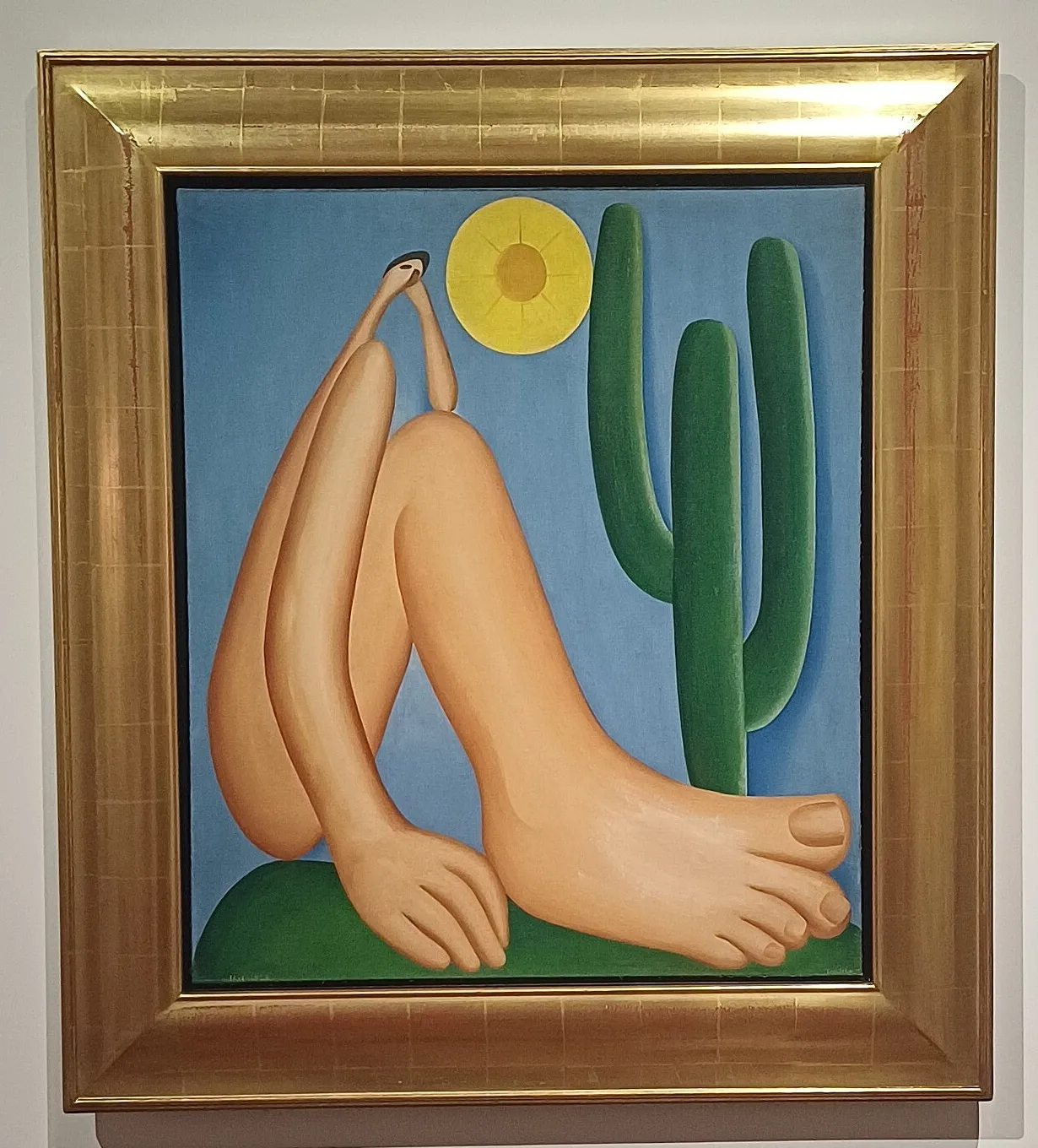
On January 11, 1928, Tarsila do Amaral gave Oswald de Andrade a painting as a birthday present. The figure in it, with enormous feet planted in the earth, a small head, a green cactus and a hot blue sky, was named Abaporu, which Itaú Cultural glosses as "anthropophagus" in Tupi-Guarani. The writer Raul Bopp, who was with Oswald, proposed building a movement around the canvas. A club and the Revista de Antropofagia followed, and in the magazine Oswald published the Manifesto Antropófago. The movement dissolved in 1929, when Oswald and Tarsila separated.
The idea is the distinctive part. Itaú Cultural explains that the manifesto reworks the negative, Eurocentric image of cannibalism into a metaphor for a critical process of forming Brazilian culture: instead of copying European models, Brazilians could devour imported forms and produce something genuinely national. The same entry notes that cannibal imagery was already circulating among European avant-gardists of the 1920s, and that what Oswald added was to make it a method for creating, active and critical. MALBA, which holds the painting in its permanent collection, describes it as symbolizing the Anthropophagic Movement's wish to "swallow" the prevailing European culture. For a fuller portrait of the artist, see Who was Tarsila do Amaral? and, for the movement itself, What was Anthropophagy in Brazilian art?
Threads two and three: the constructive tradition, and the body that broke into it
Constructive abstraction. Itaú Cultural dates the official start of concrete art in Brazil to December 9, 1952, when the exhibition Ruptura opened at the Museu de Arte Moderna de São Paulo. Seven artists organized it, with Waldemar Cordeiro as spokesman. Concrete art reached Latin America mainly through the Swiss artist Max Bill after the Second World War, and the encyclopedia ties its Brazilian reception to a developmentalist faith in industry and progress. The program rejected lyrical or symbolic meaning: a picture built only from planes and colors means nothing beyond itself.
The body. The break came from Rio de Janeiro. On March 22, 1959, a group of artists published the Neo-Concrete Manifesto in the Jornal do Brasil and opened the first Neo-Concrete exhibition at the Museu de Arte Moderna do Rio de Janeiro. Its seven signatories included Lygia Clark, Lygia Pape, Amilcar de Castro and the critic Ferreira Gullar. Itaú Cultural summarizes their position as freedom of experimentation, a return to expressive intention and the recovery of subjectivity. The viewer, who touches and handles the work, becomes part of it. Tate describes the group as asking for "greater sensuality, colour and poetic feeling in concrete art."
The encyclopedia names works that carry this out: Lygia Clark's Bichos, Lygia Pape's Balé Neoconcreto (1958) and, in the 1960s, Hélio Oiticica's Penetráveis, Bólides and Parangolés. It also notes that studies on the subject treat Neo-Concretism as a dividing line in the history of Brazilian visual arts, and the critic Ronaldo Brito calls it a point of rupture in Brazilian modern art. For more on the group, see What was Neo-Concrete art?.
Thread four: color as structure
This thread and the next are the page's own grouping of the sources. Color runs through all of the above, and Itaú Cultural's accounts show it changing role. In Tarsila's Antropofagia phase (1928 to about 1929), the encyclopedia describes rounded, stylized forms and emblematic colors, chiefly strong yellow, green, blue, orange and purple. In the Neo-Concrete circle, it says color, which part of Concretism had refused, invades the research of artists such as Aluísio Carvão, Hércules Barsotti, Willys de Castro and Oiticica.
Alfredo Volpi (1896-1988) is the clearest single case. According to his Itaú Cultural biography, he began in 1911 as an apprentice decorating walls, and a 1937 acquaintance with the painter Ernesto de Fiori led him toward vivid, matte colors and more intense handling of the pictorial matter. At the end of the 1940s he gave his paintings a thin texture by applying tempera, as in Casa na Praia (1949). In the 1950s the bandeirinhas, the little festival flags of Brazilian June festivals, stopped being only a popular motif and became autonomous compositional elements; in the 1960s and 1970s they alternate with flagpoles of widely varying color and rhythm. The same entry says tempera let him refuse the impersonality of industrial paint and mechanical work that the Concretists approached, so that handcraft became a form of resistance to automation. He was nonetheless invited to the national Concrete exhibitions of 1956 and 1957.
Thread five: Brasília and modern architecture
The fifth thread, again this page's grouping, is built rather than painted. Itaú Cultural's entry on modern architecture calls Brasília, inaugurated in 1960, a pioneering experience in world modern architecture: the first city designed and built entirely according to modernist precepts, with Oscar Niemeyer and Lucio Costa conceiving the pilot plan under President Juscelino Kubitschek. The Lucio Costa entry adds that he won the pilot-plan competition in 1957 and organized the city on two axes crossing at a right angle, a road-and-residential axis and a monumental axis, with different scales of use: residential in the superquadras, monumental along the axis of public buildings, and a gregarious scale in the cultural and entertainment sector.
The art world also reached the new capital: the Itaú Cultural biography of Volpi records that in 1958 he painted frescoes for the Capela Nossa Senhora de Fátima in Brasília. Seen together, the threads share a habit worth noticing: a willingness to take a European idea, from Cubism to Concrete art to the modernist plan, and rebuild it on local terms. That is a reading of the sources, not a claim the sources make in those words.
From the studio
From the studio
I am a trained architect who paints in Brasília, the city the fifth thread describes. This page does not place my work inside the history above, and I would not ask you to. What I can offer is procedure.
In Prism Garden (acrylic on canvas, 100 x 100 cm, Luminous Rebirth series, 2026, Archive ID AP-LMR-2026-006), I work in washes rather than mass: pigment diluted until it moves on its own, then allowed to run and settle, with vertical threads of yellow drawn down by gravity rather than by hand. Color is built in thin layers, each one visible through the next. Each work leaves with a signed Certificate of Authenticity carrying its technical record and Archive ID.
Frequently asked
What is the style of Brazilian art?
There is no single style. Brazilian art covers far more than the modernist episodes traced here. For the modern period, this page groups what institutional sources document into threads rather than one look: Antropofagia, which assimilates European ideas critically; Concrete and Neo-Concrete abstraction; color as structure; and modern architecture centered on Brasília. Treat them as lenses for looking, not as a rulebook.
Is there a single Brazilian art style?
No. Itaú Cultural describes the 1922 Modernism as having a double vocation, updating Brazilian art through contact with European avant-gardes while building an autonomous Brazilian art. That tension produced different answers in different decades, from the cannibalist metaphor of 1928 to the rationalist Concretism of the 1950s and the Neo-Concrete reaction of 1959. The answers disagree with each other, which is why one label does not hold.
How did Brazilian artists respond to European avant-gardes?
In several ways. Antropofagia, launched in 1928, proposed absorbing foreign forms critically to make something new rather than a copy. Concrete art arrived in the 1950s largely through the Swiss artist Max Bill and was adopted by the Ruptura group in São Paulo. In 1959 the Neo-Concrete group in Rio protested what its manifesto called a dangerous rationalist exacerbation of Concrete art and put the viewer's experience back at the center.
What role does architecture play in Brazilian art?
Brasília, inaugurated in 1960, is described by Itaú Cultural as the first city designed and built entirely on modernist precepts, with a plan by Lucio Costa and buildings by Oscar Niemeyer. Artists took part as well: Alfredo Volpi painted frescoes for a chapel in Brasília in 1958. The Itaú Cultural entries on modern architecture and on Lucio Costa describe the plan in detail.
Which Brazilian works show these ideas?
Examples named in institutional sources include Tarsila do Amaral's Abaporu (1928), now at MALBA in Buenos Aires, for Antropofagia; Lygia Pape's Balé Neoconcreto (1958) and Lygia Clark's Bichos for the body and participation; Alfredo Volpi's bandeirinhas, such as Fachada com Bandeiras (1959), for color; and the pilot plan of Brasília for architecture. Each is mentioned in the Itaú Cultural entries cited on this page.
See Prism Garden, from the Luminous Rebirth series
One original, one signature. Write to the atelier for detail photos, dimensions on your wall, and acquisition details.
Sources
- Enciclopédia Itaú Cultural - Antropofagia — 2026-10-15
- MALBA - Museo de Arte Latinoamericano de Buenos Aires (press release, June 27, 2017) — 2026-10-15
- Enciclopédia Itaú Cultural - Grupo Ruptura — 2026-10-15
- Enciclopédia Itaú Cultural - Neoconcretismo — 2026-10-15
- Enciclopédia Itaú Cultural - Grupo Neoconcreto — 2026-10-15
- Enciclopédia Itaú Cultural - Neoconcretismo — 2026-10-15
- Tate - Art Terms: Neo-Concrete — 2026-10-15
- Enciclopédia Itaú Cultural - Alfredo Volpi — 2026-10-15
- Enciclopédia Itaú Cultural - Arquitetura Moderna — 2026-10-15
- Enciclopédia Itaú Cultural - Lucio Costa — 2026-10-15
- Wikimedia Commons — 2026-10-15
- Perfeito Studio (src/data/obras.json and studio-facts.json) — 2026-10-15
Published on