International abstract art exhibitions: the shows that shaped abstraction, from MoMA 1936 to the São Paulo Biennial
The exhibitions that shaped international abstraction include MoMA's 1936 Cubism and Abstract Art, the first São Paulo Bienal in 1951 and documenta in Kassel, founded in 1955. Each had an institution behind it and a stated scope. MoMA limited its survey to Europe; the Bienal is described by its foundation as a milestone in the spread of abstract practices in Brazil.

Why 1936 matters: the survey that gave abstraction a lineage
In 1936 the Museum of Modern Art in New York opened Cubism and Abstract Art, directed by Alfred H. Barr, Jr. In the catalogue preface Barr describes it as an historical survey of an important movement in modern art, conceived in a retrospective rather than a controversial spirit. He also limits its scope: the show is confined to abstract art in Europe, because a large exhibition of abstract art in America had been held at the Whitney Museum the year before.
Two details in that preface are worth noting. Barr notes that the first purely abstract paintings were made some twenty years earlier, and that interest was quickening again in many European countries where, ten years before, one heard on all sides that abstract art was dead. He also credits Katherine Dreier and the Société Anonyme, founded in 1920, for bringing European abstraction to the United States long before MoMA existed. By Barr's own account, the 1936 survey was therefore not a pioneer effort: earlier exhibitions of European abstraction had already reached the United States.


1951: the São Paulo Bienal brings abstraction to Brazil
The first São Paulo Bienal took place in 1951. The Fundação Bienal describes it as a milestone in the spread of abstract practices in Brazil, tied to the beginning of Brazilian concretism, while noting that figurative strands remained significant and that there were intense debates and positions against abstractionism. Its own example is Max Bill's sculpture Tripartite Unity, which won the first prize for foreign sculpture.
This is the point where the story stops being European. Our page on Brazilian abstract artists to know covers the Brazilian painters who worked in this field.

documenta, Kassel: a recurring international survey
documenta opened in Kassel on 15 July 1955, in the Fridericianum, founded by the painter and academy professor Arnold Bode. Its stated aim was to reconnect Germany with the world after the Second World War through a presentation of twentieth-century art, and it showed the Classical Modernism that the National Socialists had defamed as degenerate. About 130,000 people visited. Bode planned a second edition for 1959, which began the regular cycle; documenta's own site lists fifteen editions so far and documenta 16 as scheduled for 2027.
documenta's page does not frame 1955 as an abstract art show, so it belongs here as a different kind of precedent: a recurring, international exhibition that put modern painting, abstraction included, in front of a wide public.
What these shows share, and where to look today
Taken together, the three set out how an international abstract art exhibition is usually built. It is a survey with a stated scope (Barr limits his to Europe), it has an institution behind it (a museum, a foundation, a founder), and it makes a case for lineage rather than only showing new work. documenta also became a recurring event, so the lineage keeps being revised.
For current programming, check the institutions directly: the Fundação Bienal for São Paulo, documenta for Kassel, MoMA's online exhibition history for the 1936 catalogue, which can be read in full. Our guide to where to see abstract art in New York covers one city in detail. Dates and venues change, and none of this page is a calendar.
For curators: how a studio can sit beside this history
A curator building a group show on abstraction usually asks for material evidence rather than a genealogy. The studio of Alyne Perfeito can answer that for the works shown here, as one verifiable example. Vibrant Awakening (Luminous Rebirth, 2025, Archive ID AP-LMR-2025-003) is acrylic on canvas, 100 × 150 cm (39 × 59 in), priced at R$ 5,900. Genesis of Flame (Heart of Chaos, 2025, AP-HOC-2025-001) is mixed media on canvas (acrylic, metallic pigment, high-gloss and matte finish), 120 × 200 cm (47 × 79 in), priced at R$ 8,800.
Every acquisition is direct from the artist and includes the original painting, a signed Certificate of Authenticity with the technical record and Archive ID, an invoice or official receipt, an acquisition agreement and an artist dossier. Shipping is quoted per destination. The institutional route is described on the page for galleries and curators.
For those acquiring a work: scale, light, documents
At 100 × 150 cm and 120 × 200 cm, both paintings are tall, vertical works that need a wall with clear space on each side; leave room to step back at least the width of the canvas. Hang them where light falls across the surface rather than straight onto it, so that the gloss and matte areas of Genesis of Flame and the layered brushwork of Vibrant Awakening can be read. Genesis of Flame has no fixed top or bottom and can be hung either way up, at the buyer's choice.
Documents that accompany the work are listed in the previous section. For delivery, see shipping: the studio ships within Brazil and abroad, with professional packaging included and insurance available; international freight and any import duties are paid by the buyer. For weight or other work details, ask the studio.
From the studio
From the studio: painting inside a long history
Alyne Perfeito is an emerging Brazilian visual artist and trained architect based in Brasília. Her first documented body of work was painted in 2025 and 2026, in six series that run at the same time. She does not appear in the survey above, and this page does not suggest she does: it reads those shows as the background to her procedure.
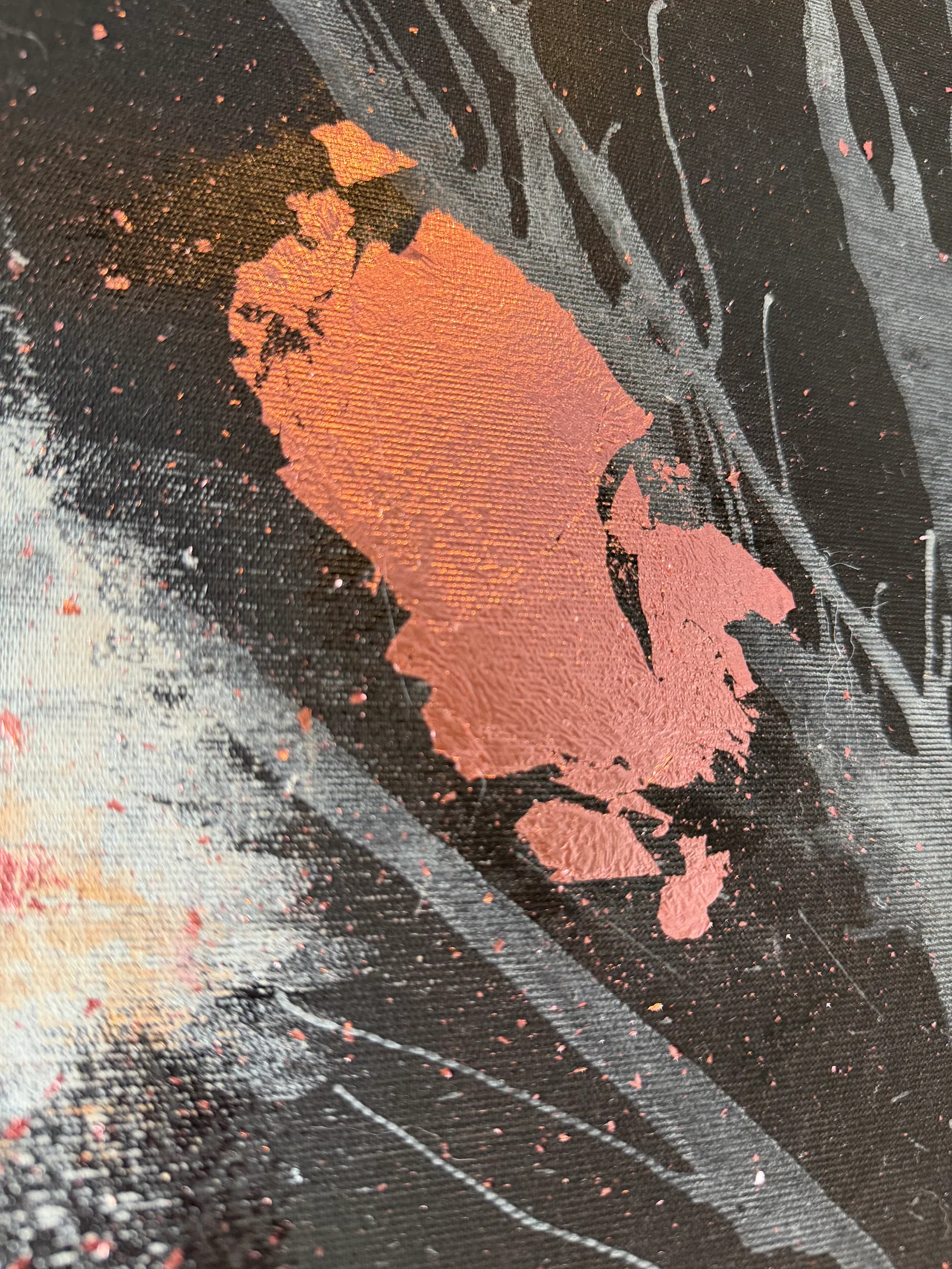
In Genesis of Flame the surface is built from metallic pigment over a black ground, with gloss and matte finishes set against each other; the photograph shows a copper-toned metallic area, grey drips and small flecks on the weave of the canvas. In Vibrant Awakening, translucent layers and broad gestures carry the colour.
Frequently asked
Which exhibitions first presented abstract art internationally?
No single show was first. Barr's 1936 preface to Cubism and Abstract Art at MoMA credits Katherine Dreier and the Société Anonyme, founded in 1920, with bringing European abstract art to the United States long before MoMA existed. MoMA's 1936 survey was, in Barr's words, an historical survey of the movement.
What was "Cubism and Abstract Art" at MoMA in 1936?
It was a survey of abstract art in Europe, directed by Alfred H. Barr, Jr., and accompanied by a catalogue. Barr's preface calls it an historical survey of an important movement, conceived in a retrospective rather than controversial spirit, and says it was limited to Europe because the Whitney Museum had shown abstract art in America the year before.
What role did the São Paulo Biennial play for abstraction in the 1950s?
The Fundação Bienal calls the first Bienal, in 1951, a milestone in the spread of abstract practices in Brazil and links it to the start of Brazilian concretism. It also mentions intense debates and positions against abstractionism. One example it gives is Max Bill's sculpture Tripartite Unity, which won first prize for foreign sculpture.
Where are international abstract art exhibitions held today?
There is no single venue. Museums, biennials and recurring exhibitions such as documenta in Kassel, which lists its sixteenth edition as scheduled for 2027, are the places to look. Check each institution's own site for current dates, since schedules and venues change.
How does an emerging abstract painter relate to that history?
By working with the same questions of surface, gesture, colour and scale, not by claiming a place in the shows above. Alyne Perfeito is an emerging Brazilian visual artist whose first documented body of work dates from 2025 and 2026. The studio publishes each work's medium, size, year and Archive ID so a curator can judge the paintings on their own record.
Ask the studio about a work
Detail photographs, documentation and a shipping quote for your destination, directly from the artist.
Sources
- The Museum of Modern Art, exhibition catalogue — 2026-11-04
- Fundação Bienal de São Paulo — 2026-11-04
- documenta — 2026-11-04
- Perfeito Studio (src/data/studio-facts.json, obras.json) — 2026-11-04
Published on