Textured abstract artists: who works in relief and matter, and how a curator finds new names
Textured abstract artists build the surface itself: relief, thick paint, added matter. Historical names to start with, according to Tate and museum records, are Antoni Tàpies, Jean Dubuffet, Alberto Burri and Manolo Millares. A curator can find new names by searching the material recorded on the label, such as sculpted texture, rather than an artist's name.
Four historical names, and what each made the surface from
Tate defines matter painting as “using thick impasto paint into which other materials such as sand, mud, cement and shells have been added.” It says the term emerged in the 1950s and is linked to Dutch and Belgian painters including Bram Bogart, Jaap Wagemaker and Bert de Leeuw, who used the technique to draw attention to painting’s materials. In its collection Tate lists three artists under the term: Jean Dubuffet (1901–1985), Antoni Tàpies (1923–2012) and Julian Schnabel (born 1951). Its example is Dubuffet’s The Exemplary Life of the Soil (Texturology LXIII), 1958.
Alberto Burri (1915–1995) is documented by the Guggenheim Venice as having begun painting on burlap sacks in 1944 in a prisoner-of-war camp, making collages from pumice, tar and burlap in 1949–1950, burning his materials from the mid-1950s (combustione), showing welded iron sheets in 1958 and using Cellotex from 1979.
Manolo Millares is represented at the Museo Reina Sofía by Cuadro 1957, oil on hessian (sackcloth), 74 x 100 cm. The museum describes torn sacking, re-glued and stuck together, and places him in Informalism.
A neighbouring vocabulary comes from Italy: Tate dates arte povera to the late 1960s–1970s, says the critic Germano Celant coined the term in 1967, lists Jannis Kounellis among its artists, and names soil, rags and twigs among the everyday materials used.
These are different practices, and the list is a way into procedure, not a ranking.
Works cited in this text


How a curator can search by material instead of by name
A name-first search returns what is already famous. A material-first search starts from the line a label or catalogue gives for the medium. The historical sources above show the vocabulary in use: impasto, sand, sackcloth, burlap, pumice, tar, iron.
For living artists, three practical filters reduce the field quickly. First, the medium line should say what the surface is made of, not only “mixed media”. Second, the dimensions and year should be stated plainly. Third, the artist should be able to send detail photographs of the surface, because relief is what a flat reproduction hides.
Terms such as relief, texture paste and matter painting are not interchangeable. Tate defines matter painting; the other two are descriptive and have no single definition in the sources cited here, so the safe question to put to an artist is simply what the surface is built from.

One working example: how the studio records surface
Alyne Perfeito is a Brazilian visual artist and trained architect based in Brasília; her current body of work was painted in 2025–2026 and is the studio’s first documented one. The records below are given as an example of what a curator can ask any artist for. They are not a claim of standing next to the historical names above.
- Echo of Silence, 2025, sculpted texture on canvas, 50 x 70 cm (19.7 x 27.6 in), Archive ID AP-MAS-2025-002, R$ 2,400.
- Silent Interval, 2026, mixed media with acrylic on canvas, 120 x 160 cm (47.2 x 63 in), AP-MAS-2026-003, R$ 7,900.
- Amber Strata, 2026, mixed media with acrylic on canvas, 150 x 100 cm (59.1 x 39.4 in), AP-TAE-2026-004, R$ 6,700.
- Elemental Veins, 2025, mixed media with acrylic and metallic fragments on canvas, 90 x 140 cm (35 x 55 in), AP-TAE-2025-001, R$ 6,400.
Each is a unique painting, catalogued under an Archive ID. The medium line differs on purpose: only Echo of Silence is recorded as sculpted texture, and the page does not describe materials the record does not state. For how to read relief in person, see what textured abstract art is and how to read it; for telling built relief from printed relief, textured print or real relief.
For those acquiring: scale, light, documents and shipping
Scale. Echo of Silence at 50 x 70 cm suits a wall beside a doorway or a bench; Silent Interval at 120 x 160 cm and Amber Strata at 150 x 100 cm carry a wall on their own. Measure the wall and the furniture below it before choosing.
Light and distance. Relief reads best when light crosses the surface at a low angle, and a short viewing distance shows the ridges while a longer one shows the composition. How to light a textured painting covers it in detail.
Documents. Every acquisition is direct from the artist and includes the original painting, a signed Certificate of Authenticity with the technical record and Archive ID, a fiscal invoice or official receipt, an Artwork Acquisition Agreement, an artist dossier, conservation guidance and professional packaging.
Shipping. The studio ships within Brazil and internationally; the freight is quoted per destination and paid by the buyer, as are import duties. Transit insurance is available. See shipping. Weight and handling details for a specific work are not published, so ask the studio for the information on that work. Professionals can also read the page for galleries and curators.

From the studio
From the studio
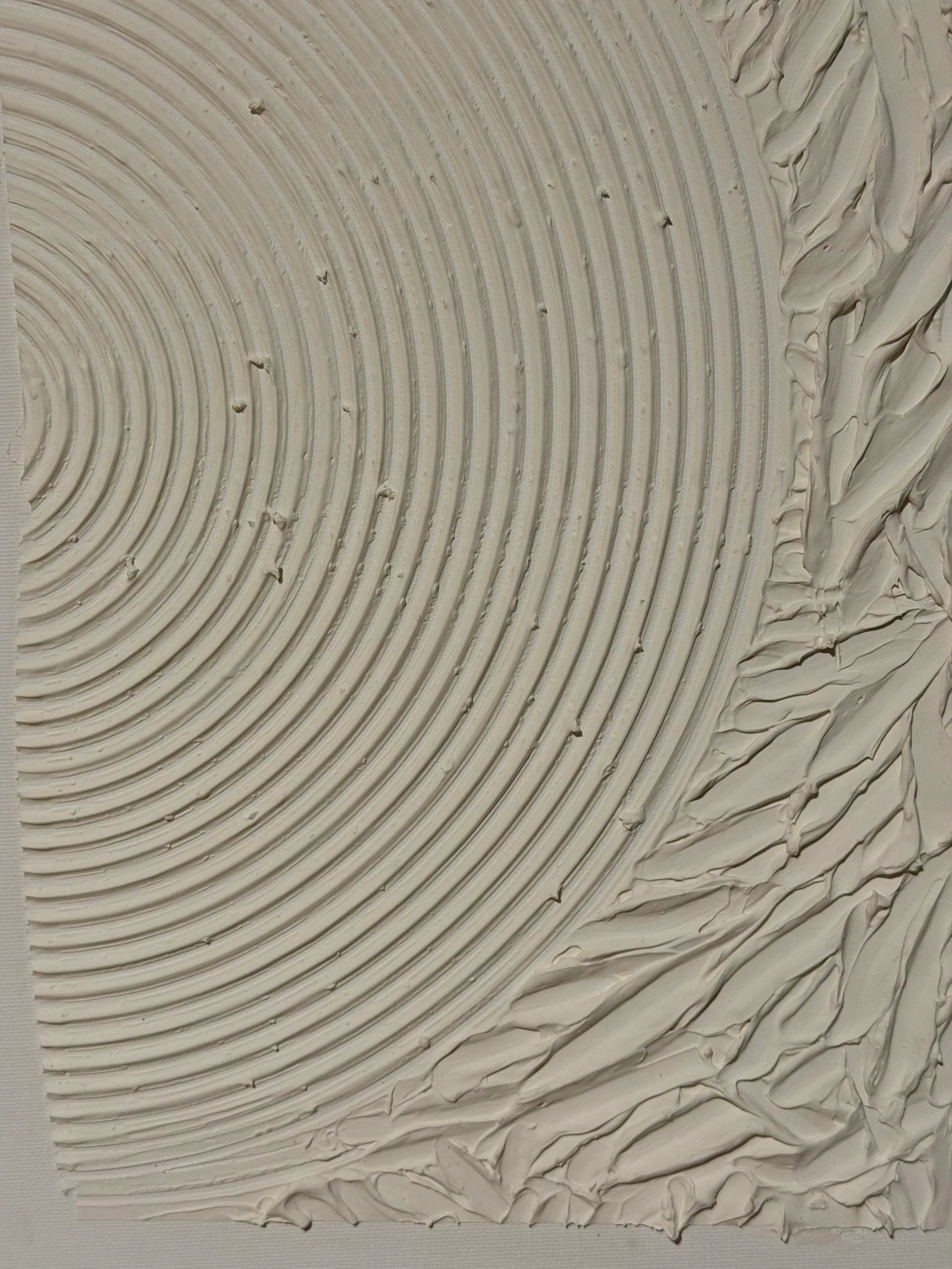
As an architect by training, I read a surface as a wall first. In Echo of Silence the record says sculpted texture on canvas: concentric reliefs and folds in a single pale tone, so the eye reads depth rather than colour. Amber Strata is another case, a 150 x 100 cm horizontal worked in ochre, bone and oxidized umber, with granular raised passages in the detail photograph. Silent Interval goes the other way: one dark gesture on a worked, scored ground, where the relief is quiet and the silence is the subject. I would rather a curator ask which surface is built and which is painted than assume that all three do the same thing.
Frequently asked
Which artists are known for textured abstract painting?
Tate lists Jean Dubuffet (1901-1985), Antoni Tàpies (1923-2012) and Julian Schnabel (born 1951) in its collection under matter painting. Museum records also document Alberto Burri, who worked with burlap, pumice, tar and burned materials, and Manolo Millares, whose Cuadro 1957 is oil on hessian. These are different practices, so the list shows procedures, not a ranking.
What is the difference between texture paste, relief and matter painting?
Tate defines matter painting as thick impasto paint with added materials such as sand, mud, cement and shells, a term from the 1950s. Relief and texture paste are descriptive terms used on labels, without a single definition in the sources cited here. The practical question for any artist is what the raised surface is made from, and the medium line should answer it.
How can a curator search for artists by material rather than by name?
Start from the vocabulary of the medium line: impasto, sand, sackcloth, sculpted texture. Ask for the plain medium, dimensions and year, and for detail photographs of the surface. Museum collection pages that group works under a term, such as Tate's matter painting entry, show how labels describe surface and can suggest search words for living artists.
Does texture survive shipping and exhibition?
The studio does not publish handling or weight data for individual works, so ask it for the information on the specific painting. What it states is that professional packaging is included and transit insurance is available. For buyers outside Brazil, damage in transit must be reported within 48 hours of delivery, with photographs.
How is a textured painting photographed for a catalogue?
A flat, frontal image shows composition but hides relief, so ask for additional detail photographs of the surface, ideally with light crossing it at a low angle. The studio publishes real surface-detail photographs for its works and can send more detail photographs or a video of a specific work on request through WhatsApp.
See the surface up close
Ask for detail photographs or a short video of a textured original.
Sources
- Tate — 2026-11-04
- Peggy Guggenheim Collection, Venice — 2026-11-04
- Museo Reina Sofía — 2026-11-04
- Tate — 2026-11-04
Published on