Who was Alfredo Volpi?
Alfredo Volpi (Lucca, Italy, 1896 – São Paulo, 1988) was a self-taught Brazilian painter who began as a wall painter and decorator. He is known for house facades and, from 1954, canvases of small festival flags (bandeirinhas), painted in egg-based tempera. MASP says the flags speak formally to Brazilian Concrete art.
From wall painter to painter: a short biography
MASP records that Volpi was born in Lucca, Italy, in 1896, and emigrated to Brazil in 1897, with his family settling in the Cambuci district of São Paulo. The museum calls him self-taught and says that before devoting himself to art he worked as a wall painter and decorator. In 1935 he joined the Grupo Santa Helena, a São Paulo group of painters that included Mário Zanini and Aldo Bonadei. He died in São Paulo in 1988.
That trade matters for how his pictures look. The sources read for this page do not say how that trade shaped his painting, so this page leaves the connection open.
Facades and houses: where the geometry comes from
According to MASP, Volpi adopted the facade as a theme in the middle of the 1940s, in a series of paintings made in Itanhaém, on the São Paulo coast. One way to read the theme: a facade is already built from rectangles, with a front wall, doors and windows.
The museum's own text on Motivo de casas (1955, tempera on canvas, 73 x 50 cm) notes geometrising elements in a painting done entirely in black and white. It is a useful picture to look at beside the flag paintings: made in 1955, it shows a facade already treated with geometrising elements. MASP dates the facade theme to the mid-1940s, before the first flag canvases of 1954.
Bandeirinhas: the small flags
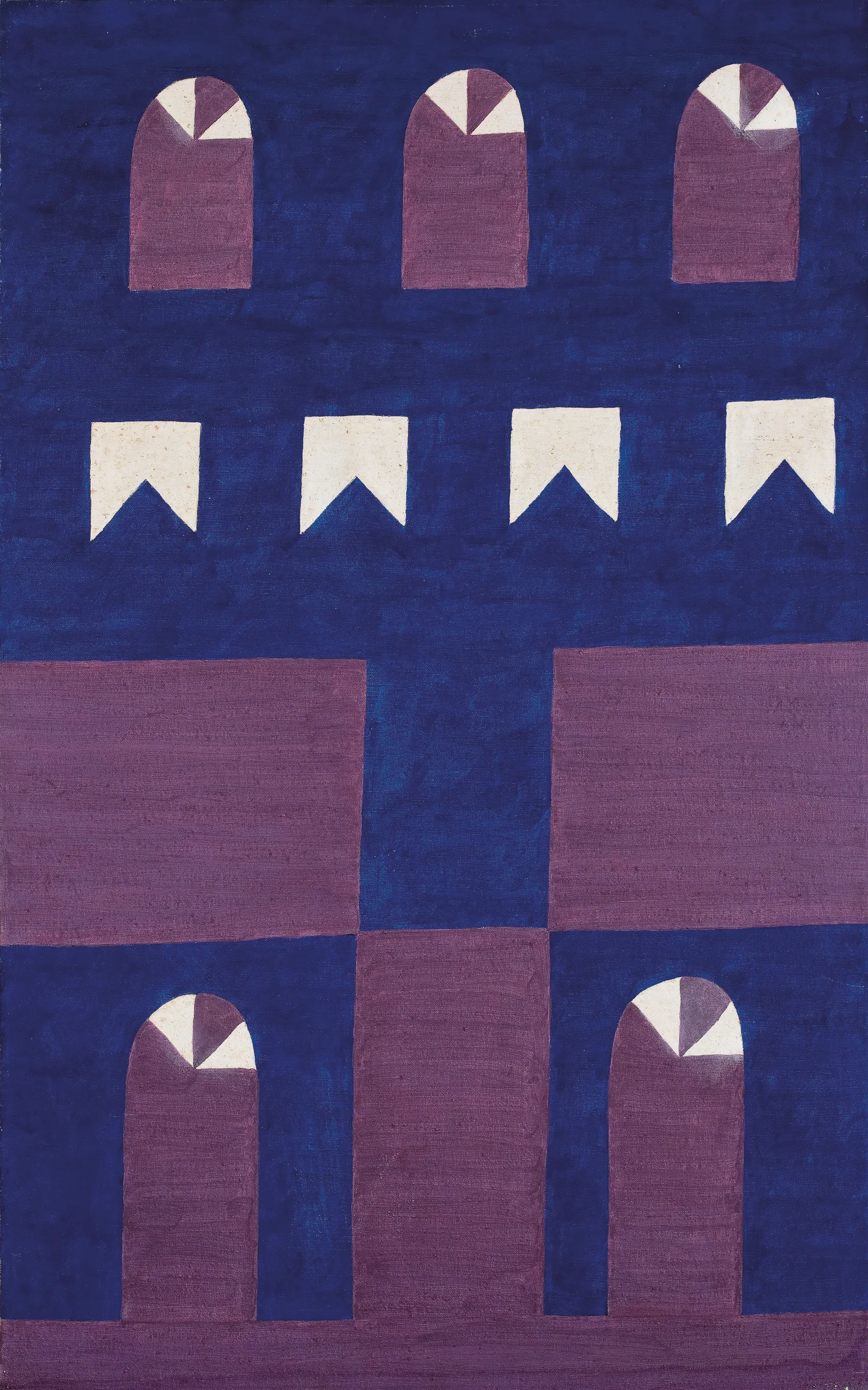
MASP states that in 1954 Volpi painted his first canvases on the theme of bandeirinhas, the small flags strung up for Brazilian popular festivals. The museum adds that the theme speaks formally to the abstract language of the Brazilian Concrete artists of the period.
The painting at the top of this page, Fachada com bandeiras (1959, 115.5 x 72 cm), places a row of white flags between rows of arched windows and doors, so the facade and the flags share one picture plane. Because the flags can be read as a real decoration or as a pattern of colour fields, the same canvas works as a street scene and as a near-abstract composition.
Why tempera?
MASP records that Volpi travelled to Europe in 1950 and became interested in the effect of tempera in the frescoes of Giotto. The museum describes tempera as a paint with an egg-white base, and then adopted it. Tempera on canvas is the medium listed for both Volpi works consulted for this page, Fachada com bandeiras and Motivo de casas.
The museum records give the medium and the 1950 starting point; they do not describe how he prepared or layered it, and this page does not guess.
Concrete art, modernism, or neither?
Volpi does not sit neatly in one movement, and this page does not file him in one. MASP says only that the flag theme dialogues formally with the abstract language of the Concrete artists. An account of the first Concrete art exhibition published by the Institute of Advanced Studies of the University of São Paulo, describes him as an older painter, running on his own track, who was cast as the elder sponsor of the movement around the 1956 show. That is a statement about how younger artists saw him, and it is not a claim that he joined the group.
For the movement itself, see What was Concrete art in Brazil?, and for the wider period, Brazilian modern art: where to start.
Where to see his work
MASP in São Paulo holds at least two of the paintings named here: Fachada com bandeiras (inventory MASP.01237, gift of Ernest Wolf, 1990) and Motivo de casas (inventory C.01260, on long-term loan from the Banco Central do Brasil). A collection record tells you where a work belongs, not what is on the wall this month, so check the museum's own website before planning a visit. Volpi also appears with seven other painters in Famous Brazilian painters, where the museum records are listed together.
From the studio
From the studio
What I take from Volpi is a question of procedure: how much of a picture comes from the paint and how much from the layout. Looking at the MASP canvas, the colour fields read as flat to me, so the layout of windows and flags carries the picture. In Golden Passage, from the Black & Gold series (2025, mixed media, texture paste and imitation gold leaf on canvas, 60 x 80 cm, Archive ID AP-BNG-2025-001), I work the other way: the surface is built up in relief, and a diagonal of sculpted forms carries the rhythm.
That is a difference of method, not a comparison of standing. As an architect by training, I read any canvas the way I would read a wall, by what it does to the room around it, and a facade painting is an easy place to practise that habit.
Frequently asked
Who was Alfredo Volpi?
Alfredo Volpi was a Brazilian painter born in Lucca, Italy, in 1896 and brought to Brazil in 1897. MASP describes him as self-taught, a former wall painter and decorator, and a member of the Grupo Santa Helena from 1935. He is known for painted house facades and the bandeirinhas, small festival flags, which he began painting in 1954. He died in São Paulo in 1988.
What are Volpi's bandeirinhas?
Bandeirinhas are the small flags strung across streets and squares for Brazilian popular festivals. MASP records that Volpi painted his first canvases on this theme in 1954. The museum says the theme speaks formally to the abstract language of the Brazilian Concrete artists of the period.
Why did he use tempera?
According to MASP, Volpi went to Europe in 1950 and became interested in how tempera behaved in Giotto's frescoes, then adopted the technique. The museum describes tempera as an egg-white-based paint. The two works consulted for this page, Fachada com bandeiras (1959) and Motivo de casas (1955), are listed as tempera on canvas. The sources read here do not give his own stated reasons beyond that interest.
Was Volpi concrete or modernist?
The sources read for this page do not settle it, so this page does not label him. MASP says his flag theme dialogues formally with Concrete art. A University of São Paulo account describes him as a painter on his own track, cast as an elder sponsor of the Concrete movement around the 1956 exhibition. Both statements describe a relationship with the movement, not membership in it.
Where can I see his work?
MASP in São Paulo holds Fachada com bandeiras (1959, gift of Ernest Wolf, 1990) and Motivo de casas (1955, on long-term loan from the Banco Central do Brasil). A collection record shows where a work is kept, not whether it is on display now, so confirm on the museum's own website before travelling. Other institutions may also hold his work; this page names only what was checked.
Contemporary Brazilian painting, direct from the studio in Brasília
Each original comes with a signed certificate of authenticity and an Archive ID. Ask about a specific work and the studio will reply on WhatsApp.
Sources
- MASP - Museu de Arte de São Paulo — 2026-10-14
- MASP - Museu de Arte de São Paulo — 2026-10-14
- Instituto de Estudos Avançados, Universidade de São Paulo — 2026-10-14
- Perfeito Studio (src/data/obras.json) — 2026-10-14
Published on · Updated on