Who was Candido Portinari?
Candido Portinari (1903–1962) was a Brazilian painter born on a coffee farm near Brodowski, São Paulo, who became known for monumental pictures of Brazilian workers and history. His best-known works are Café (1935), the Retirantes series (the MASP canvas is dated 1944) and the War and Peace murals at the United Nations in New York.
Early life and training
Portinari was born in 1903 on a coffee farm near Brodowski, in the state of São Paulo, the son of Italian immigrants. The Projeto Portinari, the research archive that catalogues his work, records that he had only a primary education and began painting at the age of nine.
He studied at the Escola Nacional de Belas Artes in Rio de Janeiro from 1919 to 1921, won early prizes in 1923, and received a travel prize in 1928 that took him to Europe, where he spent time in Paris. He died in Rio de Janeiro in 1962.
What he is known for
His subject, across techniques that changed over the decades, was the Brazilian worker and Brazilian history, especially rural labour. The USP portal calls his Baile na roça (1924) a landmark of social art in Brazil, and notes that the jury of the Escola Nacional de Belas Artes rejected it.
Café (1935) is an oil on canvas of 130 x 195 cm, now in the Museu Nacional de Belas Artes in Rio de Janeiro. It received a Second Honorable Mention at the Carnegie Institute in Pittsburgh in 1935, which the Projeto Portinari records as his first award outside Brazil.
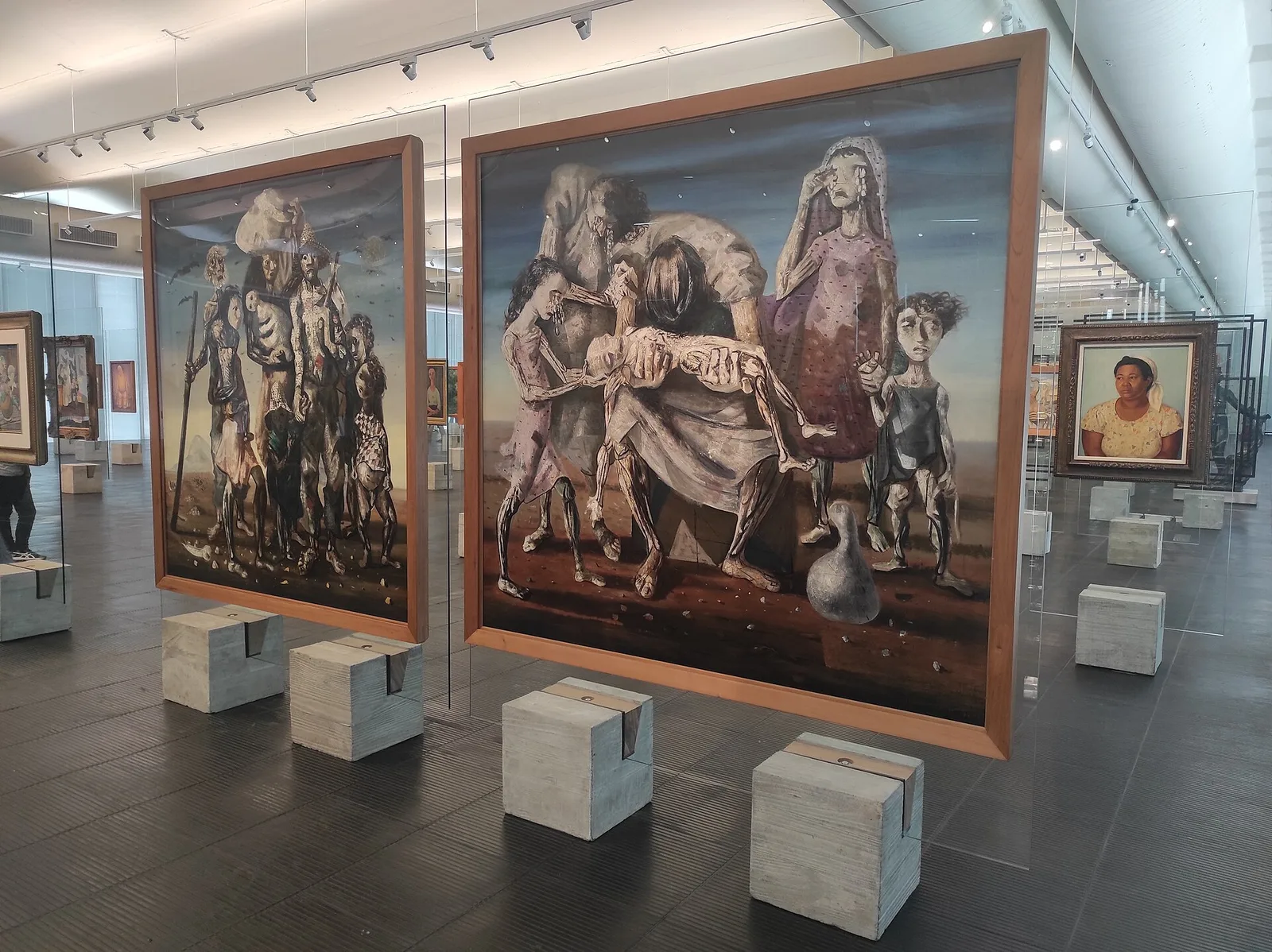
Retirantes (1944), at MASP in São Paulo, is an oil on canvas of 190 x 180 cm. It belongs to a series on migrants fleeing drought in the Brazilian northeast. MASP's own text describes figures that seem to lose their humanity and blend into the landscape, followed by vultures.
The War and Peace murals
Brazil offered the two War and Peace (Guerra e Paz) murals to the United Nations in 1957. According to UN News, each measures 10.4 by 14 metres, and they hang on the east and west walls of the delegates' lobby of the General Assembly building in New York.
The panels were restored and shown in São Paulo and Belo Horizonte, and drew admirers in Paris, before being reinaugurated at UN Headquarters in 2015, according to UN News.
Murals and public commissions
Portinari worked at architectural scale throughout his career. The USP portal lists frescoes for the Ministry of Education and Health building in Rio, panels for the Brazil Pavilion at the 1939 New York World's Fair, a mural for the Hispanic Foundation of the Library of Congress in Washington, and the church of São Francisco at Pampulha in Belo Horizonte (1945).
Portinari and Brazilian modernism
The USP portal calls his Baile na roça (1924) a landmark of social art in Brazil, and it records that in 1955, when abstraction was rising in Brazil, its supporters criticised him harshly. For readers new to the period, our guide Brazilian modern art: where to start sets out the wider map, and artists similar to Tarsila do Amaral covers a contemporary of his.
Where to see his work
Works named above are held by public institutions: Café at the Museu Nacional de Belas Artes in Rio de Janeiro, Retirantes at MASP in São Paulo, and War and Peace at United Nations Headquarters in New York. Many of his works sit in other collections. For a wider orientation, see famous Brazilian painters and where their work is held. Check each institution before you travel; displays change.
From the studio
From the studio
Portinari built his pictures from the human figure. I paint without figures, so I will not compare the two bodies of work. What I can describe is my own work. In Fire of Devotion, from the Heart of Chaos series, a crimson field carries the whole surface, with flashes of gold and copper and diagonal white streaks cutting through it. It is acrylic on canvas, 100 x 150 cm, made in 2026.
The work is original and unique, and the page for it carries the full technical record and price in BRL.
Frequently asked
Who was Candido Portinari?
Candido Portinari (1903–1962) was a Brazilian painter born on a coffee farm near Brodowski, in São Paulo state, to Italian immigrant parents. He studied at the Escola Nacional de Belas Artes in Rio de Janeiro and became known for large pictures and murals of Brazilian workers and history. He died in Rio de Janeiro in 1962.
What is Portinari known for?
He is best known for Café (1935), now in the Museu Nacional de Belas Artes in Rio de Janeiro, the Retirantes series on drought migration in the northeast, with the 1944 canvas held at MASP in São Paulo, and the War and Peace murals at the United Nations. His recurring subject was the Brazilian worker, especially rural labour.
What is the War and Peace mural?
War and Peace (Guerra e Paz) is a pair of murals by Portinari that Brazil offered to the United Nations in 1957. According to UN News, each measures 10.4 by 14 metres and hangs in the delegates' lobby of the General Assembly building in New York. They went through a restoration and a tour of Brazilian cities, and were reinaugurated at UN Headquarters in 2015.
How is he linked to Brazilian modernism?
The USP portal calls his Baile na roça (1924) a landmark of social art in Brazil. His Café won a Carnegie Institute honourable mention in 1935, and in 1955, as abstraction rose in Brazil, its supporters criticised his work harshly.
Where are his works?
Café is at the Museu Nacional de Belas Artes in Rio de Janeiro, and Retirantes is at MASP in São Paulo. The War and Peace murals are at United Nations Headquarters in New York. He also painted a mural for the Hispanic Foundation of the Library of Congress and decorated the church at Pampulha, Belo Horizonte. Confirm current displays with each institution.
See Fire of Devotion, from the Heart of Chaos series
One original, one signature. Write to the studio for detail photos, dimensions on your wall and acquisition details.
Sources
- Projeto Portinari — 2026-10-15
- Universidade de São Paulo, Portal Latinoamericano — 2026-10-15
- Projeto Portinari — 2026-10-15
- Museu de Arte de São Paulo (MASP) — 2026-10-15
- ONU News — 2026-10-15
- Wikimedia Commons — 2026-10-15
- Perfeito Studio (src/data/obras.json) — 2026-10-15
Published on