Who was Lygia Pape?
Lygia Pape (1927-2004) was a Brazilian artist born in Nova Friburgo who worked in Rio de Janeiro and, with Lygia Clark and Hélio Oiticica, was one of the key figures of the Neo-Concrete movement. Her work runs from the woodcut Tecelares and the Livro da Criação to films, collective performances and the thread installations called Ttéia.
From Nova Friburgo to Grupo Frente
Lygia Pape was born in 1927 in Nova Friburgo, in the state of Rio de Janeiro, and grew up in a middle-class family. She married young and moved to the city of Rio de Janeiro, where she lived until her death in 2004. The Kunstsammlung Nordrhein-Westfalen records that she never studied art, though she had contact with other artists from an early age.
In 1954 the Grupo Frente was founded in Rio, a group of artists, poets and critics that included Pape, Lygia Clark and Hélio Oiticica. It took up the geometric abstraction and Concrete art that had arrived from Europe, along with the Brazilian modernism of the 1920s and 1930s. The Museo Reina Sofía describes the carioca wing of concretism as one in which geometric language was an open field of experimentation, and dates Pape's first geometric paintings and engravings to 1953 to 1955.
The Tecelares: weaving space with a woodblock
In 1955, according to the Reina Sofía's exhibition dossier, Pape began to experiment with woodcut, and the result was the Tecelares, from the Portuguese word for weavings. Museums date the series a little differently: the Art Institute of Chicago says she made it primarily between 1955 and 1959, the Reina Sofía's collection text speaks of constructive wood prints made between 1956 and 1958, and the Kunstsammlung gives 1953 to 1960.
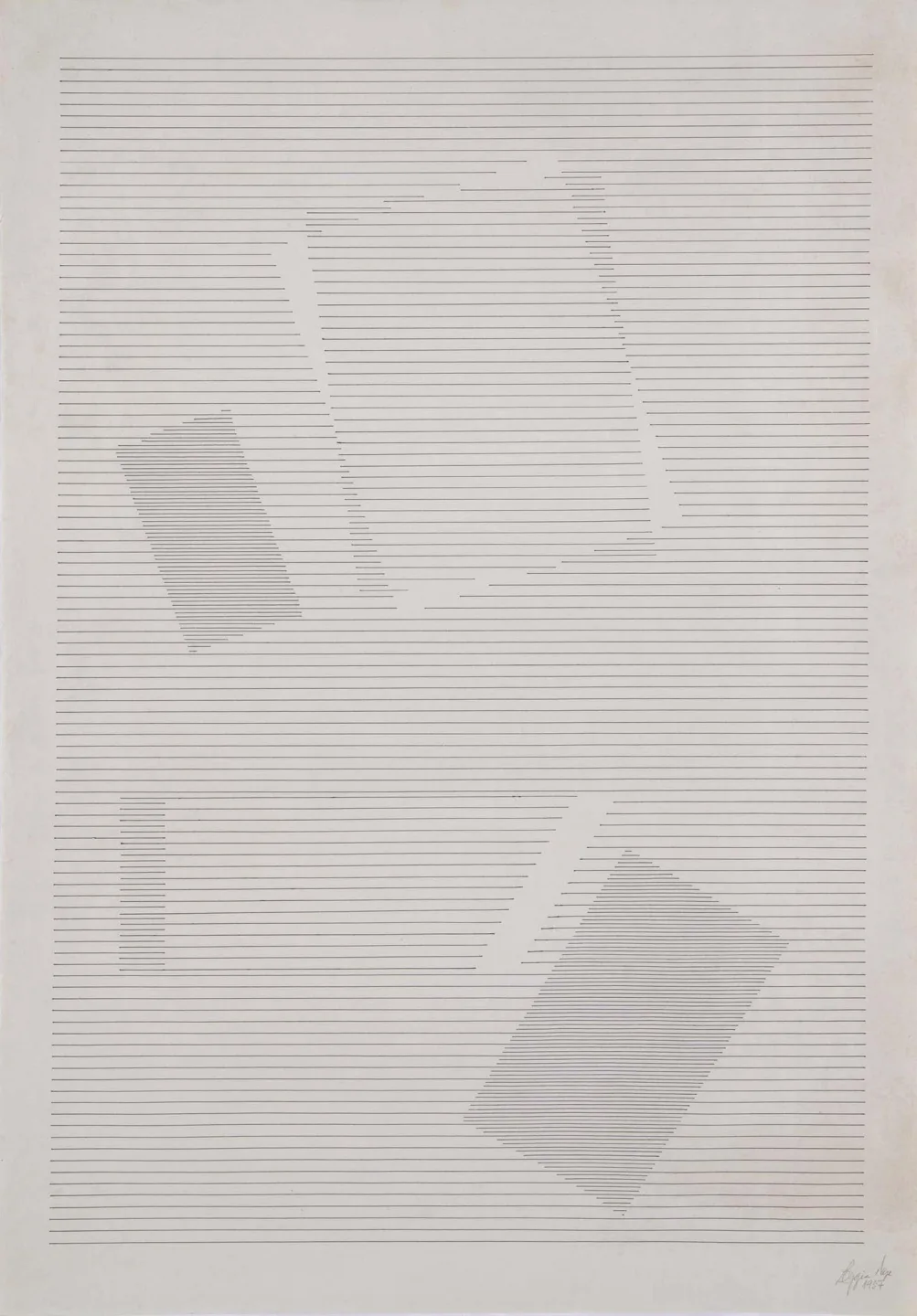
The procedure is what sets them apart. As the Kunstsammlung's guide describes it, Pape worked wooden panels with tools and sandpaper, coloured them with black ink and usually printed each one only once, on slightly transparent rice paper, so that the grain lines and other indentations show up white. The Art Institute adds that she gave up the idea of the multiple for unique prints in which the grain became an aesthetic element, and that the interplay of incised line, the gradation of the wood and the uneven absorption of ink produced a tension she called "magnetised space."
The sheet shown above is catalogued by the Reina Sofía as Sin título (Tecelar), 1957, ink on Japanese paper. The museum's text places it in the Tecelares group and ties the series to her path toward Neo-Concretism. Note that the museum records this sheet as ink on Japanese paper, so it shows the series' line structure rather than the printed wood grain described above.
The neo-concrete years: a ballet and a book
The Neo-Concrete movement emerged from Grupo Frente in 1959, with the aim of going beyond a Concrete art its artists found too rationalistic and mechanical, as the Kunstsammlung's guide puts it. For the manifesto and its signatories, see What was neo-concrete art?. Two of Pape's works from these years show what she brought to it.
Ballet neoconcreto I was performed at the Teatro Copacabana Palace in Rio de Janeiro in 1958. Its choreography follows a poem by Reynaldo Jardim made of just two words, olho (eye) and alvo (target): white cylinders stand for eyes and orange parallelepipeds for targets, and they move across the stage to minimalist piano music. A second ballet, a dance of a pink square and a pink-blue rectangle, followed in 1959.
Livro da Criação (Book of Creation), 1959, tells the creation of the world in sixteen episodes without words. The Reina Sofía catalogues it as a sixteen-page pop-up book in gouache and tempera on paperboard, each part measuring 30.5 by 30.5 cm. The Kunstsammlung notes that its loose square pages only become active when held and unfolded, so the narrative forms in the mind of each user. A related piece, Livro do Tempo (Book of Time), is a wall-filling work of 365 painted wooden units, one for each day of the year.
Cinema, the dictatorship and Divisor
After the Neo-Concrete group ended, Pape designed graphic work for Cinema Novo. The Reina Sofía lists her posters and title credits for films that include Glauber Rocha's Deus e o Diabo na Terra do Sol (1964). Brazil's military dictatorship began in 1964 and lasted until 1985. In 1967 she showed Caixa das baratas in the exhibition Nova objetividade brasileira at the Museu de Arte Moderna in Rio de Janeiro, a work the Kunstsammlung reads as her critique of the museum, where art is exhibited in a state of stasis. Her first film, La Nouvelle Création, dates from the same year.
The work that gives the Düsseldorf retrospective its title is Divisor: a cloth with openings through which participants put their heads, joined and separated at once by a shared surface. The Reina Sofía dates it to 1968 and calls it her first collective experience; the Kunstsammlung records a first activation with children in 1967. In Roda dos Prazeres (Wheel of Pleasures), participants put drops of coloured, flavoured water on their tongues from bowls arranged in a circle. The Reina Sofía notes that Pape wanted such pieces to be repeatable without her presence.
From 1972 she taught in the Department of Architecture and Urbanism at the University of Santa Úrsula. In 1973, the Kunstsammlung records, she was imprisoned and tortured for three months for allegedly aiding opponents of the regime, and was acquitted.
Ttéia: thread and light
The Kunstsammlung describes Ttéia 1 C as an installation of silver thread, nails, wood and light stretched between floor and ceiling in a dark room; only light makes the threads visible, and the viewer has to move to see the rays overlap. The Reina Sofía notes variations by space (corner or free-standing), light (natural or artificial) and thread (copper, silver or transparent).
Sources differ on the start. The Reina Sofía places the first Ttéia in a 1977 project with her students at Parque Lage, in Rio; the Kunstsammlung says that in 1978 to 1979, in a seminar at Parque Lage, she first stretched threads between trees. The Kunstsammlung adds that the installations, in silver and gold thread, continued until shortly before her death. The title plays on teia (net) and teteia, a colloquial word for a strange person or thing, and the Kunstsammlung connects the series back to the Tecelares, since both weave space.
From the studio
From the studio
Pape is history to me, not a lineage I claim. What a studio can take from the Tecelares is a point of procedure: a line only becomes visible against the surface that resists it, whether that is the grain of a woodblock or a ground built up in layers.
That is how I work in Quartz Seam (Terra & Ether, 2026, mixed media with acrylic and imitation gold leaf on canvas, 98 x 152 cm, Archive ID AP-TAE-2026-007). The pigment is laid thick enough to carry its own relief and then bounded rather than blended, so each field of dusty rose keeps its border, and fine seams of gold run where one mass of colour meets another. As an architect I think about the wall a painting will hang on as part of how it is read.
Frequently asked
Who was Lygia Pape?
Lygia Pape (1927-2004) was a Brazilian artist born in Nova Friburgo, in the state of Rio de Janeiro, who lived and worked in the city of Rio de Janeiro. She was a member of Grupo Frente and, with Lygia Clark and Hélio Oiticica, a key figure of the Neo-Concrete movement. Her work spans woodcut prints, a ballet, book objects, films, collective performances such as Divisor, and the thread installations called Ttéia.
What are the Tecelares?
The Tecelares, from the Portuguese word for weavings, are woodcut prints Pape began in the 1950s. She worked wooden panels with tools and sandpaper, inked them in black and usually printed each only once on thin rice paper, so the grain appears white. The Art Institute of Chicago describes them as unique prints made primarily between 1955 and 1959, in which the grain of the wood becomes part of the image.
What is Ttéia?
Ttéia is a series of installations in which silver, gold, copper or transparent threads are stretched through a space and made visible by light. Pape first experimented with threads between trees at Parque Lage in Rio de Janeiro in the late 1970s, with her students, and kept developing the idea until shortly before her death. The name plays on teia (net) and teteia, a colloquial word for a strange person or thing.
How does she differ from Lygia Clark?
Both were members of Grupo Frente and are named together as key figures of Neo-Concretism. The difference is clearest in the media museums record. Pape is known for woodcut Tecelares, then film, collective performance and thread installations. The Art Institute of Chicago holds Clark's Unidade (1958) in industrial paint on wood and her aluminium Bicho (1960). Clark lived from 1920 to 1988. This page does not attempt a full account of Clark's work.
Where can I see her work?
The Museo Reina Sofía in Madrid catalogues Livro da Criação and a Tecelar from 1957, and the Art Institute of Chicago holds Tecelares prints and showed them in the exhibition Lygia Pape: Tecelares in 2023. Major retrospectives include Magnetic Space (Madrid, 2011, then London and São Paulo) and The Skin of ALL (Düsseldorf, 2022). Displays change, so confirm what is on view with each museum before travelling.
See Quartz Seam, from the Terra & Ether series
One original, one signature. Write to the atelier for detail photos, how it reads at scale, and acquisition details.
Sources
- Kunstsammlung Nordrhein-Westfalen, exhibition guide Lygia Pape. The Skin of ALL (K20, Düsseldorf, 19 March-17 July 2022) — 2026-10-15
- Museo Nacional Centro de Arte Reina Sofía, Lygia Pape: Magnetic Space, exhibition dossier (PDF) — 2026-10-15
- Museo Nacional Centro de Arte Reina Sofía — 2026-10-15
- Museo Nacional Centro de Arte Reina Sofía, collection record — 2026-10-15
- Museo Nacional Centro de Arte Reina Sofía, collection record — 2026-10-15
- Art Institute of Chicago, Weaving (Tecelar), 1953, reference number 2018.197 — 2026-10-15
- Art Institute of Chicago — 2026-10-15
- Art Institute of Chicago — 2026-10-15
- Art Institute of Chicago — 2026-10-15
Published on · Updated on