How big should abstract art be above the bed, and how high do you hang it?
Above a bed, size is a budget of two numbers. Take 50 to 75 percent of the headboard's width for the painting's width, then subtract the headboard's height, a gap of about 15 to 30 cm and the clearance below the ceiling from the ceiling height. What is left is the tallest canvas that fits.
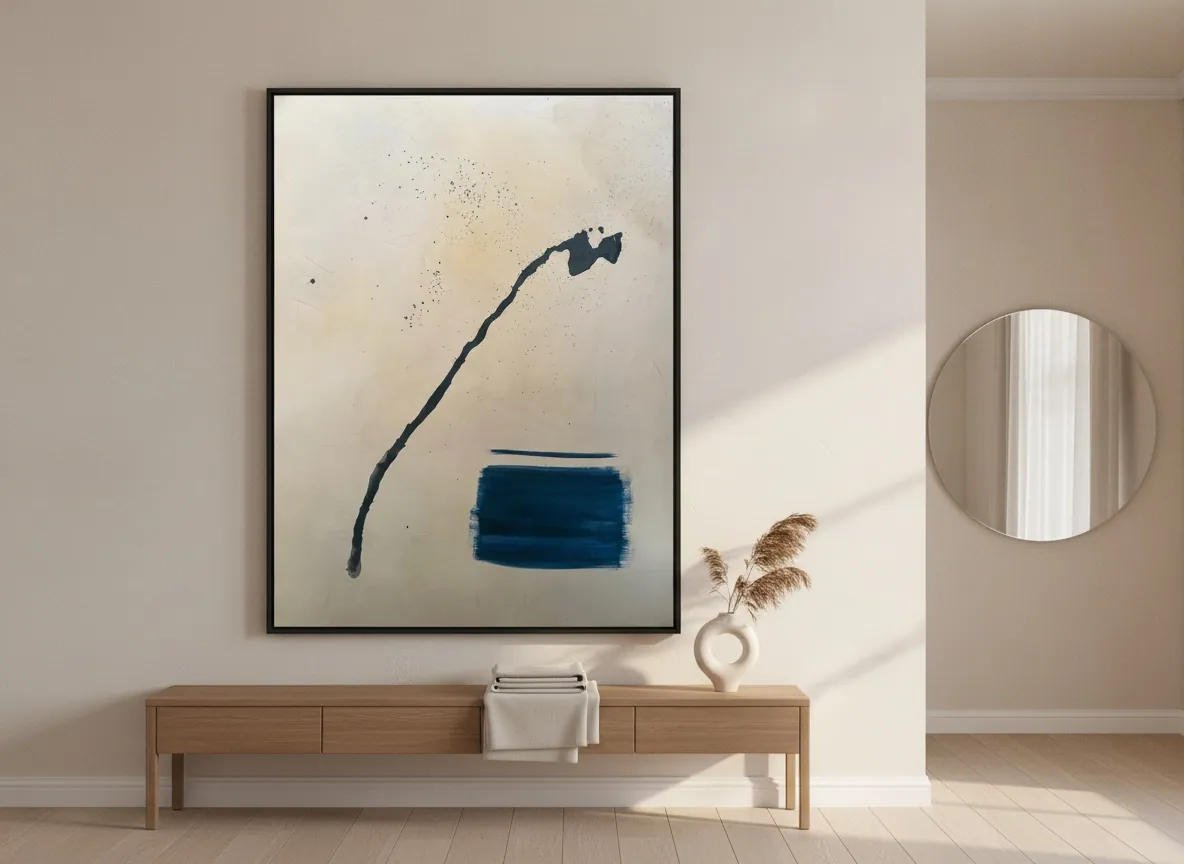
Width: the easy half of the question
Width is the number every guide agrees on, give or take. The painting should be narrower than the bed but not by much. Mattress sizes first: a queen is 60 x 80 inches (about 152 x 203 cm) and a king is 76 x 80 inches (about 193 x 203 cm), so the width you measure on your own headboard wall is what matters, and it may be a little wider than the mattress.
- One designer guide asks for 50 to 75 percent of the bed or headboard width: 30 to 49 inches (about 76 to 124 cm) over a queen, 40 to 60 inches (about 102 to 152 cm) over a king.
- Another works from about two-thirds of the bed: 40 to 48 inches (about 102 to 122 cm) over a queen, 50 to 60 inches (about 127 to 152 cm) over a king, and warns against going narrower than half the bed.
The two overlap more than they disagree. Over a queen, roughly 102 to 122 cm sits inside both. Over a king, roughly 127 to 150 cm does. For a longer treatment of the ratio, see our guide to a large abstract painting for a bedroom; this page is about the second number. Its ranges are slightly different from the two guides quoted here; use any of them as a starting point and settle the exact width with a paper template.
Height: the half that decides what fits
Above a bed, the usual standing-eye-level rule does not apply. One guide says to position the work relative to the headboard rather than at standing eye level, and puts the center of the work at around 62 to 70 inches (about 157 to 178 cm) above the floor. Whatever the center does, the work has to fit in a vertical band with three limits.
- Gap above the headboard: 6 to 8 inches (about 15 to 20 cm) in one guide, 8 to 12 inches (about 20 to 30 cm) in the other. The two guides disagree, so treat 15 to 30 cm as the range to judge by eye.
- Clearance below the ceiling: at least 6 inches (about 15 cm) in one guide, and 8 to 12 inches (about 20 to 30 cm) of bare wall above the frame, on 8-foot ceilings, in the other.
- The headboard itself: its height is yours to measure. Nothing in a guide can supply it.
That gives a small piece of arithmetic, which is ours and not a rule from a source: maximum painting height = ceiling height - headboard height - gap - clearance. With a 250 cm ceiling, a 110 cm headboard, a 20 cm gap and 25 cm of clearance, the budget is 95 cm. Tighten the gap to 15 cm and the clearance to 20 cm and it becomes 105 cm. Raise the ceiling to 280 cm and the budget is 125 cm. These are worked examples with round numbers; replace each with the measurement of your own wall.
What the height budget means for format
The same arithmetic can be run backwards: for a given painting, what is the lowest ceiling that still leaves a 20 cm gap and 25 cm of clearance over a 110 cm headboard? That is the painting's height plus 155 cm. Dimensions below are width x height, as listed on each work's page, and the ceiling figures are our arithmetic on the example numbers above, not a recommendation.
- 100 cm tall: Amethyst Ground, Prism Garden and Patina Field (all 100 x 100 cm), and the horizontal Amber Strata (150 x 100 cm). Ceiling of about 255 cm. At 100 cm wide the square works sit inside the queen band; at 150 cm, Amber Strata belongs over a king.
- 120 cm tall: Crossing Currents and Vegetal Dawn (both 80 x 120 cm). Ceiling of about 275 cm.
- 150 cm and taller: Vibrant Awakening and Fire of Devotion (100 x 150 cm), Quartz Seam (98 x 152 cm), Silent Interval (120 x 160 cm). Ceiling of 305 to 315 cm, or a low headboard.
The pattern is the point: a vertical format spends height, and height is the scarce quantity over a bed. Horizontal and square formats spend width instead, which a bed has plenty of. A tall vertical is not wrong above a bed; it simply needs a high ceiling or a low headboard to leave room around it. Every work on this site is an original, so a size is not something to be rescaled later: check the numbers first.
Test it with paper before you order
Cut sheets of paper or taped newspaper to the painting's exact width and height, and tape them to the wall at the gap you have chosen. Leave them up for a day or two and look from the door and from the pillow. Check the three limits directly: is the gap above the headboard comfortable, is there bare wall above the top edge, and does the template feel proportionate to the bed rather than lost above it? If it does not, change one measurement and test again.
A large canvas over a bed is also a question of what holds it to the wall. Weight depends on the size of the work and the wall behind it, and the hardware has to be rated for both; our guides on hanging a heavy painting on drywall and on standard hanging height cover the rest, and a professional installer is the right call when in doubt.
From the studio
From the studio
I trained as an architect, and an elevation drawing is the clearest way I know to see this problem: a stack of heights, with the bed at the bottom and the ceiling at the top. Silent Interval, 120 x 160 cm, is a good example of why. Its 120 cm width sits at the lower end of what the guides allow over a king bed, and the 160 cm height is the number I would check before anything else. Its single black line is a long gesture, and a gesture like that needs air above and below it; a canvas squeezed between a tall headboard and the ceiling stops being read as a field and becomes a stripe.
Amber Strata, at 150 x 100 cm, is the other reading of the same wall. It is horizontal and layered in warm, mineral tones, so it spends its size across the wall instead of up it. I think of the two as answers to two different elevations, not as the same idea in two sizes.
Frequently asked
What size painting goes above a queen bed?
Two published guides overlap at roughly 102 to 122 cm wide. One gives 50 to 75 percent of the headboard width, which is 30 to 49 inches (about 76 to 124 cm) for a queen. The other works from about two-thirds of the bed, 40 to 48 inches (about 102 to 122 cm). One of them warns against going narrower than half the bed. Measure your own headboard wall first, then check the height budget as well.
Is a vertical or horizontal painting better above a headboard?
Neither is better in general; it depends on the height you have. A vertical spends height, which is limited by the headboard, the gap above it and the clearance below the ceiling. A horizontal or square work spends width, which a bed has more of. A tall vertical works above a bed when the ceiling is high or the headboard low. Test the exact size with paper templates before choosing.
How far above the headboard should the painting hang?
The published guides disagree: one gives 6 to 8 inches (about 15 to 20 cm), another 8 to 12 inches (about 20 to 30 cm). Treat 15 to 30 cm as the range to judge by eye, then fix the exact gap with a paper template taped to the wall. Whatever gap you choose, leave bare wall between the top of the frame and the ceiling as well.
How does Perfeito Studio ship an original painting?
The studio ships within Brazil and internationally. Shipping is quoted per destination and paid by the buyer, as are any import duties or taxes in the destination country. Professional packaging is included and transit insurance is available. Domestic delivery takes up to 15 business days depending on destination, and international shipping is quoted on request. Collection in person after purchase is also possible.
What comes with an original from Perfeito Studio?
Every acquisition is made directly from the artist and includes the original, unique painting, a signed Certificate of Authenticity with the full technical record and Archive ID, a fiscal invoice or official receipt, an Artwork Acquisition Agreement, an artist dossier, conservation and care guidance, and professional packaging. The certificate carries a QR code linking to the work's official page.
Want to check a work against your headboard wall?
Send the headboard width, headboard height and ceiling height, and we will talk through which formats fit before you decide.
Sources
- Welsh Design Studio — 2026-10-08
- Fine Art America blog — 2026-10-08
- DreamCloud — 2026-10-08
Published on