Abstract art for a corporate lobby: scale, light and the wall behind reception
For a corporate lobby, choose one large original abstract painting with a single clear structure, on the wall visitors face as they enter, sized to two-thirds to three-quarters of the furniture beneath it. Keep it out of direct sun and unfiltered lamps. A lobby wall is usually read from across the room, so scale and light matter more than detail.
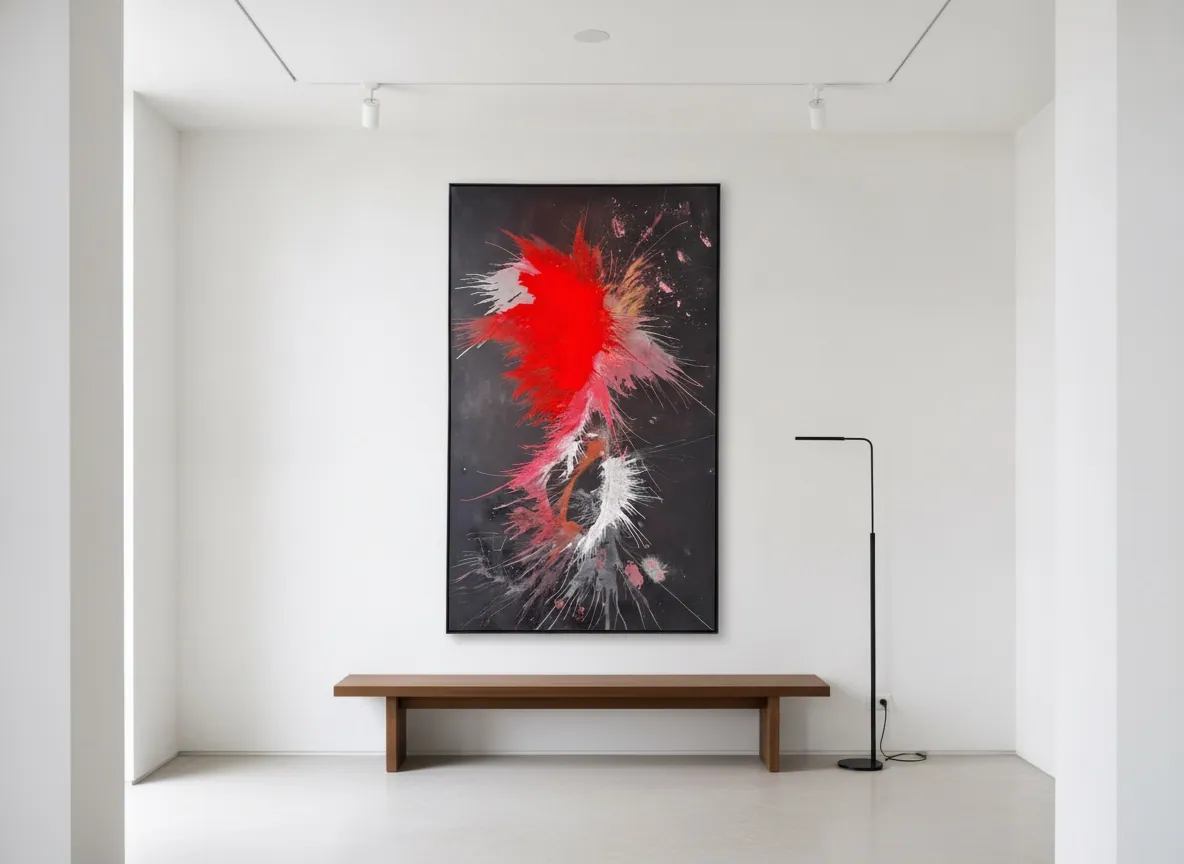
Find the wall first: what a visitor actually faces
A lobby is a room people cross, not one they sit in. Visitors typically approach the reception wall from the entrance, walk toward the desk, may pause or wait before moving on. The painting is therefore seen first from a distance, then briefly from close up. Decide which wall carries that sightline before you think about the painting: usually the wall behind the desk, sometimes the wall opposite the door, occasionally a side wall beside a waiting area.
The same logic separates a lobby from the rooms behind it. A boardroom wall is faced for an hour; a lobby wall is passed in seconds. Offices are covered in the guide to abstract painting for a corporate office. This page is about the entrance wall, where the work has to be legible from far away and hold up under a short, close look.
Scale: measure the furniture, then the wall
One interior-design retailer's guide states a sizing convention, the two-thirds rule: art should span roughly two-thirds to three-quarters of the width of the furniture it hangs over. It is a convention, not a regulation, and it only works where a piece of furniture sits beneath the painting, such as a credenza or a long bench behind the desk.
The arithmetic is simple. Over a 160 cm credenza, the range is about 107 to 120 cm. Over a 180 cm credenza it is 120 to 135 cm. Silent Interval is 120 × 160 cm (width × height), and Genesis of Flame is 120 × 200 cm; both therefore sit at the upper end of the range over a 160 cm piece and at the lower end over a 180 cm one.
Where the desk stands free in the room and nothing is beneath the painting, the rule has nothing to measure. Measure the clear wall between doors, columns, signage and glazing instead, and compare it with the dimensions in the gallery. Then add the height: a vertical work such as Genesis of Flame is 200 cm tall, so check its top edge against the ceiling, any rail and any pipe or fixture on that wall before choosing.
One painting or a grouping: what a formal lobby asks for
In the studio's practice, a formal lobby wall is usually better served by a single work than by several. One large composition reads as a decision about the room; a row of smaller pieces reads as a collection of decisions, and each one competes with the others when seen from the door. A grouping makes sense when the wall is very long or when the architecture already divides it into bays, and then the pieces should share a palette and a scale.
For a single work, structure matters more than detail. In the studio's experience, an abstract composition with one dominant gesture or one clear field of colour tends to hold from across the room, while a surface of many small incidents can read as a grey average at that distance. If the work also has texture or metallic pigment, it will reward the visitor who comes closer to the desk, which is the second look a lobby gives it. Height on the wall follows the same rules as anywhere else; see the standard height guide.
Light and circulation: what the entrance wall has to survive
Entrances often have glazing, and the Canadian Conservation Institute is direct about what that means for paintings. It says paintings ideally should not be exposed to any UV light from daylight or from unfiltered, UV-emitting fluorescent lamps. It reports that daylight of 30,000 lux can cause observable fading of highly sensitive paint in as little as a day to two weeks, and of medium-sensitivity paint between two weeks and a year. For highly sensitive pigments under normal office light of 500 lux, it reports noticeable fading within a few months to two years.
Those figures describe sensitive pigments, not every painting, and they are not a verdict on any specific work. They do explain why a wall facing an unshaded window, or one washed by unfiltered lamps, is a poor home for an original. Prefer a wall away from direct sun, screen the daylight where you cannot avoid it, and ask the artist what to expect from the particular work.
Circulation is the other constraint. In the United States, the ADA Standards limit wall-mounted objects whose leading edge is between 27 and 80 inches above the floor to a projection of 4 inches (about 10 cm) into a circulation path. Other countries have their own accessibility rules. Measure the depth of the canvas plus its hanging hardware, and confirm the requirement for your building with your facilities team or a code consultant.
What an organisation receives with an original from Perfeito Studio
Perfeito Studio sells original paintings only: each is unique and signed, and the studio does not sell prints. Every acquisition is made directly from the artist and comes with a signed certificate of authenticity carrying the technical record and Archive ID, a fiscal invoice or official receipt, an acquisition agreement covering transfer of ownership, copyright and image use, an artist dossier, conservation and care guidance, and professional packaging. Genesis of Flame, for example, is Archive ID AP-HOC-2025-001: mixed media on canvas (acrylic, metallic pigment, high-gloss and matte finish), 2025, priced at R$ 8,800. Silent Interval is AP-MAS-2026-003, 2026, R$ 7,900. Prices are set by the studio in Brazilian real.
Before ordering a work this size, confirm the route it will travel into the building, including doors and lifts, and the wall it will hang on.
From the studio
From the studio: reading a lobby as an architect
I trained as an architect, and I read an entrance wall the way I read a plan: where the door is, where the eye travels in the first three steps, and where the desk interrupts that line. A painting for that wall has to answer from the doorway, not from arm's length. That is why I think first about Genesis of Flame and Silent Interval for this kind of room. Genesis of Flame is 120 × 200 cm: a red nucleus igniting from a black ground, with silver, copper and rose fragments leaving it, so it holds a vertical wall from a distance and rewards a closer look. Silent Interval, at 120 × 160 cm, is the opposite temperament: one dark gesture in a large field of warm bone-white and a block of blue near the lower edge, with a great deal of open ground between them. I would ask a lobby to decide between those two temperaments before it asks about colour. Whichever it is, I would also ask for the wall measurements and a photograph of the light on it before suggesting any work at all.
Frequently asked
How large should art be behind a reception desk?
One interior-design retailer's guide states that art should span about two-thirds to three-quarters of the width of the furniture beneath it. Over a 180 cm credenza that means roughly 120 to 135 cm wide. If the desk stands free and nothing is beneath the painting, measure the clear wall instead and compare it with a work's catalogue dimensions, including its height against the ceiling and any fixtures.
Is a single large painting better than a grouping in a lobby?
In the studio's practice, a formal lobby is usually better served by one large work, because it reads as a single decision and holds from the entrance. A grouping suits a very long wall or one already divided into bays, and then the pieces should share a palette and a scale. There is no rule that forbids a grouping; the single work is simply the safer default at distance.
What is the difference between buying an original and a print for this?
An original is a single, unique painting, signed by the artist, with its own certificate of authenticity and Archive ID, and it carries the texture of the actual surface. Perfeito Studio sells originals only and does not sell prints, so the question is about what kind of object you want on the wall. The studio can describe how a specific original is made and what documentation comes with it.
How does Perfeito Studio ship an original painting?
The studio ships within Brazil and internationally. Shipping is quoted per destination, by postcode within Brazil, and is paid by the buyer, as are any import duties or taxes in the destination country. Professional packaging is included and transit insurance is available. Domestic delivery takes up to 15 business days depending on destination, and international shipping is quoted on request. Collection in person after purchase is also possible.
What comes with an original from Perfeito Studio?
Every acquisition is direct from the artist and includes the original painting, a signed certificate of authenticity with the technical record and Archive ID, a fiscal invoice or official receipt, an acquisition agreement covering ownership, copyright and image use, an artist dossier, conservation and care guidance, and professional packaging. The certificate is signed by hand and carries a QR code linking to the work's official page.
Planning a lobby or reception wall?
Send the width of the wall, what stands beneath it and a photo of the light on it. The studio can point to works whose dimensions suit the wall.
Sources
- MontCarta — 2026-10-11
- Canadian Conservation Institute (CCI Notes 10/4) — 2026-10-11
- U.S. Access Board — 2026-10-11
Published on · Updated on