Abstract art for a reading corner: quiet wall, right light, right distance
For a reading corner, choose an original abstract painting with a quiet field, hung where the reading lamp does not throw a reflection into your eyes. Keep the lamp and the picture light separate, light the wall at an angle of about 30 degrees, and size the work to the distance from the chair.
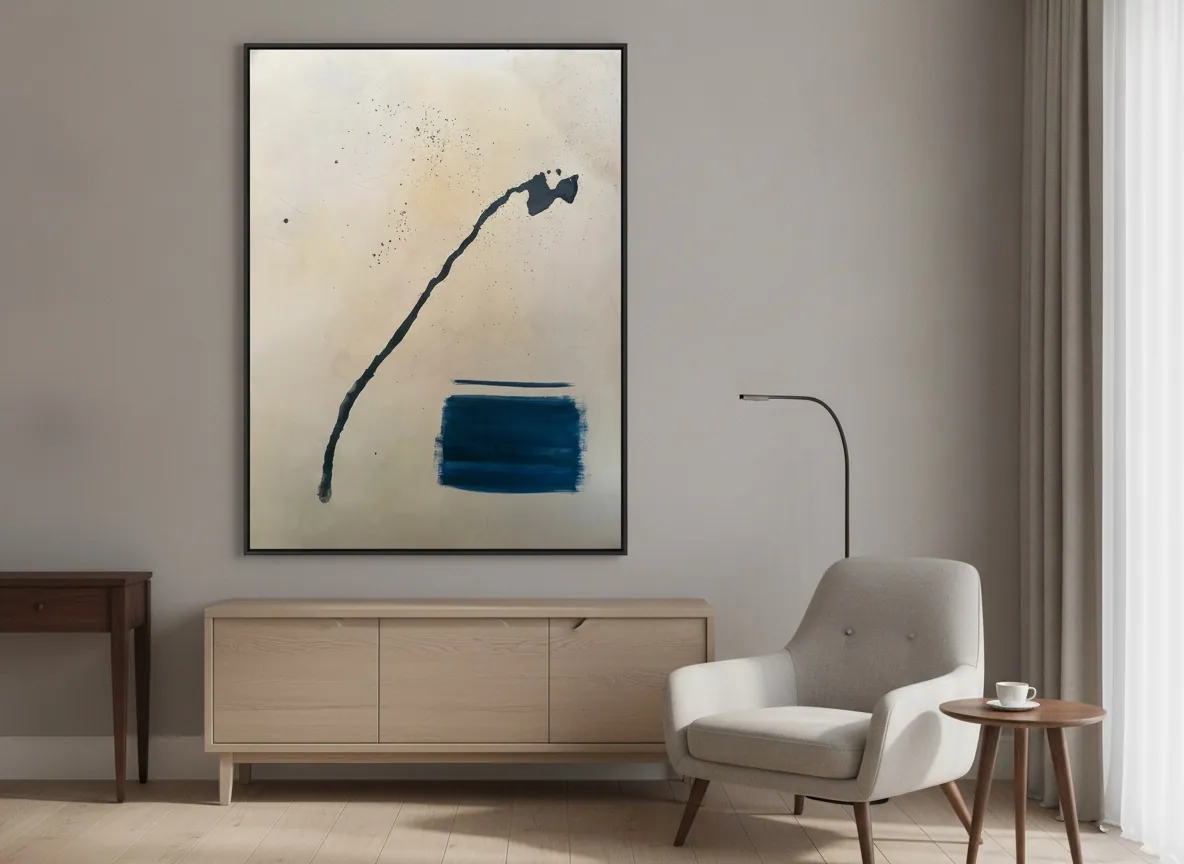
What a reading corner asks of a painting
A reading corner is looked at in two ways. You look at it briefly when you sit down, and you glance up at it between paragraphs, usually without moving your head. A painting for that wall does not need to hold your attention the way a work over a sofa does; it needs to give the eye somewhere to rest when you look up from the page.
If the same corner doubles as a desk, the guide to art for a home office covers that overlap.
In practice that points to compositions with a clear structure and open space rather than many competing focal points: one dominant gesture, a broad field of colour, a restrained palette that sits comfortably with the chair, the rug and the wall colour. The surface can be quiet in colour and still be rich up close, which suits a spot where you will see it often and from nearby.
Light: keep the reading lamp and the painting from fighting
Two lights share this corner and they do different jobs. The reading lamp is a task light: a homebuilder's guide to task lighting suggests a floor or table lamp with adjustable brightness placed next to the chair, ideally on a dimmer so you can set the level for the page. The painting needs a gentler, separate light, or simply the room's ambient light.
The risk is glare. Lutron's guide to lighting artwork gives the common professional rule: aim the light at about 30 degrees to the wall, a tilt it recommends in particular to avoid glare on work behind glass, and one it says also picks up the shadows and highlights of a textured surface. In practice, keep the reading lamp aimed at the page, give the painting its light from a different source or from the room's ambient light, and look at the wall from the chair with the lamp on. If the painting sits beside a window, check it from the chair at the hour you usually read, not only at noon.
For further reading on the texture side of this, see the guide on how to light a textured painting.
Viewing distance and scale in a small corner
Viewing-distance guidance is usually written for open rooms. One printmaker's guideline is to stand at about three times the diagonal of the work, so the whole image sits in your field of view without scanning. It is a guide for prints, not a rule for paintings, but it shows the problem: the distance to a reading chair is short.
Take two works from the studio. Echo of Silence measures 50 × 70 cm, a diagonal of roughly 86 cm, which at three times is about 2.6 m. Silent Interval measures 120 × 160 cm, a diagonal of 200 cm, which would imply around 6 m. A corner rarely offers that depth, so in a tight space the guideline can only be a rough reference: a large work will be taken in part by part from the chair, and as a whole only when you stand up.
Hanging height changes with the seat as well, since a seated eye line is lower than a standing one. The hanging height guide covers the standard figure; for a chair, step back, sit down and check the sightline before you mark the wall.
Two works from the catalogue, read against this brief
Echo of Silence (Matter & Silence, 2025, sculpted texture on canvas, 50 × 70 cm, R$ 2,400) is monochrome, built from concentric reliefs and folds. It is a small, close-range work for a narrow wall, and its relief shows best under the angled light described above.
Silent Interval (Matter & Silence, 2026, mixed media with acrylic on canvas, 120 × 160 cm, R$ 7,900) is a warm bone-white field crossed by one dark gesture, with a block of blue near the lower edge. It suits a corner with wall height and a few metres of room in front of the chair. Both are original, unique paintings; the gallery shows the rest of the catalogue by size.
From the studio
From the studio
When I look at Silent Interval, what I notice is how much of the canvas is left open: a warm bone-white field, one dark line, one block of blue. As an architect by training I read a wall the way I read a plan, by what is left empty as much as by what is placed. In my view a reading corner is where that emptiness is most useful, because the eye has room to leave the page and come back.
Echo of Silence works the other way. Its silence is in the surface rather than in the field, so it asks to be seen close and at a slant, the way an angled light picks out a relief.
Frequently asked
What kind of art suits a reading corner?
A composition with a clear structure and some open space tends to work best, such as one dominant gesture or a broad field of colour, in a palette that agrees with the chair and the wall. Because you glance at it from nearby and often, a quiet surface with detail to find up close suits the spot better than a busy composition with many focal points.
Should art compete with a lamp or sit beside it?
Keep them separate. The reading lamp is a task light for the page, ideally adjustable. The painting should be lit from a different direction, with the light aimed at about 30 degrees to the wall, as lighting guides recommend, so the lamp does not reflect off the surface into your eyes. Checking the view from the chair at your usual reading hour settles most doubts.
What is the difference between buying an original and a print for this?
An original is the object the artist made, unique and signed, with its surface, relief and brushwork present on the wall. A print is a reproduction of an image. The studio's catalogue consists of original works. In a reading corner, where you sit close and look often, the physical surface of an original, particularly a textured one, is what you will notice.
How does Perfeito Studio ship an original painting?
The studio ships within Brazil and internationally. Shipping is quoted per destination, by postcode within Brazil, and is paid by the buyer, as are any import duties or taxes in the destination country. Professional packaging is included and transit insurance is available. Domestic delivery takes up to 15 business days depending on destination; international shipping is quoted on request.
What comes with an original from Perfeito Studio?
Every acquisition is direct from the artist and includes the original painting, a signed Certificate of Authenticity with the technical record and the internal Archive ID, a fiscal invoice or official receipt, an Artwork Acquisition Agreement, an artist dossier, conservation and care guidance, and professional packaging. The certificate carries a QR code linking to the work's official page.
Planning a reading corner?
Send a photo of the wall and the chair, with the wall width, and we will talk through which original fits the distance and the light.
Sources
- Lutron — 2026-10-09
- Century Communities — 2026-10-09
- John Paul Caponigro — 2026-10-09
- Perfeito Studio (catalogue source) — 2026-10-09
- Perfeito Studio — 2026-10-09
Published on