Abstract art for a staircase wall: height, angle and what works on a climb
Hang a staircase painting by measuring up from the stair, not from the floor: centre it about 57 to 60 inches (145 to 152 cm) above the nosing directly beneath it. A single canvas stays level while the stairs climb, so decide where it will mostly be seen from, often the landing, and centre it for that spot.
Measure from the stair, not from the floor
On a flat wall the usual reference is the centre of the artwork at 57 inches (about 145 cm) from the floor, because that is roughly where an adult's eyes sit when standing [1]. A staircase wall breaks the premise, because there is no single floor: the person looking is always standing on a different tread. The guides written for stairs therefore move the reference to the stair itself and keep each centre 57 to 60 inches (145 to 152 cm) above the nosing directly beneath it [2] [3].
The reason is easy to see in the numbers. One of those guides points out that a frame hung from the height measured at the landing reads as roughly 26 inches above the step you are actually standing on, which is why measuring everything from the bottom step or from the top landing leaves the work well below or well above the eye line elsewhere on the flight [2]. The nosing is the front edge of each tread, and it is the one line on the wall that rises at exactly the slope of the stairs.
For the general rule on a flat wall, see the standard height guide; for a wall that rises through more than one storey, see art for a double-height wall.
The angle: a set follows the rake, a single canvas does not
When several pieces are hung up a stair, the standard method is to mark the eye-level centre at the bottom and at the top and join the two with painter's tape or a chalk line, so the arrangement follows the pitch of the stairs rather than a horizontal [2]; another guide likewise says the frames should follow the angle of the stairs [3]. A single rectangular canvas cannot do that. Its top and bottom edges stay level, and only its position along the climb is yours to choose. One of the guides makes the practical point that one piece on the landing wall, where the floor is level, is easier to get right than a row of frames on the slope [2].
The consequence is geometric, and you can work it out for your own flight. Take the stair used as the example in that guide, a 7.75-inch riser with a 10-inch tread [2]. The nosings climb at about 38 degrees (the arctangent of 7.75 over 10), and a canvas 80 cm (about 31.5 in) wide spans roughly three treads, so the stair line under its right edge sits about 24 inches (62 cm) higher than under its left. Centre it at 145 cm over the nosing below its middle and the bottom edge of a 120 cm tall canvas is 85 cm above that nosing, but only about 54 cm above the nosing beneath its uphill side edge (half the canvas width, 31 cm of rise, further along the climb). A wider canvas loses more: a work 150 cm wide spans close to six treads, a rise of about 116 cm, so it fits a rake badly and suits the level landing wall far better. These are worked figures on one assumed stair; measure your own riser and tread before you mark the wall.
What holds up on a climb
A stair wall is seen in motion and at an angle: from below on the way up, from above on the way down, and rarely from a standing distance square to the canvas. Three choices follow from that, offered as practical judgement rather than rule. First, a vertical format echoes the climb and uses height the wall already has, while a wide horizontal fights the slope, as the arithmetic above shows. Second, one composition with a clear gesture reads in a glance and from a sharp angle better than a dense field of small incidents. Third, one anchor piece placed at a landing or turn is easier to resolve than a sequence that has to track the rake.
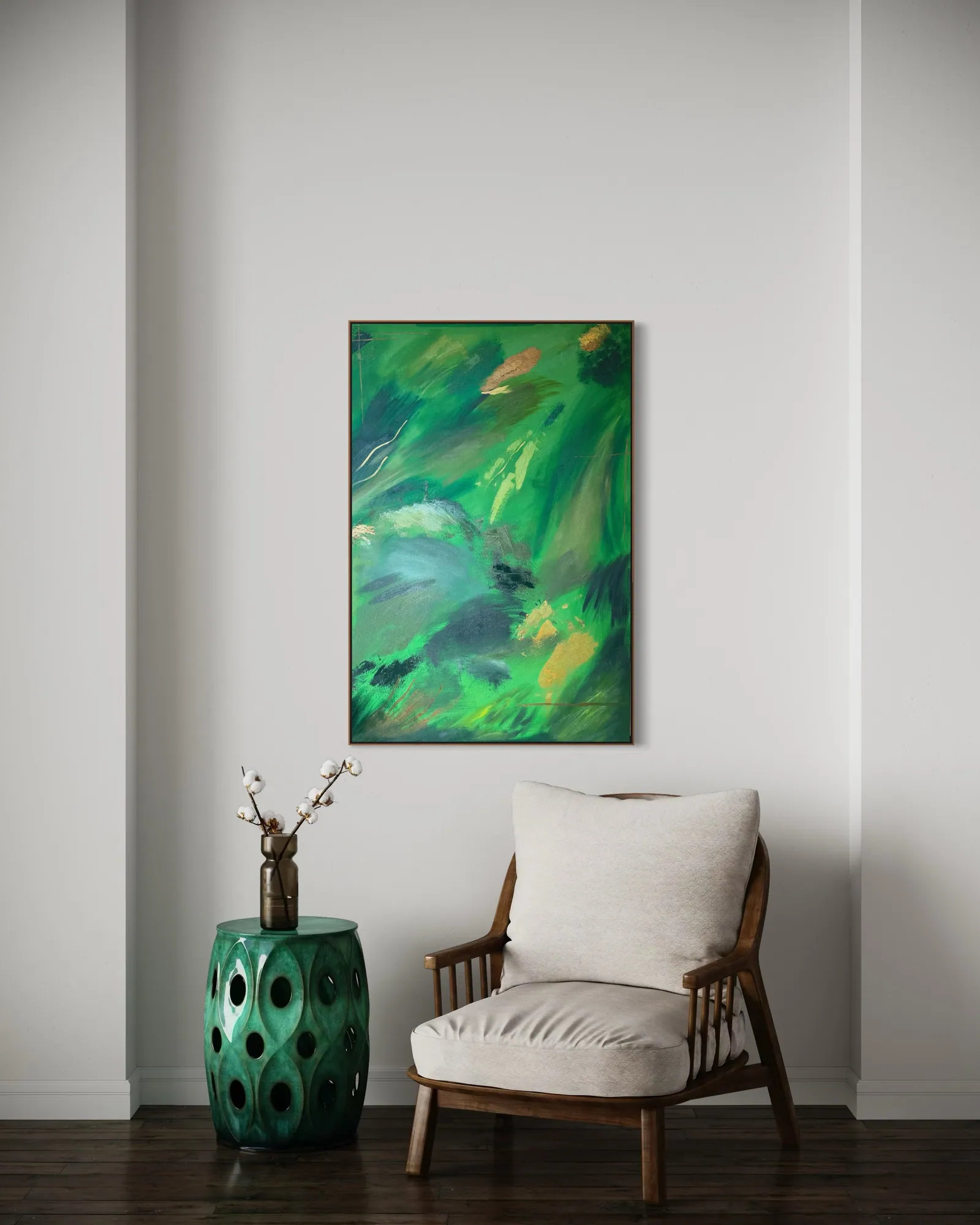
For scale reference, the studio's tall verticals are Vegetal Dawn, 80 × 120 cm (31.5 × 47.2 in), acrylic on canvas, R$ 4,900, and Genesis of Flame, 120 × 200 cm (47 × 79 in), R$ 8,800. Centred at 145 cm over the nosing below, Genesis of Flame runs from 45 cm to 245 cm above that stair, which is a lot of wall to plan for; Vegetal Dawn runs from 85 cm to 205 cm. Amber Strata, 150 × 100 cm (59 × 39 in), is wider than tall, so it belongs on the level wall of a landing or a hall rather than climbing the rake. Each is a one-of-one original, and the current availability and price on each page are the authoritative ones. The works currently available are listed in the gallery.
Hanging it safely on a stair wall
Stair walls are awkward places to work: the floor under the ladder is a slope, and a fall from a stairwell is a different matter from a fall in a room. Guidance from art installers lists stairwells, together with vaulted ceilings, among the placements that justify professional installation [4]. The same source says to find the wall studs, which are almost always 16 or 24 inches apart centre to centre, and to choose hardware rated to hold at least two to four times the weight of the artwork [4]. What a given anchor or hook can carry depends on the wall and on the manufacturer's stated load rating, so read the rating on the package for your own wall type rather than relying on a general figure. Before the painting comes out of its packaging, check that it can be carried up the flight at all; the guide to lifts and stairwells covers that route.
From the studio
From the studio
I trained as an architect, so a staircase wall is a drawing problem I would start with a section: a line climbing at a fixed slope, and a rectangular canvas that has to stay level against it. Vegetal Dawn, at 80 × 120 cm, is a vertical work that stays within a few treads of width, which is why the arithmetic for it stays manageable. Amber Strata, at 150 × 100 cm, is the opposite case. It is wider than it is tall, and a wide, level format is exactly what a rake works against, so I would read it as a work for a level landing wall rather than for the climb itself.
Frequently asked
How high should art be hung on a staircase wall?
Measure up from the stair, not from the floor. The usual guidance is to centre each piece 57 to 60 inches (145 to 152 cm) above the nosing, the front edge of the tread, directly beneath it. That keeps the work at eye level for someone standing on the stair below it, instead of drifting low or high as the flight climbs. Mark your own riser and tread first, because every stair is slightly different.
Should a staircase painting follow the angle of the stairs?
A group of pieces is usually arranged along a line parallel to the stairs. A single canvas cannot follow the angle, because its edges stay level. What you control is where it sits along the climb. Choose the point it will mostly be seen from, often the landing, centre it at 57 to 60 inches above the nosing there, and check the clearance above the nosing at its uphill side edge.
What is the difference between buying an original and a print for this?
An original is a single physical object with its own surface, while a print is a reproduction. Perfeito Studio sells originals only: each work is a one-of-one piece, with no editions and no reproductions. On a stair wall, where a work is met close up and at an angle, that matters in practice because the canvas surface is the work itself. Details of any piece are on its own page and on request.
How does Perfeito Studio ship an original painting?
The studio ships within Brazil and internationally. Shipping is quoted per destination, by postcode inside Brazil, and is paid by the buyer, as are any import duties or taxes in the destination country. Professional packaging is included and transit insurance is available. Domestic delivery takes up to 15 business days depending on destination; international shipping is quoted on request, and in-person collection after purchase is also possible.
What comes with an original from Perfeito Studio?
Every acquisition is direct from the artist and includes the original painting, a signed Certificate of Authenticity with the technical record and the Archive ID, a fiscal invoice or official receipt, an Artwork Acquisition Agreement, an artist dossier, conservation and care guidance, and professional packaging. The certificate is signed by hand and carries a QR code linking to the work's official page.
Planning a painting for a staircase wall?
Send a photo of the stair wall with the riser and tread measurements, and the studio will help work out which work and which scale fit.
Sources
- Park West Gallery — 2026-10-08
- The Houseland — 2026-10-08
- Love & Renovations — 2026-10-08
- Colorado Art Services — 2026-10-08
Published on · Updated on