Abstract art for an open-plan living space: one wall, three zones
In an open-plan room, choose one anchor wall and one large original painting for it, rather than a work for each zone. Pick the wall that kitchen, dining and sofa can all see, size the piece against that wall and the furniture beneath it, and prefer an abstract work whose colour reads from across the room.
Why open-plan rooms break the usual rules
Most advice about hanging art assumes a room with a sofa wall, a dining wall and a clear place to stand back. An open-plan space has none of that. Kitchen, dining table and seating share one volume, the walls are often interrupted by cabinetry, glazing or a staircase, and the same wall is seen from several distances at once.
The usual answer is to treat each zone as a small room and fill it with its own picture. The result tends to be three unrelated pieces competing across one space. A steadier approach is to decide first what the whole room should look at, and let one painting do that job. For single-zone questions, the dining room guide and the large painting for a living room already cover sizing and mood in detail; this page is about the case where those zones are one room.
Step one: choose the anchor wall
The anchor wall is the one wall that can be seen from the most places in the room. Walk the three positions where people actually spend time and note what is in front of them:
- Standing at the kitchen counter or hob: which wall is in the line of sight, beyond the island or the table?
- Seated at the dining table: which wall is behind the person opposite you?
- Seated on the sofa: which wall sits in front of you or at the edge of your view?
If one wall appears in all three answers, that is the anchor. If none does, look for the wall that appears in two of them and is longest. A wall that is only visible from the sofa is a sofa wall, and it can be handled as one.
Mark the candidate with painter's tape at the size you have in mind and look at it from each position before buying anything. It costs nothing and removes most scale mistakes.
Step two: size it to the wall and the furniture beneath it
In a large open room, a painting can look smaller than its catalogue measurements suggest, which is why measuring the wall matters more than judging by eye. Size the piece against two things: the wall, and whatever sits below it, whether a console, a sideboard, a low cabinet or the sofa itself. Leave clear margin on both sides rather than running to the edges.
When the wall is tall, a vertical canvas can use the height. In the studio's catalogue, a work like Silent Interval at 120 × 160 cm gives a wall presence from across the room, while a square work such as Prism Garden at 100 × 100 cm suits a narrower anchor wall or a shorter stretch between openings. For height from the floor, see the hanging height guide.
Step three: choose a work that reads from across the room
In an open plan the painting is seen from the kitchen end as often as from the sofa. In the studio, the working rule is to judge a work from the far end of the room first and from arm's length second.
- A strong gesture or a clear field of colour. In the studio's experience this is what still holds when you look at the wall from the far end of the room; dense small marks are better suited to the near view.
- Colour that talks to the room, not to one corner. Look at the dominant tones already shared across the zones, such as timber, stone, cabinet colour, flooring, and choose a work that sits comfortably with them.
- Surface that rewards the near view. The person at the sofa or the table is the one who will see the surface up close; texture and layering give them something to find.
Abstraction suits this brief in the studio's view, because there is no scene to read from one particular side of the room.
One large painting or several smaller ones
Several smaller pieces spread across an open plan can work, but only when they are chosen as a set. Without that, the room can read as scattered. One large original on the anchor wall gives the space a single point of reference and lets the rest of the walls stay quiet. If a second zone, such as a study corner, needs its own wall, the home office guide is the place to look, and it is better decided after the anchor work is in place.
What an original from the studio includes
Perfeito Studio sells original, unique paintings only, direct from the artist. Each acquisition includes a signed Certificate of Authenticity with the technical record and the internal Archive ID, an invoice or official receipt, an Artwork Acquisition Agreement, an artist dossier, conservation guidance and professional packaging. A photograph of your wall and its measurements, sent over WhatsApp, is enough to start checking scale before any decision. The full list of available works is on the gallery page.
From the studio
From the studio
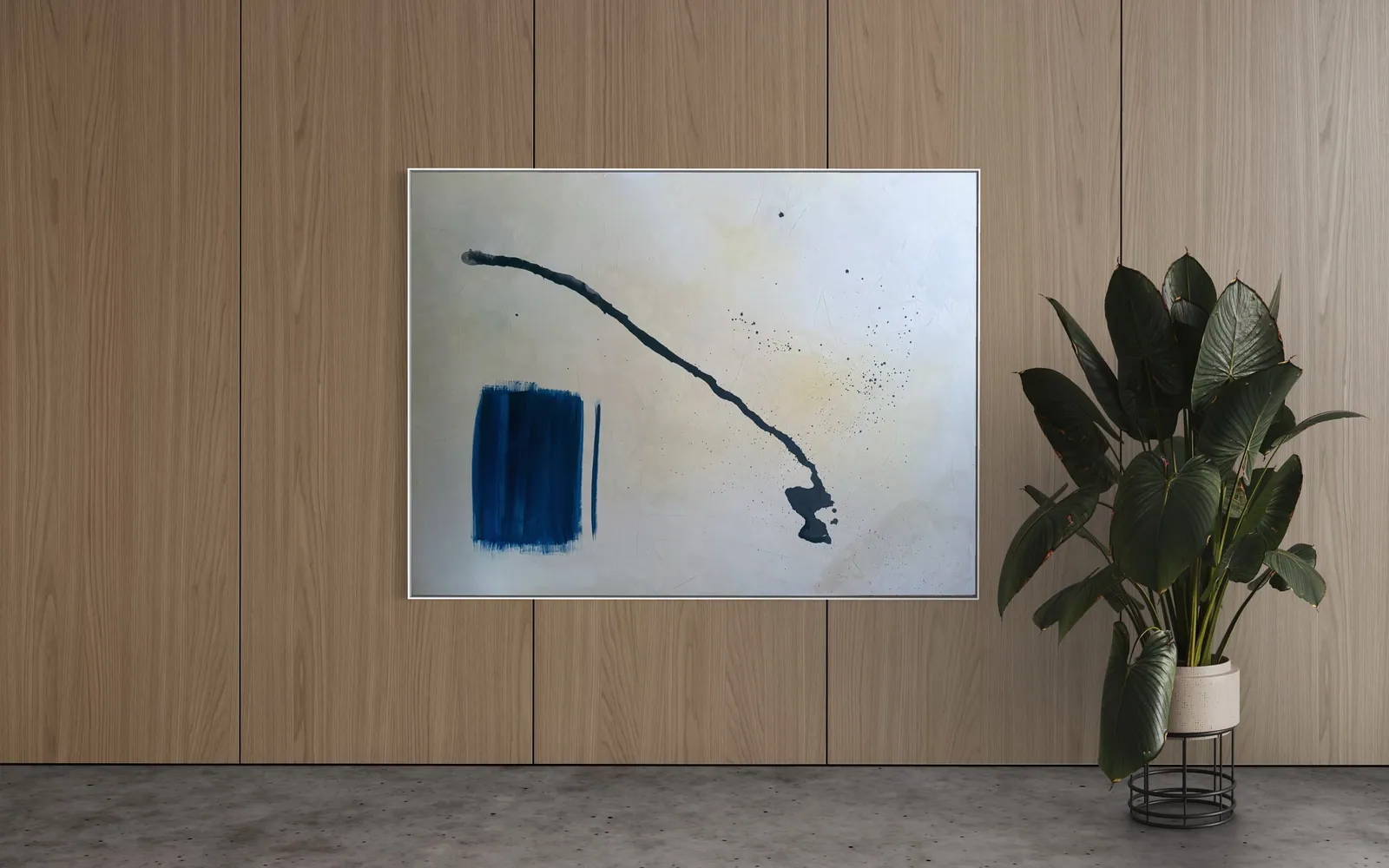
I trained as an architect, so I tend to look at a room as a plan before I look at it as a wall. Silent Interval is a 120 × 160 cm canvas with one dark gesture falling through a wide bone-white field and a block of blue near the lower edge: the composition is built from two clear elements, the line and the blue block, so it can be read from across a room, while the worked, scored ground gives the person standing close something to read.
That is the quality I would look for in a work for an open-plan room. It should hold the wall from across the space and still reward the person who walks up to it.
Frequently asked
How do you choose art for an open-plan room with no walls to spare?
Start by finding the one wall visible from the kitchen, the dining table and the sofa. That is the anchor wall. Put painter's tape on it at the size you are considering, look from each position, and adjust. A single large painting on that wall usually does more for a shared space than several small pieces distributed across interrupted walls.
Can one painting tie the kitchen, dining and sofa zones together?
It can, if it sits on the wall all three zones can see and its colours relate to materials the zones share, such as timber, stone, cabinetry or flooring. A painting cannot make separate zones feel unified on its own, but it gives the whole room one clear point of reference.
What is the difference between buying an original and a print for this?
A print is a reproduction of an image, usually made in multiples. An original is a single, unique work made by the artist. Perfeito Studio sells originals only: every painting is unique and comes with a signed Certificate of Authenticity and an Archive ID. On a large open wall, an original also carries the surface texture and layering of the painting itself, which a flat reproduction does not reproduce.
How does Perfeito Studio ship an original painting?
The studio ships within Brazil and internationally. Shipping is quoted per destination, by postcode inside Brazil, and is paid by the buyer, as are any import duties or taxes in the destination country. Professional packaging is included and transit insurance is available. Domestic delivery takes up to 15 business days depending on destination; international shipping is quoted on request.
What comes with an original from Perfeito Studio?
Every acquisition is direct from the artist and includes the original painting, a signed Certificate of Authenticity with the technical record and Archive ID, an invoice or official receipt, an Artwork Acquisition Agreement, an artist dossier, conservation and care guidance, and professional packaging. The certificate carries a QR code linking to the official page of the work.
Not sure which wall should carry the painting?
Send a photo of the open-plan room and the wall measurements, and we will tell you what fits before any purchase decision.
Published on