Art for a CEO office: one original that reads behind the desk and on camera
For a CEO office, the first decision is which wall the painting is for: behind the desk it faces visitors and the camera; on a side or facing wall, only the executive sees it all day. Then size it by measurement, at two-thirds to three-quarters of the width of the desk or credenza beneath it, with its bottom edge 18 to 25 cm above that furniture.
What suits a CEO office: one original with a single clear structure
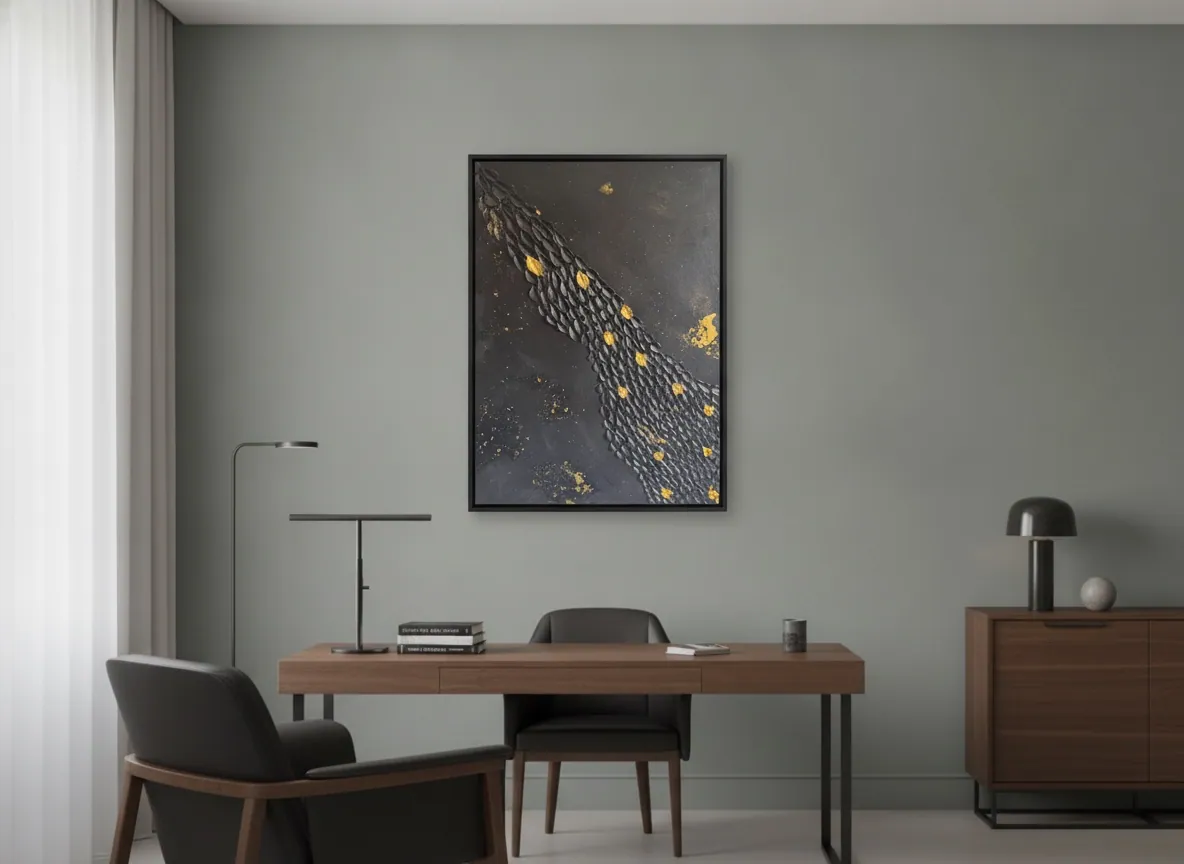
Genesis of Flame (Heart of Chaos, 2025) is mixed media on canvas in acrylic and metallic pigment, with high-gloss and matte finishes on one surface, 120 × 200 cm (47 × 79 in): a red nucleus rises from a black field and releases silver, copper and rose fragments. Golden Passage (Black & Gold, 2025) works the other way: texture paste is built into a diagonal band of sculpted forms on black, and fragments of imitation gold leaf (metallic leaf), sealed with a spray sealant, mark the surface sparingly. Two executive rooms, two temperatures, and the same underlying test.
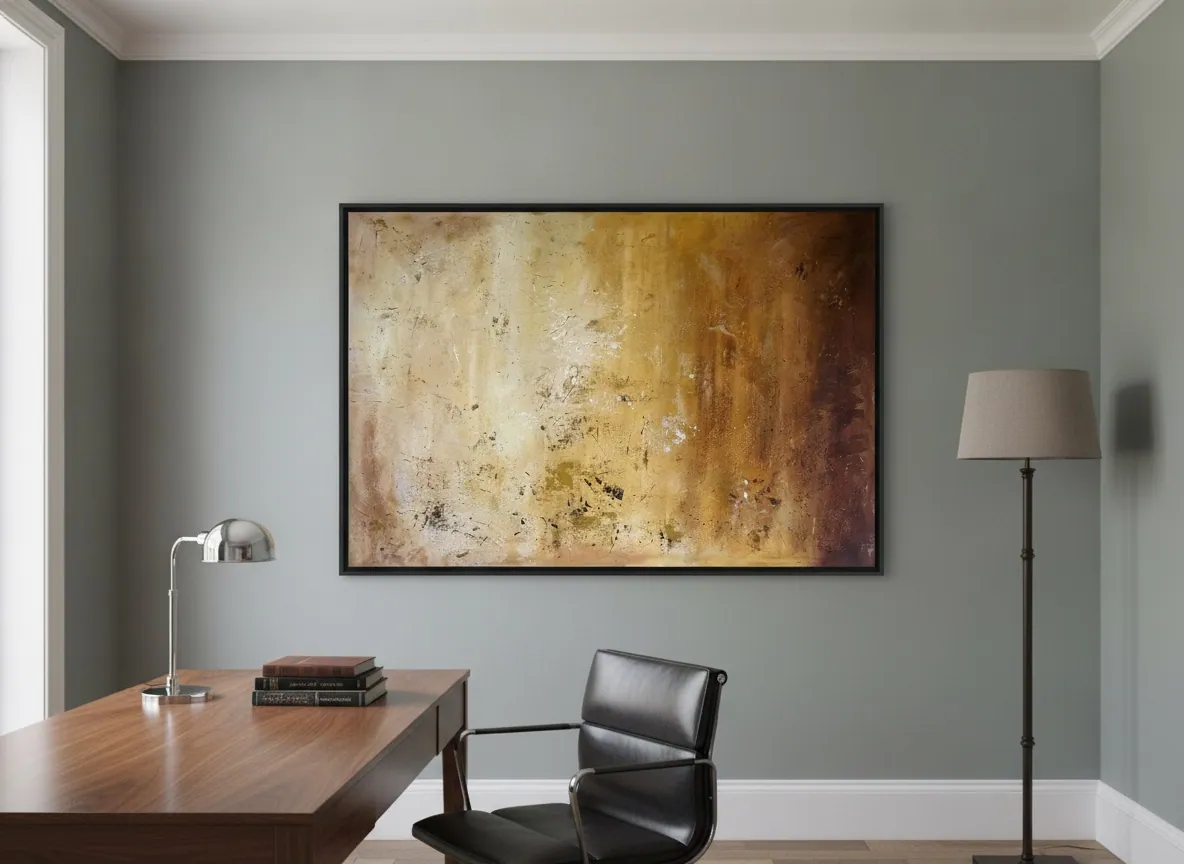
That test is structural. An office wall is read from across a desk, usually in a few seconds and often while someone is talking. A composition with one clear structure (a nucleus, a diagonal, a horizon) still reads from the visitor's chair; a surface of evenly distributed small marks asks to be approached. Then check the palette against what the room already has: walnut, leather, stone, the wall colour. In the visualisations on this page the wall is a grey-green and the furniture walnut; the red of Genesis of Flame, the black and metallic leaf of Golden Passage and the ochre-to-umber of Amber Strata (Terra & Ether, 2026, horizontal) each answer it differently.
The last criterion is paper, not taste. An original comes with a signed certificate, a technical record and an invoice, which is the paperwork a company or a family office typically asks for when recording a work. What accompanies each acquisition is listed in the last section.
Works cited in this text


Behind the desk or facing it: who the wall is for
The two placements do different jobs, and the choice follows from who needs to see the wall.
- Behind the desk. The wall is what a visitor faces across the desk and, on a video call, the part of the wall that appears around the executive's head. The painting is part of the executive's setting rather than something the executive looks at. Because the seated person sits in front of the lower-central part of the canvas, a composition whose weight sits higher or to one side is less likely to be hidden. Genesis of Flame has no fixed top or bottom and can be hung either way up, at the buyer's choice, so the red nucleus can be placed where the head will not be.
- Facing the desk, or on a side wall. The executive sees the work all day; visitors see it only from the seating area. A wall beside the desk, with an armchair or sofa opposite, gives a tall work the viewing distance that a wall directly behind a desk does not, and it stays out of the camera frame.
The wall behind the desk is also usually where the window or the door is. If the light comes from behind the executive, the guide to a boardroom wall on camera covers framing and backlighting; this page stays with scale, height and acquisition.
Size: scale to the desk, not to the wall
A widely cited interior-design convention, the two-thirds rule, puts a painting at roughly 66% to 75% of the width of the furniture it hangs over. It is a convention, not a regulation. Behind a desk it gives a way to choose by measurement: measure the desk or credenza, multiply by 0.66 and 0.75, and compare with the width of the work. The arithmetic for works from the catalogue:
- Genesis of Flame, 120 × 200 cm, R$ 8,800: 120 cm is two-thirds of a 180 cm desk and three-quarters of a 160 cm desk. At 200 cm tall it needs a high ceiling above the desk (see the next section).
- Amber Strata, 150 × 100 cm (horizontal), R$ 6,700: 150 cm is three-quarters of a 200 cm desk.
- Elemental Veins, 90 × 140 cm, R$ 6,400: 90 cm is two-thirds of a 135 cm credenza and three-quarters of a 120 cm one.
- Golden Passage, 60 × 80 cm, R$ 3,500: 60 cm is two-thirds of a 90 cm piece of furniture, a credenza rather than a full desk. Over a wide desk it reads as an object on a large wall, as in the first image.
Where nothing stands under the painting, the rule has nothing to measure against: use the clear wall between door frames, columns and shelving instead.

Height and light: the desk sets the line
Commonly cited museum practice puts the centre of a work at 57 to 60 inches (about 145 to 152 cm) above the floor, within the range of average eye level. Over furniture the furniture sets the height instead: one framing guide puts the bottom of the frame 7 to 10 inches (about 18 to 25 cm) above the top of a couch, bed or desk.
For a vertical work behind a desk the sum is: top edge = desk height + 18 to 25 cm + the height of the work. For Genesis of Flame (200 cm) that is the desk height plus 218 to 225 cm; compare the total with the ceiling and with any rail or light fitting before choosing. A work 100 cm tall, such as Amber Strata, adds 118 to 125 cm to the desk height and fits ceilings that a tall vertical does not.
On light, museum guidance is to hang works away from direct sunlight. A desk set against a window wall is the case to check: send the studio a photograph of the wall and of the window before choosing.
For whoever is acquiring: scale, light, documents and shipping
Scale. Measure the desk or credenza and the clear wall; compare with the dimensions on each work's page. Each work's page gives its dimensions, year and price in Brazilian reais.
Light and detail. The studio can send additional detail photographs and video of a specific work on request, which is the way to judge relief, gloss and metallic leaf from another city or country.
Who buys. The documents below are issued for the acquisition, so decide beforehand whether the company or the executive is the buyer. How a company records art on its books is covered in Can a company own art as a corporate asset?; for the treatment in a specific company, ask its accountant.
What accompanies the work. Every acquisition is direct from the artist and includes the original, unique painting; a signed Certificate of Authenticity with the full technical record and the internal Archive ID, carrying a QR code that links to the work's official page; a fiscal invoice or official receipt; an Artwork Acquisition Agreement covering transfer of ownership, copyright and image use; an artist dossier; conservation and care guidance; and professional packaging. See what is included with every acquisition.
Shipping. The studio ships within Brazil and internationally. Shipping is quoted per destination and paid by the buyer, as are any import duties or taxes in the destination country; professional packaging is included and transit insurance is available. International buyers can pay by bank transfer in USD, and the studio replies to international inquiries within 48 hours. Details on the shipping page. For a project run by an architect or interior designer, the studio's services for architects include a selection from a floor plan, previews of the work in the actual space and a dossier per project.
From the studio
The studio's view: an office read as a plan and an elevation
Alyne Perfeito is a Brazilian visual artist and trained architect, so the questions that matter for an office wall are the ones a plan and an elevation answer, with the desk, the door and the window located before the painting is chosen: how wide is the furniture, how high is the ceiling above it, where does the light come from, and where will the person who sits there be in relation to the canvas.
The works answer different versions of those questions. Genesis of Flame, from the Heart of Chaos series, has no right way up, which makes the placement of its red nucleus a decision about the room rather than a correction. Golden Passage is built in relief, with sculpted forms in texture paste and sealed metallic leaf: its relief and metallic leaf are best judged in the detail photographs, which the studio sends on request. Amber Strata is the horizontal option, a wide field of ochre, bone and umber that sits easily above a long desk.
Frequently asked
What kind of painting suits a CEO or executive office?
An original abstract painting with one clear structure that reads from across a desk, a palette that sits with the existing joinery and wall colour, and a documented provenance. In the catalogue, Genesis of Flame is the high-contrast option (red on black), Golden Passage a textured black and metallic leaf, Amber Strata a horizontal field of ochre and umber. Choose by the room first and the work second.
Should the art go behind the desk or facing it?
Behind the desk, the painting is what visitors face and what appears around the executive on a video call. Facing the desk or on a side wall, the executive sees it all day and visitors see it from the seating area. Both are valid; decide by who the wall is for. A tall work often gains viewing distance on a side wall facing the seating.
How large should a painting be behind an executive desk?
A widely cited convention puts a painting at 66% to 75% of the width of the furniture beneath it. For a 180 cm desk that is 120 to 135 cm wide, which is the width of Genesis of Flame (120 × 200 cm). The bottom edge sits about 18 to 25 cm above the desk. This is a convention, not a rule; measure the actual wall.
Does a painting behind the desk work on video calls?
The camera frames a narrower part of the wall than the room sees, so a test call shows what stays in frame. The seated person also sits in front of the lower-central part of the canvas, so a composition with a clear structure higher or to one side tends to stay visible. The studio's boardroom guide covers framing and backlighting in more detail.
Who owns the art: the company or the executive?
Whoever is the buyer on the invoice and the Artwork Acquisition Agreement. Decide this before acquiring, because the acquisition documents are issued for the acquisition. How a company records art on its books is a question for its accountant; the studio's guide on corporate assets explains the general framework without giving tax advice.
Can Genesis of Flame be hung either way up?
Yes. Genesis of Flame has no fixed top or bottom: it can be hung either way up, at the buyer's choice. On a wall behind a desk, that lets the red nucleus sit high or low relative to the seated person. The work is 120 × 200 cm.
Planning the wall behind an executive desk?
Send the width of the desk, the ceiling height and a photo of the light on the wall. The studio can point to works whose dimensions suit it.
Also read
- Genesis of Flame, 120 × 200 cm
- Available original works, with dimensions and prices
- Art for a boardroom on camera
- Abstract painting for a corporate office: size and height
- Can a company own art as a corporate asset?
- How high to hang a painting: the standard height guide
- Worldwide shipping
- For architects and interior designers
Sources
- Framebridge — 2026-11-02
- MontCarta — 2026-11-02
- Fine Art Shippers — 2026-11-02
Published on