Art for show homes and model homes: what sells the space without distracting from it
Art for a show home should make the rooms legible, not compete with them. Choose one large original per principal room, sized to the furniture beneath it (roughly two-thirds of the sofa or bed width is a common starting point), in a palette the buyer can imagine living with. Neutral grounds with one warm or dark accent usually read best in photographs and on site visits.

What a show home asks of its art
Amber Strata (2026, 150 × 100 cm) is built in horizontal passages of ochre, bone and oxidized umber on canvas, in mixed media with acrylic. Warm light gathers at the centre and darkens toward the edges, so the eye reads the wall as one calm field rather than as a picture to decode. That is the quality a show home needs from a large work: it gives the room a centre of gravity without telling the visitor what to think about it.
A show home or model apartment has a different job from a lived-in room. It is walked through in minutes, photographed for brochures and listings, and judged by people who are imagining their own furniture in it. Art that carries a strong narrative, a loud palette or an unusual subject pulls attention away from the floor plan, the finishes and the light, which are what the developer is selling.
A practical way to brief the work is to give it three tasks: anchor the main wall of each principal room, set a tone of colour and material that suits the finishes, and stay open enough that different buyers can project onto it. Abstract paintings with a restrained palette meet all three more easily than figurative or high-contrast work. This is a staging recommendation, not a rule, and a bolder piece can be right when the project's identity is itself bold.
Works cited in this text


Room by room: where the money works hardest
Living room. The sofa wall is the one most photographed. A horizontal work such as Amber Strata (150 cm wide) suits a sofa of roughly 2.2 m, which puts it near the common two-thirds proportion. If the sofa is shorter, a vertical piece or a smaller work keeps the wall from feeling crowded.
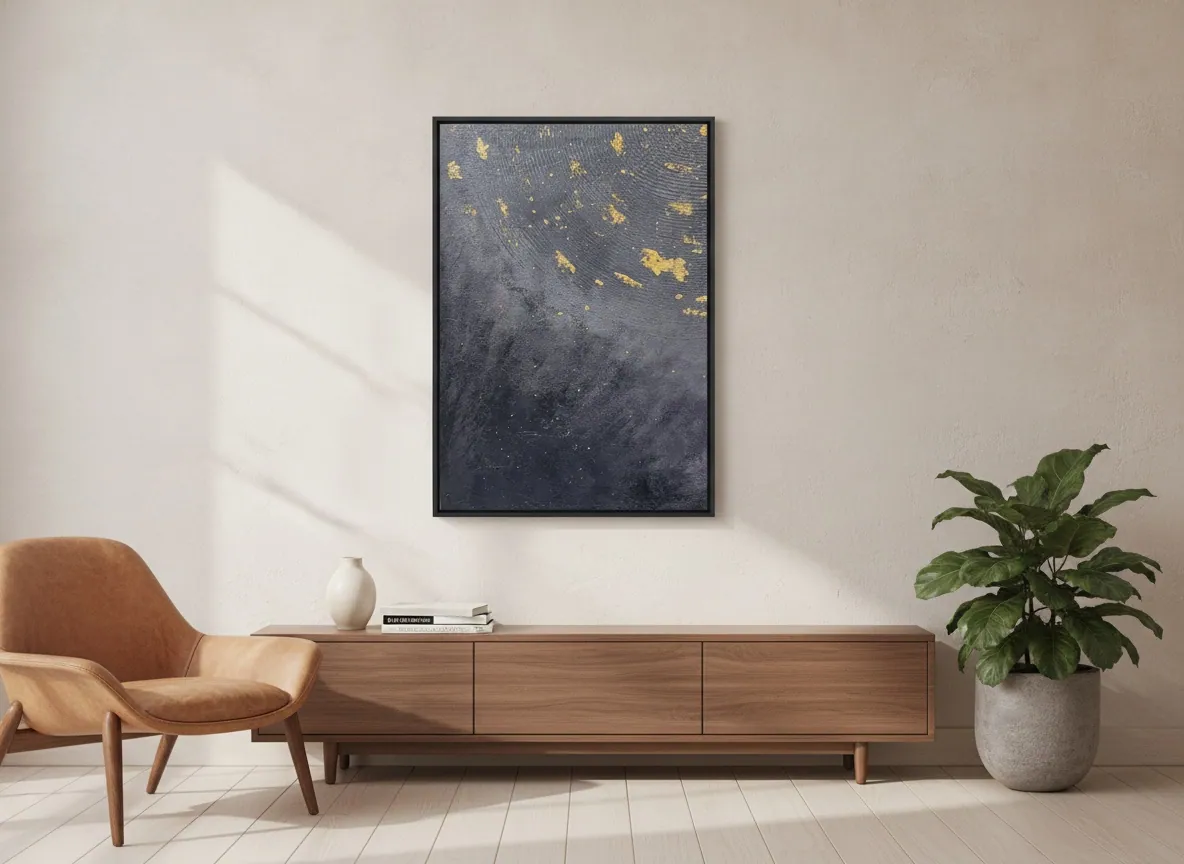
Entrance and console wall. A vertical work above a sideboard gives the entry a first point of focus. Celestial Plan (2025, 50 × 70 cm) is a black ground with concentric textures made in texture paste and scattered fragments of imitation gold leaf (metallic leaf), on canvas. At 50 × 70 cm it is a compact work for a console or a narrow wall, and its dark field reads clearly against pale walls.
Bedroom. In a bedroom the painting is often seen from the bed or from the door, so a work on the wall opposite the bed (above a dresser) or above the headboard can both work. Vibrant Awakening (2025, 100 × 150 cm, acrylic on canvas) is a colourful vertical work and is shown in the mockup below on the wall facing the bed.
Colour and scale: staying out of the way of the architecture
Walls in show homes are usually pale and light is often generous, so a work with a dark or warm field gives the eye somewhere to rest. A bright work such as Vibrant Awakening is better placed where the project wants energy (a bedroom for a younger buyer, a studio apartment) than throughout the entire unit. A rule of thumb that holds up in practice: let one room carry colour and let the others stay tonal.
Scale is more reliable than colour. One large work in the main room and a smaller one in each secondary room reads as intentional; many mid-sized works of equal weight read as decoration. Golden Frond (2026, 45 × 45 cm with frame, watercolour and acrylic on paper, framed) shows how a small work can serve a reading corner, hallway or bedside wall, places seen up close. For wall-size questions in general, see our guide to how large is large abstract art.
Photographs matter as much as the site visit, because most prospective buyers first see the unit online. Texture paste, metallic leaf and layered pigment read in photographs as surface rather than as flat colour, which helps the image feel like a room and not like a render. The studio can supply additional detail photographs and video of a specific work on request.

Original or print, and what happens when the show home closes
A show home is a place where the choice between original art and reproductions is visible: an original has surface, relief and slight irregularities that a print does not, and visitors who stand close can see it. Every painting in this catalogue is a unique original. The choice is commercial as much as aesthetic, and a developer whose brand sits in the upper tier of its market may prefer originals for exactly that reason.
When the show home closes, the work belongs to the developer, as with any other acquisition. It can stay in the sales office, move to the next show unit, or go to the company's own offices. The Artwork Acquisition Agreement covers transfer of ownership, copyright and image use, which matters if the developer intends to use photographs of the work in brochures or on the website. The works in this catalogue are offered for acquisition.
For those acquiring the work for a development
Scale. Measure the wall and the furniture beneath it before choosing. Dimensions are listed in centimetres and inches on every work page (Golden Frond's listed size includes its frame).
Light. Metallic leaf and texture paste respond to the direction of light. Check the work against the lighting plan of the room, or ask the studio for detail photographs. The metallic leaf on the works that carry it is sealed with a spray sealant.
Distance. Large works are legible from the doorway; small works reward close viewing and suit places visitors pass slowly.
Several works at once. For architects and interior designers the studio offers a curated selection from a floor plan and lighting context, custom renders or mockups of the work in the actual space when reference photography is provided, a per-project dossier and guidance on hanging height, lighting angle and conservation. Conditions for repeat collaborations are available upon request.
Documents and shipping. Every acquisition is direct from the artist and includes the original, a signed Certificate of Authenticity with the technical record and Archive ID, a fiscal invoice or official receipt, an Artwork Acquisition Agreement, an artist dossier, care guidance and professional packaging. Shipping is quoted per destination and paid by the buyer, as are any import duties or taxes; see shipping. Transit insurance is available.
From the studio
The studio's view
Alyne Perfeito is a Brazilian visual artist and trained architect, and the works in this guide are the way she sees a room: as a sequence of walls, each with a scale and a light. Amber Strata, with its horizontal passages, is made for a long wall above low furniture. Celestial Plan, built in concentric texture and metallic leaf on black, is made for a short wall, close to the eye. Vibrant Awakening is a vertical, colourful work that holds a wall of its own. The studio's view is that a show home needs few works placed deliberately, not many placed for volume.
Frequently asked
Should a show home use original art or prints?
Both are used in the trade, and the choice depends on the project's market position. Originals have visible surface and relief that visitors can see up close, which suits upper-tier developments. Every painting at Perfeito Studio is a unique original, so a project that needs many identical pieces for a large number of units is looking for a different product from what this catalogue offers.
What kind of art helps buyers imagine living in the space?
Abstract work with a restrained palette tends to be easiest, because it does not tell a story the buyer has to accept. A single warm or dark accent in a pale room gives the eye a resting point. This is a staging recommendation, not a rule: a project with a bold identity can carry more colour, ideally in one room rather than every room.
How many works does a show apartment need?
There is no fixed number. A practical approach is one large work in the principal room, one work in the bedroom and one small work for an entrance, console or reading corner. Several works of equal size on neighbouring walls read as decoration. Send the floor plan and the studio can propose a selection for the space.
What happens to the art after the show home closes?
The work is acquired, so it belongs to the developer and can be moved to another unit, a sales office or the company's own premises. The Artwork Acquisition Agreement covers transfer of ownership, copyright and image use.
Can a developer buy several originals for show units at once?
Yes. Architects, interior designers and curators can send a floor plan, reference images and lighting context and receive a curated selection, mockups of the works in the actual space, a per-project dossier and guidance on hanging height, lighting angle and conservation. Conditions for repeat collaborations are available upon request. Each work is unique, so the selection is made from the paintings currently available.
Choosing art for a show home
Send the floor plan and lighting context for a curated selection and mockups in the space.
Sources
- Perfeito Studio — 2026-11-02
- Perfeito Studio — 2026-11-02
- Perfeito Studio — 2026-11-02
Published on