Abstract art for brutalist and raw-concrete interiors
Brutalism is defined by raw concrete and block-like mass, not by grey alone, so art for such a room is best chosen against that history: a physical surface, real scale and restraint. The word comes from Le Corbusier's béton brut. In the studio's view, an original with relief shares that vocabulary better than a smooth, flat surface.
Where the word comes from
Tate calls brutalism an architectural style of the 1950s and 1960s, known for simple, block-like forms and raw concrete construction, and says the name derives from Le Corbusier's béton brut, French for raw concrete. It credits the critic Reyner Banham with coining the term, with a pun that also conveyed how poorly this architecture was received in Britain [1]. The RIBA places the first use of "new brutalism" with Alison Smithson in 1953, and says Banham's 1955 review of the Smithsons' school at Hunstanton helped establish the movement [2].
The point for a buyer is that the name points to the material, raw concrete, rather than to colour, so a "brutalist interior" that is merely grey borrows only part of the idea.
What the surface of the wall is actually like
The RIBA notes that by the 1960s brutalism was dominated by béton brut, and describes the surface treatments that gave the concrete its character: boardmarking, which replicates the pattern of wooden shuttering in the surface, and aggregate that was bush-hammered or pick-hammered. It also stresses scale and mass, with large concrete shapes and textured surfaces [2]. A wall in this tradition is therefore not a blank plane; it carries texture, mass and the marks of its formwork.
The tradition is not only British. A FAPESP article on the architect Vilanova Artigas describes brutalism as a worldwide movement whose most obvious traits are reinforced concrete, usually exposed, and basic, undecorated lines, and presents Artigas as the first exponent of the "Paulista" school in São Paulo, a label some specialists contest. It adds that he used colour to soften those features [3]. For anyone in Brazil, in other words, raw concrete has its own local lineage, and a warm or coloured note inside a concrete room is not a contradiction of it.
What this suggests for a painting
What follows is the studio's reading, not a rule from the sources above. If the wall's character is mass and surface, then a painting is easiest to place when it has some mass and some surface of its own. Two practical consequences:
Scale. A small, smooth canvas on a large block-like wall reads as an afterthought. Among the originals in the collection, Amber Strata (150 × 100 cm / 59.1 × 39.4 in, mixed media with acrylic on canvas, R$ 6,700) and Silent Interval (120 × 160 cm / 47.2 × 63 in, R$ 7,900) are the ones with the presence for a principal wall. Echo of Silence (50 × 70 cm / 19.7 × 27.6 in, sculpted texture on canvas, R$ 2,400) is better suited to a secondary wall, a recess or the side of a doorway. For the wider question of size, see large abstract painting for a living room.
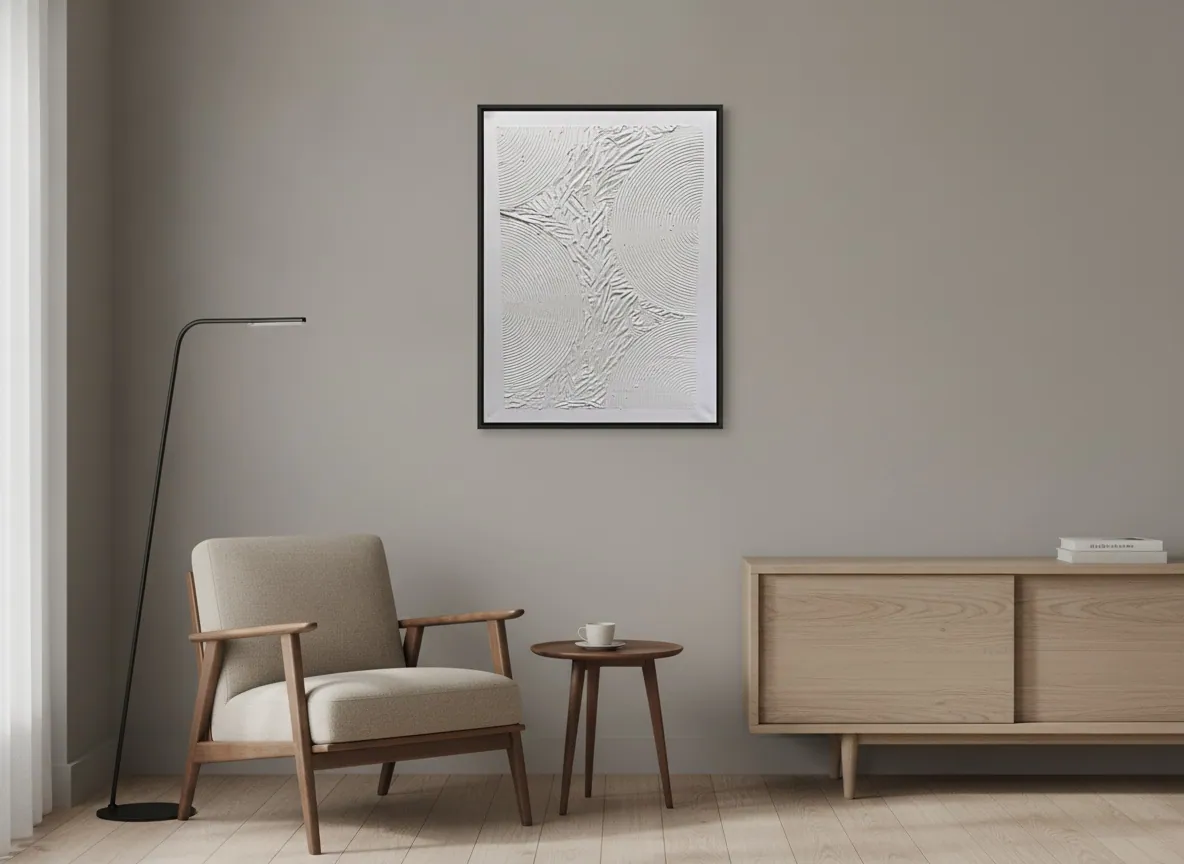
Relief. Echo of Silence is a sculpted relief, and Patina Field (100 × 100 cm / 39.4 × 39.4 in, acrylic on canvas, R$ 5,200) is made by applying pigment, scraping it back and applying it again, until the surface reports wear. Neither is smooth, and that is the quality worth looking for beside concrete. Prices are the studio's own, in Brazilian reais.
For the mechanics of fixing a heavy work to masonry, see how to hang a painting on a concrete wall; for exposed brick and loft-style rooms, abstract art for industrial lofts covers that different problem.
An original, and how it reaches the room
Perfeito Studio sells original paintings directly from the artist, and each is unique, signed and catalogued under an Archive ID. An acquisition includes a signed Certificate of Authenticity, a fiscal invoice or official receipt, an Artwork Acquisition Agreement, an artist dossier, care guidance and professional packaging. The studio ships within Brazil and internationally; freight is quoted per destination and paid by the buyer, as are any import duties or taxes in the destination country. To see a work in person in Brasília, a viewing can be arranged by appointment. More on the process: how to buy a painting from Perfeito Studio.
From the studio
From the studio
I trained as an architect, so the first thing I ask of a concrete wall is what it is made of: how the formwork was set, how it takes light across the day. Echo of Silence was sculpted into relief and Patina Field was built up and scraped back by hand, both conceived around surface rather than image, which is the same logic as a wall that shows how it was made. I have not hung either against raw concrete, so I will not promise how they read there. I would start from the width and height of the wall.
Frequently asked
Is every raw-concrete interior brutalist?
No. Brutalism is an architectural style of the 1950s and 1960s, according to Tate, associated with raw concrete and block-like forms. Many rooms today use exposed concrete as a finish without belonging to that tradition, and some are simply painted grey. The distinction matters less for hanging art than for reading the wall: look at its texture, mass and formwork marks rather than at the label.
Where does the word brutalism come from?
Tate says the name derives from Le Corbusier's phrase béton brut, French for raw concrete, and credits the British critic Reyner Banham with coining the term. The RIBA dates the first use of new brutalism to Alison Smithson in 1953. Tate adds that Banham's coinage was a pun that also conveyed the horror with which this architecture was met in Britain; the name refers to the raw material itself.
Can colour work in a brutalist room?
It can. Brutalism is defined by its material and mass, not by a colour rule, and a FAPESP article notes that the Brazilian architect Vilanova Artigas used colour to soften the movement's severity. Whether a room needs warmth or should stay austere is a matter of taste. The studio's Patina Field, for example, is mostly slate blue and iron brown with one ochre passage.
How does Perfeito Studio ship an original painting?
The studio ships within Brazil and internationally, in professional packaging, with transit insurance available. Freight is quoted per destination and paid by the buyer, together with any import duties or taxes in the destination country. Domestic delivery takes up to 15 business days depending on destination, and international shipping is quoted on request. Collecting the work in person after purchase is also possible.
What comes with an original from Perfeito Studio?
Every acquisition is made directly from the artist and includes the original painting, a signed Certificate of Authenticity with the Archive ID, a fiscal invoice or official receipt, an Artwork Acquisition Agreement covering transfer of ownership and image use, an artist dossier, conservation and care guidance, and professional packaging. The package is the same for every work and is not sold as an add-on.
Considering an original for a concrete wall?
Send the wall's width and height and the studio will suggest which works to look at.
Sources
- Tate — 2026-10-15
- RIBA — 2026-10-15
- Pesquisa FAPESP — 2026-10-15
Published on