Buying art online in the United States: what protections apply
Two federal mechanisms matter most when you buy art online in the United States. The FTC's Mail, Internet, or Telephone Order Merchandise Rule governs shipping time, delay notices and refunds for goods ordered online, and the Fair Credit Billing Act lets a cardholder dispute a charge for goods not delivered as agreed. Neither covers every problem; each has stated limits.
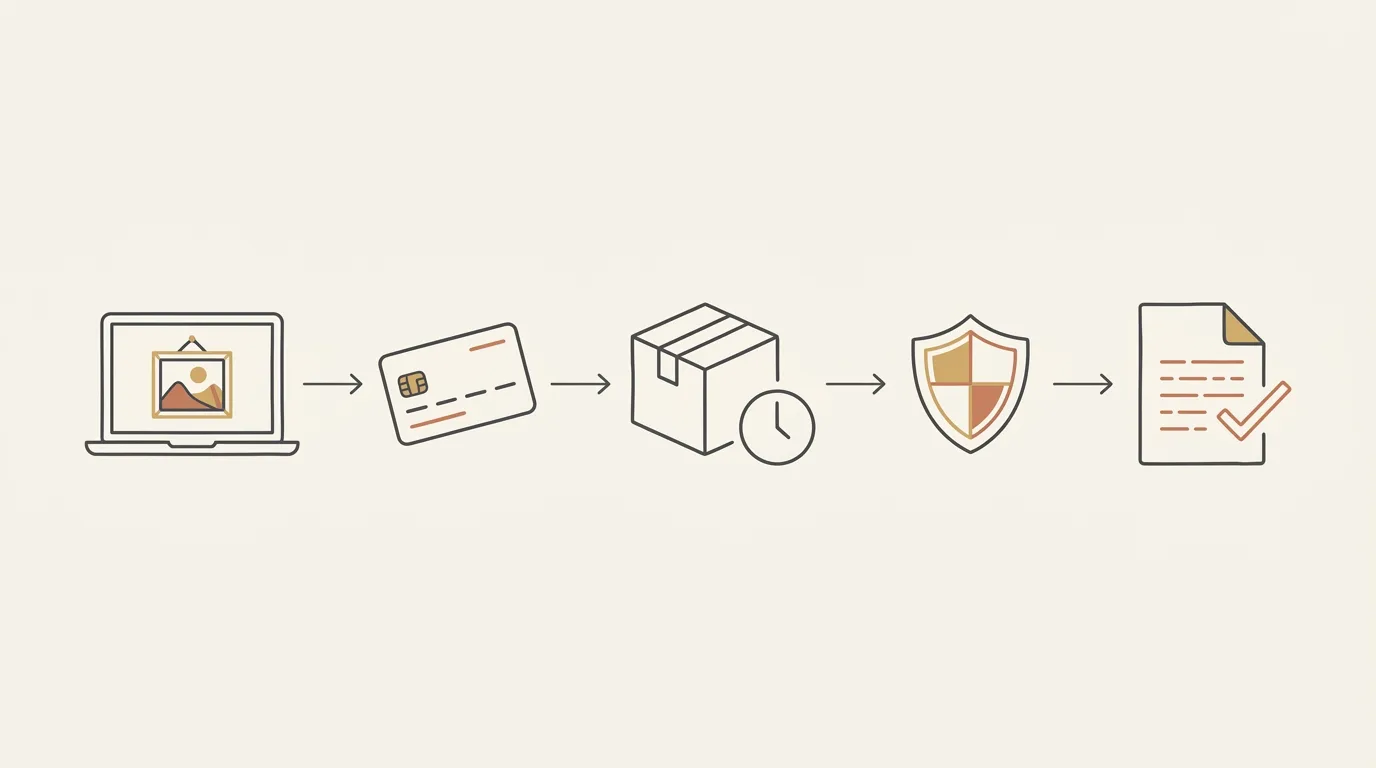
The FTC rule: what it covers and what it does not
The Federal Trade Commission enforces the Mail, Internet, or Telephone Order Merchandise Rule (16 CFR Part 435). According to the FTC's business guidance, it applies to most goods a customer orders from a seller by mail, telephone, fax or on the Internet, and it does not matter how the merchandise is advertised, or how the customer pays. Services are outside it, as are certain categories the rule lists, such as serial subscriptions, seeds and growing plants, and C.O.D. orders.
The rule is about timing. A seller must have a reasonable basis to expect to ship within the time it states, or within 30 days of receiving a properly completed order when no time is stated. If the seller cannot ship on time, it must offer the buyer a delay notice with a revised date and a way to cancel for a full, prompt refund. Refunds for cash, check, money order or third-party credit are due within seven working days after the order is cancelled. Different periods apply in some credit situations, such as 50 days when the buyer applies for credit with the order.
What the rule does not do is set a general right to return a work you have received, or define when a work counts as different from its description. The FTC guidance reviewed for this page does not address cross-border sales either, so how it applies to a seller located outside the United States is a question the guidance leaves open.
Disputing a card charge under the Fair Credit Billing Act
The FTC's consumer guidance on disputing credit card charges describes a second mechanism. Under the Fair Credit Billing Act, billing errors on credit cards include charges for things the cardholder did not accept or that were not delivered as agreed. The process is written and time-bound: the notice must reach the card issuer within 60 days after the first bill containing the error was sent, the issuer must acknowledge it in writing within 30 days, and it must resolve the dispute within 90 days.
While a dispute is open, the FTC explains that the cardholder may withhold payment of the disputed amount, and the issuer may not close or restrict the account because of it. Disputes about the quality of goods carry extra conditions listed by the FTC, including a minimum purchase amount, a location condition tied to the buyer's home state or distance from the billing address, and an attempt to resolve the matter with the seller first. These conditions are the reason a quality complaint and a non-delivery complaint can be treated differently.
When a work arrives different from what was agreed
A mismatch between what was described and what arrived is usually handled first through the seller's own terms and the written record of the sale: the listing, the dimensions and medium stated, the photographs, and any certificate or agreement issued. Those documents are what a card issuer or a seller will look at in a dispute. Because the FTC order rule is silent on returns, the seller's stated policy and the card dispute route are the two places the question is normally resolved.
For the practical side of sending an original back across a border, see can I return original art bought online from Brazil. For damage in transit, the question is who carries the risk and what a policy covers, explained in what insurance covers a painting in international transit.
Sellers abroad: what changes
Buying from a seller outside the United States adds layers that the two mechanisms above do not resolve on their own: the seller's own national consumer rules, the way the card network handles an international merchant, and import duties and taxes at the border. The FTC order-rule guidance does not speak to cross-border sales, while the card dispute process is defined by the relationship between cardholder and issuer. Customs treatment is a separate subject, covered in do you pay import duty on art entering the United States. For a comparison with the European framework, see buying art online in Europe: consumer rights.
What a buyer can keep on file
Whichever route applies, a complete paper trail is what makes any of these mechanisms workable: the order confirmation and payment record, the stated shipping time, the description of the work, and the documents that travel with it. At Perfeito Studio, each acquisition is direct from the artist and includes a signed Certificate of Authenticity with the technical record and Archive ID, a fiscal invoice or official receipt, and an Artwork Acquisition Agreement covering transfer of ownership, copyright and image use. The studio ships internationally; shipping is quoted per destination and paid by the buyer, as are import duties and taxes in the destination country.
A work such as Celestial Plan (50 x 70 cm, mixed media, texture paste and imitation gold leaf on canvas, Archive ID AP-BNG-2025-002) shows the kind of record the studio keeps for each piece.
This page is informational and is not legal or financial advice. Rules, thresholds and procedures change and depend on the facts of each purchase; consult the official sources below or a qualified professional.
From the studio
From the studio: why the record matters
Alyne Perfeito is a trained architect, and the studio documents each painting in the way a drawing is documented: with a precise written description. Each piece is catalogued under an Archive ID and described with its medium and measurements, so that what a buyer reads and what arrives can be compared line by line. For a distance purchase, that is the practical meaning of protection in this studio: a precise description, written down, which both sides can return to. Additional detail photographs and video of a specific work are available on request through WhatsApp.
Frequently asked
What protects me when I buy art online in the US?
Two federal mechanisms are most often relevant. The FTC's Mail, Internet, or Telephone Order Merchandise Rule covers shipping time, delay notices and refunds for goods ordered online, and the Fair Credit Billing Act allows a cardholder to dispute charges for goods not delivered as agreed. Each has stated limits, and neither is a general right of return. This page is informational and does not replace legal advice.
Does the FTC Mail, Internet, or Telephone Order Rule apply?
According to the FTC, the rule applies to most goods ordered by mail, telephone, fax or on the Internet, regardless of how they are advertised or paid for. It excludes services and certain listed categories. It requires a reasonable basis to ship within the stated time, or within 30 days when none is stated. The FTC guidance reviewed does not address sales by sellers located abroad.
Can I dispute a card charge?
The FTC describes a dispute process under the Fair Credit Billing Act for billing errors, including charges for goods not delivered as agreed. The written notice must reach the issuer within 60 days after the first bill with the error was sent; the issuer must acknowledge within 30 days and resolve within 90 days. Quality disputes carry additional conditions described by the FTC.
What if the work arrives different?
The FTC order rule is about shipment timing and refunds for orders that are not shipped on time; it does not define a right to return a work that arrives different. Such a case is generally examined against the seller's stated terms, the written description and photographs, and the card dispute route, whose conditions for quality problems are listed by the FTC.
What about sellers abroad?
The FTC guidance on the order rule does not address cross-border sales, and the card dispute process runs between the cardholder and the issuer. A foreign seller also brings its own national rules, plus import duties and taxes at the border. These are separate questions, and the details depend on the facts of each purchase.
Ask about a work and its documentation
Photographs, detail views and the record that accompanies each painting are available directly from the artist.
Sources
- Federal Trade Commission — 2026-10-18
- Federal Trade Commission (Consumer Advice) — 2026-10-18
Published on · Updated on