Can you hang a painting above a radiator or a heating vent?
It is better to avoid it. The Canadian Conservation Institute says many cases of incorrect temperature sit near local heaters and air vents. A radiator, baseboard heater or floor register sends warm air up the wall, and each swing in temperature moves relative humidity too. Choose a wall away from the heat source.


What conservators say about heaters and vents
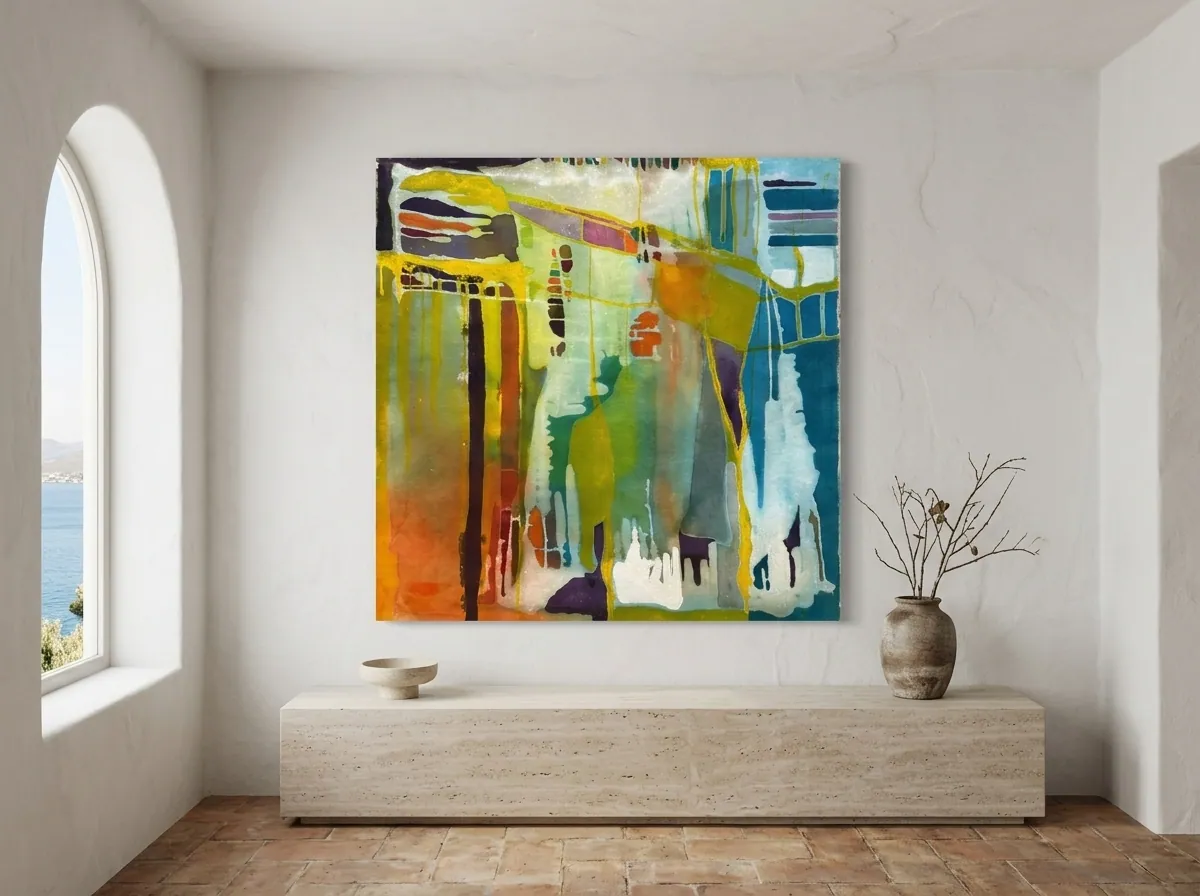
Prism Garden is acrylic on canvas, 100 × 100 cm, painted in 2026: yellow lines laid over washes of green, teal and orange, with the weave of the canvas left visible in places. A surface like that sits directly in whatever air moves across the wall.
The Canadian Conservation Institute (CCI) sorts incorrect temperature into three cases: too high, too low, and fluctuating. Its page on this agent of deterioration notes that many forms of incorrect temperature are found near local heaters and air vents, and that in a room the ceiling is always warmer and the floor always colder. A painting hung right above a radiator or a register sits in the air that the heater warms each time it runs.

Warm air, dry air and relative humidity
Heat alone is part of the story. CCI gives a rule of thumb for a closed space: a change of 1 °C moves relative humidity by about 3%, and a change of 5 °C by about 15%. A radiator that switches on in the morning and off at night repeats that swing every day at the height where the canvas hangs.
The other page on this site about hygrometers at home explains how to measure the air near a wall before you choose it. A small digital hygrometer left on the shelf for a week, once with the heating on and once with it off, shows how much the spot moves.
Lamps and sunlight on the same wall
CCI names direct sunlight as the single most damaging source of incorrect temperature, and it notes that incandescent lamps can heat a surface because of their high infrared output. A picture light with an incandescent bulb close to the canvas adds heat at the same point as the radiator below. Keep lamps at a distance and the painting out of the sun's path.
The same page has a note for the opposite case. Below about 5 °C, artists' acrylic paints enter a glassy phase and acrylic paintings become more vulnerable to knocks than at room temperature. In a holiday house where the heating goes off for weeks, avoid moving or handling the paintings until the rooms warm up.
Which wall to choose
CCI does not give a safe distance in centimetres or inches from a radiator, and this page will not invent one. Its advice points to location: move the painting out of the column of warm air that rises from the heater, and out of the stream from a forced-air register. An interior wall with no heater, vent or fireplace below it is the simplest answer.
Watch the cold side too. CCI writes that damp is most often caused by humid air reaching localised cold spots. An outside wall in winter can be one of them, which is the subject of the page on hanging a painting on a cold exterior wall. If the only free wall has a radiator, a sideboard or shelf can hold books or a lamp there, and the canvas can go to the next wall over.

For buyers
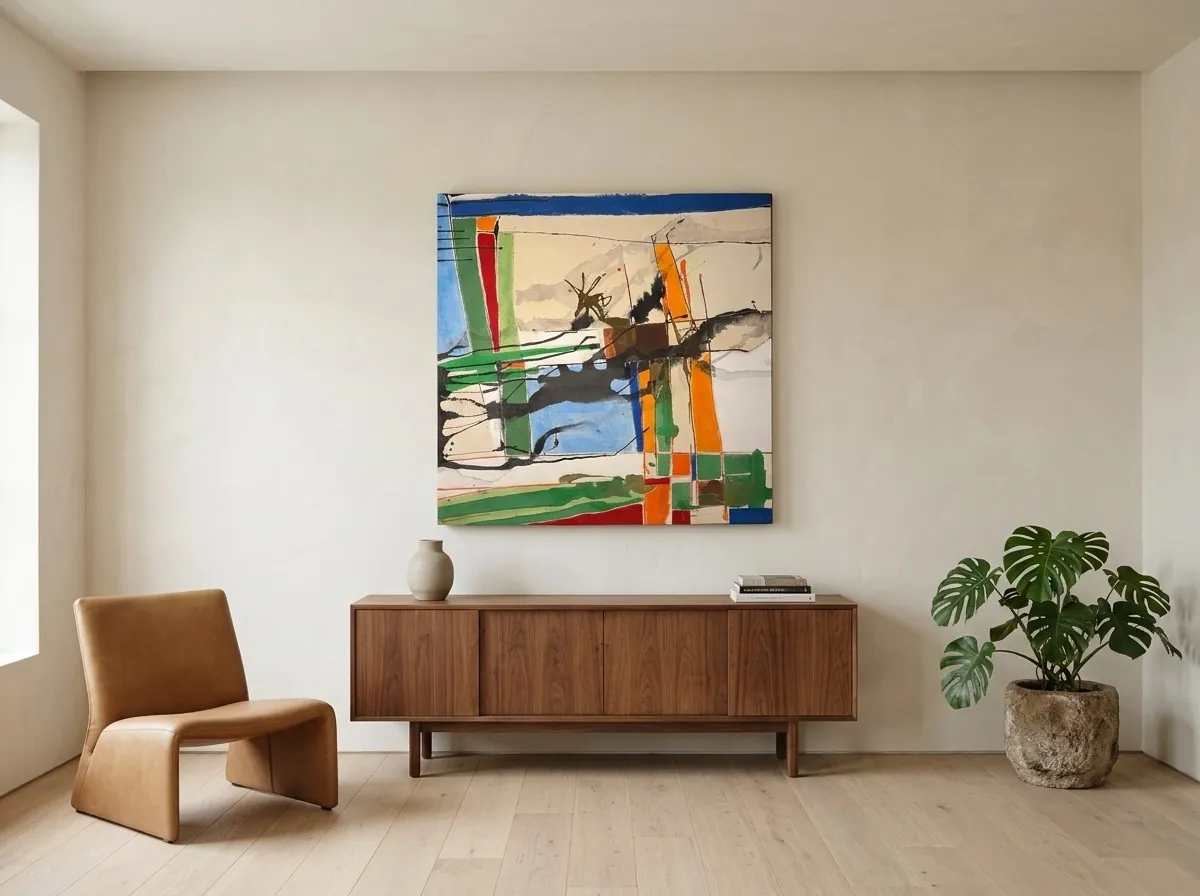
Prism Garden, Azure Cartography and Chromatic Lattice are acrylic on canvas, 100 × 100 cm each, from 2026, at R$ 5,500 each. Mark the square on the chosen wall with painter's tape and look at it in morning and evening light. Ask the studio for the work's details before you choose a hanging system.
Each work is acquired directly from the artist with a signed Certificate of Authenticity carrying the Archive ID, a fiscal invoice or official receipt, the Artwork Acquisition Agreement and conservation guidance (see acquisition). Shipping is quoted per destination and paid by the buyer, with professional packaging included and transit insurance available (see shipping). More works are in the gallery.
Available works
-
 Prism Garden
100 x 100 cm (39.4 x 39.4 in) · R$ 5.500
-
 Prism Garden
100 x 100 cm (39.4 x 39.4 in) · R$ 5.500
-
 Azure Cartography
100 x 100 cm (39.4 x 39.4 in) · R$ 5.500
-
 Azure Cartography
100 x 100 cm (39.4 x 39.4 in) · R$ 5.500
-
 Chromatic Lattice
100 x 100 cm (39.4 x 39.4 in) · R$ 5.500
-
 Chromatic Lattice
100 x 100 cm (39.4 x 39.4 in) · R$ 5.500
From the studio
From the studio
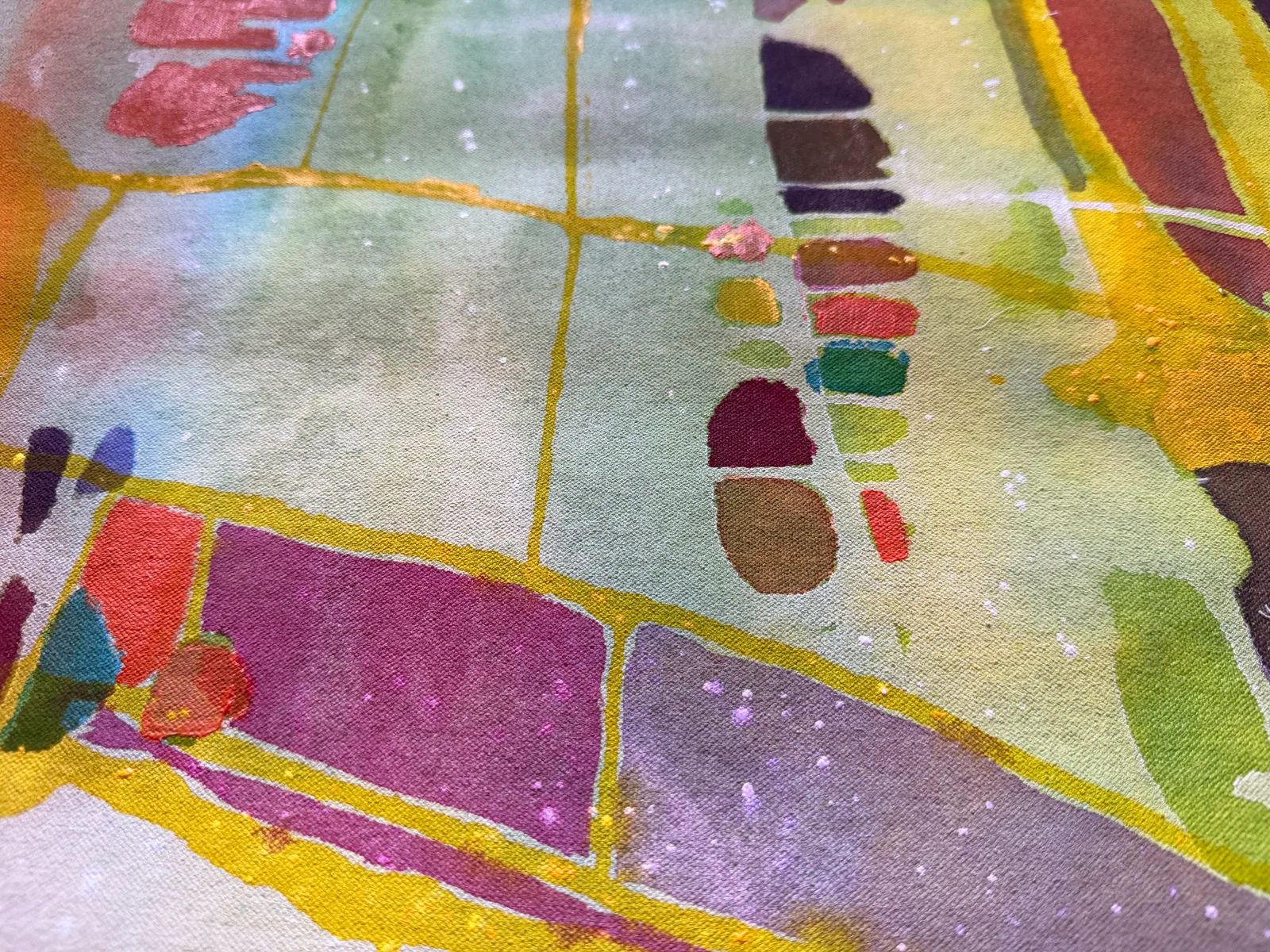
The three works on this page share one series, one size and one technique: acrylic on canvas in the Luminous Rebirth series, 100 × 100 cm. Their surfaces carry thin washes next to denser lines, as the detail photographs show. Conservation guidance goes with each one. Before it arrives, look at what sits under the wall you have in mind: a radiator, a register or a fireplace.
Frequently asked
Is it safe to hang a painting above a radiator?
Conservators advise against it. The Canadian Conservation Institute notes that many forms of incorrect temperature are located near local heaters and air vents. Warm air rising from a radiator heats and dries the wall area above it each time the heating runs.
Does warm air from a heating vent dry out a canvas?
Warm air lowers relative humidity. The Canadian Conservation Institute gives a rule of thumb for a closed space: a 1 °C change moves relative humidity by about 3%, and 5 °C by about 15%. A vent that cycles on and off repeats those swings at the canvas.
How far from a heater should a painting hang?
The Canadian Conservation Institute does not give a figure in centimetres or inches. Its guidance is about location: keep the painting out of the warm air rising from the heater or blowing from the register, and prefer a wall with no heat source below it.
Which wall works better?
An interior wall with no radiator, vent or fireplace below it and out of direct sunlight. Avoid cold outside walls in winter as well, since the Canadian Conservation Institute links damp to humid air reaching cold spots.
A painting for the wall without a heater
Send the studio a photo of the wall you have in mind and your postcode or city for a shipping quote.
Sources
- Canadian Conservation Institute, Government of Canada — 2026-11-26
- Perfeito Studio — 2026-11-26
- Perfeito Studio — 2026-11-26
Published on
Edited and reviewed by: Alyne Perfeito, architect and visual artist · CAU A1023098
Alyne Perfeito is a trained architect and visual artist with a studio in Brasília, Brazil. She edits and reviews the Journal from her painting practice. See Alyne's works →