Can you hang original art in a bathroom?
It depends on the bathroom, not the word. Conservation guidance puts the safe range for a canvas painting at a stable 40 to 60% relative humidity, and warns of mould risk above 70 to 75%. In our reading, a powder room without a shower is likely to sit closer to that range than a daily-shower bathroom.
A bathroom is not one climate
The word covers a powder room off the hallway and a windowless en-suite with a daily hot shower, and a painting experiences them very differently. What matters is how often the room fills with moisture, how fast it dries, and how large the swings are.
Moisture in a bathroom comes mainly from showering. A TU Delft study of student housing recorded "high peak moisture excess values up to 20 g/m³" in bathrooms, "but for brief periods only." (an absolute-moisture measure in student apartments, not a relative-humidity reading, so it shows the pattern of brief peaks rather than what a given bathroom reaches). The same study found that moisture from showering and personal hygiene had little impact on overall indoor moisture conditions in the dwellings. Brief peaks are still repeated peaks, and a canvas on the wall lives through every one of them, which is why the useful question is the room's pattern of use, not whether a bathroom is allowed.
What conservation guidance says about humidity and canvas
The Canadian Conservation Institute (CCI) states that "the safest RH for paintings on canvas or wood is a stable level between 40 and 60%," with a recommended temperature of 16 to 25°C. The Western Australian Museum's preventive conservation manual uses a narrower 45 to 55% and adds a limit on swings of 5% in any 24-hour period.
At the high end, CCI says artworks are susceptible to fungal infestation when humidity exceeds 70 to 75% RH, and that above 75% some canvases shrink while the wooden stretcher expands. Paint, canvas and wood all change dimension with moisture, and where those parts restrain one another the movement becomes stress, which can crack or flake paint.
Two details matter for bathrooms. First, CCI notes that when warm air is cooled, its relative humidity climbs, so steam meeting a cold exterior wall pushes the local RH up. Second, CCI cautions that a stable humidity is not a good thing if it is stable just within the danger zone. Our reading for a bathroom is that a room that stays damp is the worse case, and one that steams and then dries is the better one.
Where it can hang, and where it should not
No conservation source we found gives a fixed distance from a shower, so this page does not offer one. The documented principle comes from the Western Australian Museum: choose a location that is not prone to large variations in temperature and relative humidity. The same manual warns against hanging a painting above a fireplace because of the heat and the lower humidity there.
Applied to a bathroom, that points to the following, which is our reading of the principle rather than a measured rule:
- A powder room or a bathroom with a closed shower enclosure is a safer candidate than an open wet room.
- The wall furthest from the shower and the sink is preferable to the one beside them.
- A cold exterior wall in a room that steams is a poor choice, for the temperature-and-humidity reason above.
- Above a radiator or heated towel rail is poor, for the same reason the manual gives against fireplaces.
The spa guide covers the extreme case, a steam room at close to 100% RH, and the humid-climate guide covers a whole home that stays damp.
Glass, backing board and the trade-off
CCI states that "placing glass or acrylic glazing in front of a painting to which a backing board has been attached will provide even better protection" than the backing board alone. The Western Australian Museum agrees that a backboard minimises humidity changes for the support, and that glazing buffers changes in ambient conditions and keeps out dust and dirt.
The same manual points out that paintings are generally not glazed because glazing can detract from the artist's intent. For a textured work, glass also hides the surface relief that is much of the point. In a humid room, buffering is the argument for glass and the loss of surface relief is the argument against; weighing them is a decision to make with the artist and a framer, not a default. Our guide to framing a contemporary painting covers the options.
From the studio
From the atelier
Reading a bathroom the way an architect reads a plan is a better test than the word "bathroom": where is the water, where does the air move, and what is on the other side of the wall? Alyne Perfeito trained as an architect, and reading a room in plan, by where the water, the air and the cold walls are, is the first check we would make before placing any work in a humid room.
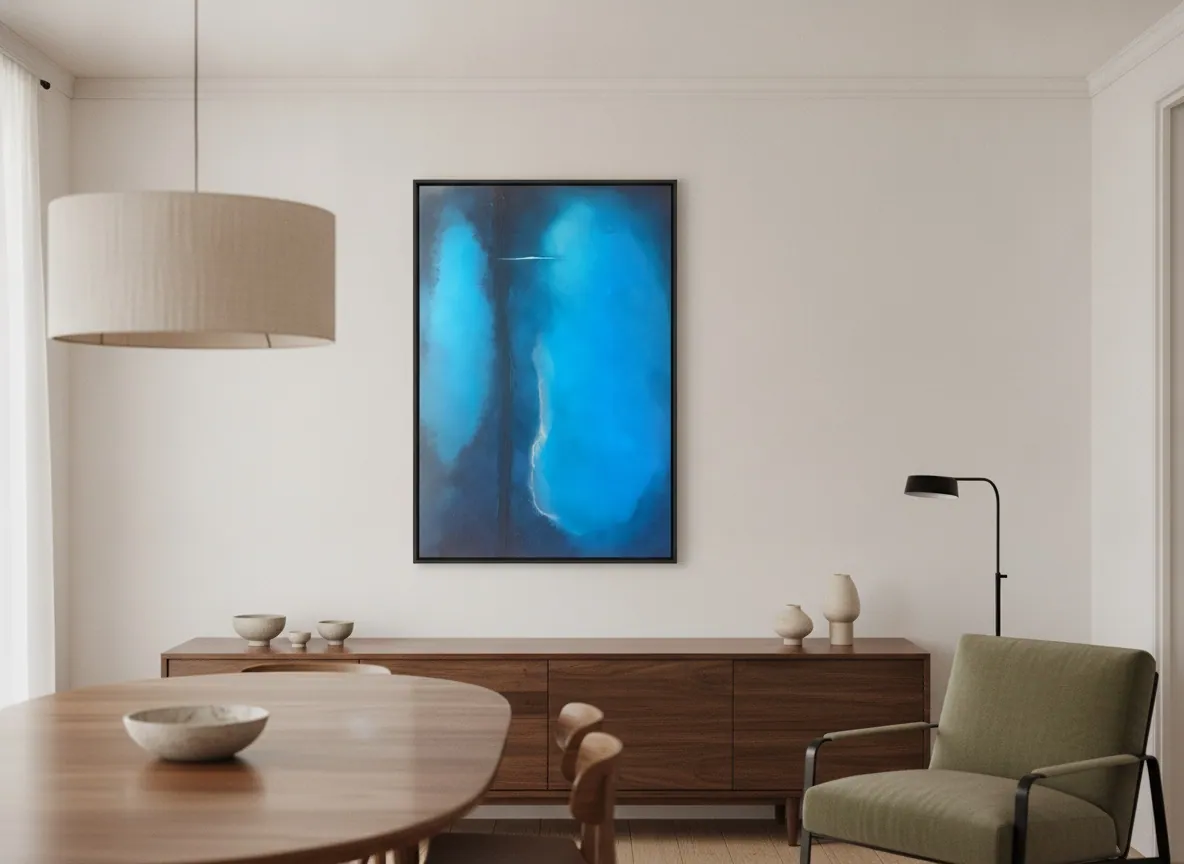
Veil of Light, from the Luminous Rebirth series, is catalogued as mixed media on canvas with sculpted texture and acrylic, 70 × 110 cm, and its technical record states the materials, as every work's does. That record is the right thing to read before choosing any wall in a humid room. We do not present Veil of Light, or any work in the catalogue, as made for a bathroom, and anyone considering one is welcome to ask about a specific work before deciding.
Frequently asked
Does humidity damage acrylic paintings?
The sources we found speak about paintings on canvas in general and do not single out acrylic. The Canadian Conservation Institute puts the safest range for paintings on canvas at a stable 40 to 60% relative humidity and warns that artworks become susceptible to fungal infestation above 70 to 75%. It also notes that paint, canvas and wood respond to moisture by changing dimension, and when parts of a painting are restrained against each other that movement creates stress.
Is a powder room safer than a bathroom with a shower?
In principle, yes, because the peaks come from showering. A TU Delft study of student housing recorded high moisture peaks in bathrooms for brief periods and attributed the moisture to showering and personal hygiene. A powder room without a shower has no such source, so its humidity is likely to sit closer to the rest of the home. It still needs a wall away from the sink splash and from any cold exterior surface.
Should I use glass?
Glazing helps, but it is a trade-off. The Canadian Conservation Institute says glass or acrylic glazing in front of a painting that also has a backing board gives even better protection than a backing board alone. The Western Australian Museum notes that paintings are generally not glazed because it can detract from the artist's intent, yet glazing buffers changes in ambient conditions. For a humid room, the weighing depends on the work and the room, and is a decision for the artist and a framer.
How far from a shower should it hang?
No conservation source we found gives a fixed distance, so we will not invent one. The documented principle is to choose a location that is not prone to large swings in temperature and relative humidity, as the Western Australian Museum advises. Our reading of that principle is the wall furthest from the shower and the sink, away from heat sources, steam and cold exterior walls.
What conditions should I avoid?
Avoid sustained relative humidity above 70 to 75%, rapid daily swings, and heat sources. The Western Australian Museum specifically warns against hanging a painting above a fireplace because of the higher temperatures and lower humidity there. The Canadian Conservation Institute also notes that cooling warm air raises its relative humidity, so a cold exterior wall in a steamy room is worth avoiding too.
Considering a work for a humid room?
Ask the artist about the materials and technical record of a specific painting before you decide where it hangs.
Sources
- Canadian Conservation Institute / Government of Canada — 2026-10-02
- Canadian Conservation Institute / Government of Canada — 2026-10-02
- Canadian Conservation Institute / Government of Canada — 2026-10-02
- Government of Western Australia, Museum Collections Care Manual — 2026-10-02
- TU Delft, Clima 2022 proceedings (Spatiotemporal humidity variation in student housing) — 2026-10-02
Published on