How to choose a frame for a contemporary painting: float frame or none
Start with the edges. A gallery-wrapped canvas with finished sides needs no frame; a float frame is a choice for shadow, protection or a mixed wall, not a requirement. Pick a float frame if you want a thin gap around the canvas, and keep glass off textured paint. Framing can also wait until after purchase.
The first question is the edge, not the style
Most frame advice starts with colour and period. For a contemporary canvas the better starting point is the side of the canvas. A gallery-wrapped canvas is stretched so that the fabric folds around the sides of the stretcher bars and is fixed at the back, which lets the finished painting hang without a frame. The sides are primed like the front and may be painted solid or carry the image around the edge, as the Wikipedia entry on gallery wrap describes it.
If the sides are finished and no staples show, the painting is already presentable as an object. Framing it then becomes an aesthetic decision. If the edge is raw, stapled or unfinished, a frame is doing real work by hiding it. At Perfeito Studio, most works ship unframed and ready to hang with finished gallery edges, and framing or a float mount can be arranged at the buyer's request.
What a float frame is, and what it does not do
A float frame, or floater frame, is deeper than a standard picture frame and is built for stretched canvas. The canvas sits inside it without touching the inner sides, which leaves a gap of about ¼ to ⅛ of an inch (roughly 0.3 to 0.6 cm) and makes the painting appear to float. It has no glass over the front (FastFrame).
The gap protects the edges of the canvas from knocks (Canvas Discount), but with nothing over the face the work is more exposed to dust, moisture and contact than behind glass. A float frame frames the edge; it does not seal the painting.
Float frame or gallery wrap: how to decide
Framers describe the choice as open edges versus a defined border. Gallery wraps tend to suit open, contemporary rooms and let the sides take part in the presentation, while frames give a finished boundary and suit formal entries or busy hallways (Montcarta). A short checklist:
- Edges finished and you like them: hang it as it is.
- Other framed work on the same wall: a float frame can unify the group.
- High-traffic spot or frequent handling: the frame's gap and rim take the knocks instead of the canvas edge.
- Raw or stapled sides: frame it.
Colour, glass and depth
Framing guidance for abstract work generally favours contrast over matching: a frame in the exact colour of the wall tends to make the work look pasted on, while black suits saturated colour, natural wood adds warmth, and gold or silver work when they pick up a tone already in the painting (Montcarta). Treat this as one framer's rule of thumb, not a standard. Colour is the easy variable; the next two matter more.
Glass. A float frame is unglazed by design. If glazing is used on a textured surface, it has to stay clear of the paint (Montcarta, gallery wrap vs framed), and the same framer warns that glass on canvas can trap moisture and flatten texture (Montcarta, abstract art), so a heavily built-up painting is a poor candidate for glass.
Depth. For thick texture, check the frame's internal depth against the stretcher before buying rather than assuming a standard frame will fit (Montcarta, gallery wrap vs framed).
Frame now or later
You do not have to decide at the moment of purchase. A canvas bought unframed can be framed afterwards by a specialist, so you can live with the painting first. Buying it already framed is usually easier and cheaper than framing it afterwards (Canvas Discount), but that is a retailer's view of printed canvas; for an original, living with the work for a while before choosing a frame is a perfectly sound approach. The canvas itself is a separate quality question, covered in what canvas weight means.
From the studio
From the studio
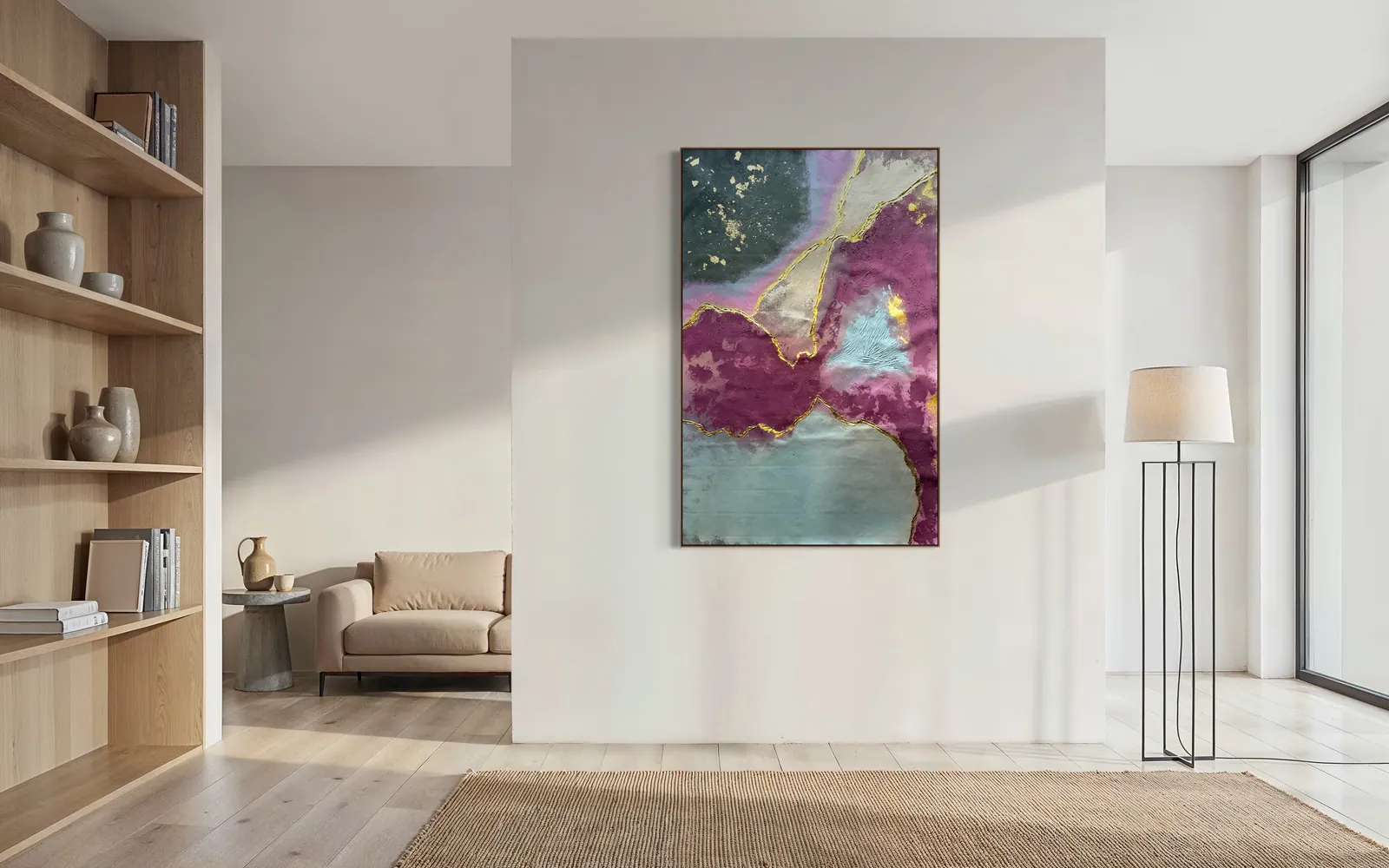
Our default is the finished gallery edge, so our advice is to look at the side of the canvas before looking at frame catalogues. A work like Quartz Seam (Terra & Ether, 2026, 98 x 152 cm, mixed media with acrylic and gold leaf on canvas) is built from pigment laid thick enough to carry its own relief, and a thin float frame is the kind of treatment that leaves that surface and its edge readable. A deep, heavily moulded frame competes with it.
If you are considering a work from the collection, tell us the room and the wall, and we can say honestly whether it needs a frame at all.
Frequently asked
Does a contemporary painting need a frame?
Not necessarily. A gallery-wrapped canvas, where the fabric folds around the stretcher bars and the sides are finished, can hang without a frame. A frame becomes useful when the edges are raw or stapled, when you want a shadow line around the work, or when you want to unify it with other framed pieces on the wall. It is an aesthetic choice more than a technical requirement.
What is a float frame?
A float frame is a deeper frame made for stretched canvas. The canvas sits inside without touching the inner sides, leaving a gap of about 0.3 to 0.6 cm, so the painting seems to float. It has no glass in front, which keeps the whole surface and the canvas edge visible. It is common for contemporary and mixed-media work on canvas.
What frame colour suits abstract art?
Framers generally suggest contrast rather than matching: black for saturated colour, natural wood for warmth, and gold or silver when they pick up a tone already in the painting. Avoid a frame in the exact colour of the wall, which tends to make the work look pasted on. These are rules of thumb from framing guidance rather than fixed standards, so test a sample against the actual canvas where it will hang.
Can a frame damage the canvas?
A well-fitted float frame does not touch the canvas edge, and the gap is described as a buffer against knocks. Problems arise with poor fit: frames too shallow for the stretcher, or glazing touching textured paint. Check the frame's internal depth before buying and keep any glazing away from the paint surface. For thick texture, ask the framer to measure the work rather than use a standard size.
Gallery-wrap or framed for a modern room?
In open, contemporary rooms a gallery wrap often feels lighter, because the edges take part in the presentation. Framing gives a defined boundary and tends to suit formal entries or busy hallways. If other works on the wall are framed, a float frame can tie the group together. If the edges are finished and you like them, leaving the canvas unframed is entirely appropriate.
Can I frame the painting after I buy it?
Yes. A canvas can be bought unframed and framed later by a specialist, so you can live with the work first. Most works from Perfeito Studio ship unframed with finished gallery edges, and framing or a float mount can be arranged at the buyer's request. Measure the stretcher depth first so the frame is ordered to fit.
Not sure whether a work needs a frame?
Tell us the room and the wall, and we will say whether the work wants a frame or hangs best as it is.
Sources
- Wikipedia — 2026-10-01
- FastFrame — 2026-10-01
- Canvas Discount — 2026-10-01
- Montcarta — 2026-10-01
- Montcarta — 2026-10-01
Published on